Educação em artes e a formação da identidade profissional docente no contexto digital do Vietnã
DOI:
https://doi.org/10.22633/rpge.v30iesp1.20917Palavras-chave:
Educação em artes, Identidade profissional docente, Transformação digital, Formação de professores, VietnãResumo
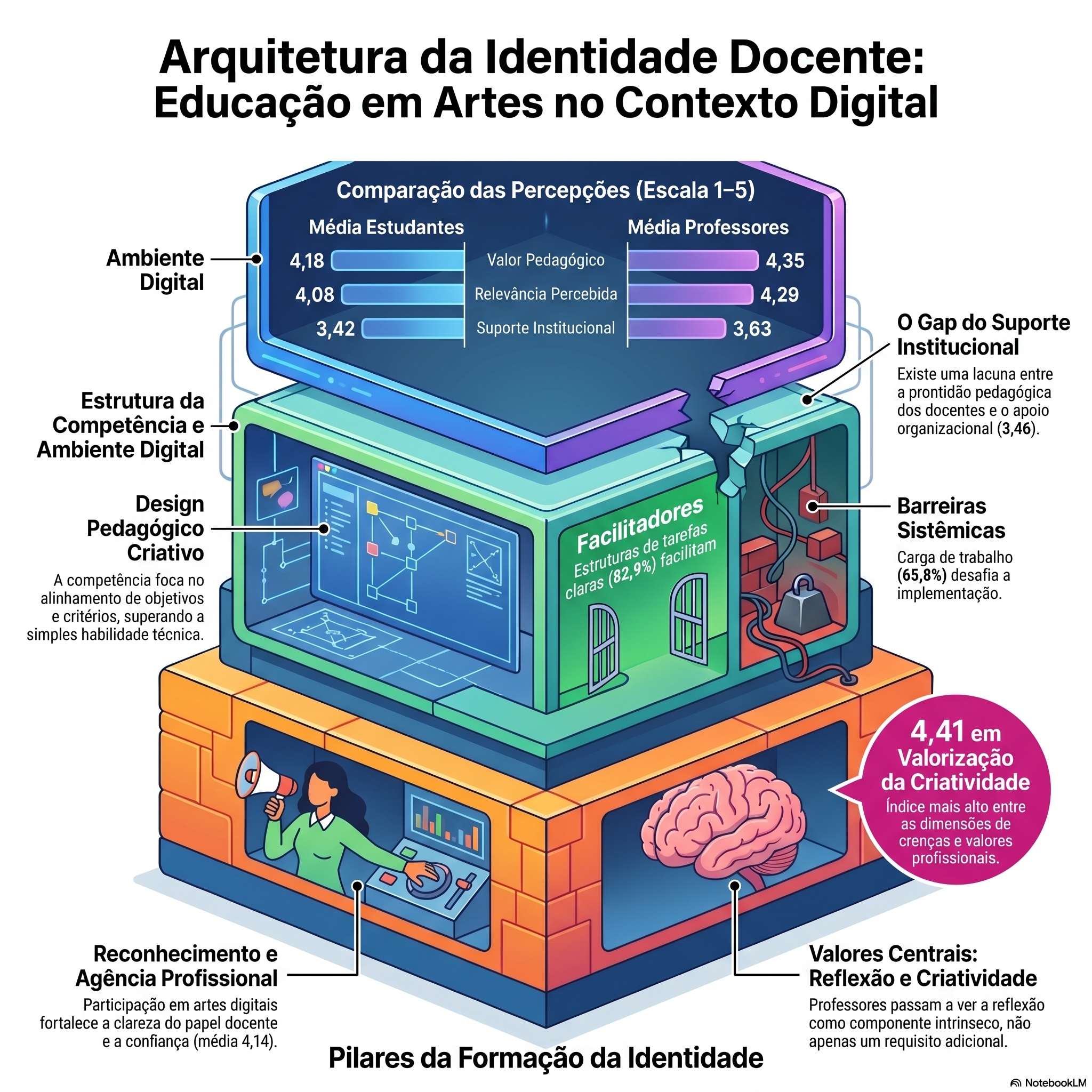
No contexto de rápida transformação digital, a formação de professores passa por mudanças significativas na pedagogia, nos papéis profissionais e na construção da identidade. A educação em artes, ao enfatizar a criatividade e a reflexão, pode apoiar os professores na adaptação a ambientes de aprendizagem mediados digitalmente. Este estudo examina o papel da educação em artes na formação da identidade profissional docente no Vietnã. Foi adotada uma abordagem de métodos mistos com 187 participantes, incluindo professores em formação inicial e docentes, utilizando questionários, entrevistas e análise de artefatos digitais de aprendizagem provenientes de três instituições. Os resultados quantitativos indicam percepções positivas sobre a educação artística digital e sua relevância para o desenvolvimento profissional. Os achados qualitativos destacam como a prática reflexiva, o engajamento criativo e a expressão pedagógica contribuem para a formação da identidade, dos valores profissionais e da competência docente. O estudo também identifica fatores facilitadores e desafios principais, enfatizando a importância do desenho instrucional e do apoio institucional. Esses resultados oferecem implicações práticas para políticas, desenvolvimento curricular e crescimento profissional docente em contextos digitais.
Downloads
Referências
Aluri, J., Ker, J., Marr, B., Kagan, H., Stouffer, K., Yenawine, P., & Chisolm, M. S. (2023). The role of arts-based curricula in professional identity formation: Results of a qualitative analysis of learners’ written reflections. Medical Education Online, 28(1), 2145105. https://doi.org/10.1080/10872981.2023.2145105
Boice, K. L., Jackson, J. R., Alemdar, M., Rao, A. E., Grossman, S., & Usselman, M. (2021). Supporting teachers on their STEAM journey: A collaborative STEAM teacher training program. Education Sciences, 11(3), 105. https://doi.org/10.3390/educsci11030105
Burke, K. (2020). Virtual praxis: Constraints, approaches, and innovations of online creative arts educators. Teaching and Teacher Education, 92, 103064. https://doi.org/10.1016/j.tate.2020.103064
Burke, K. (2021). “How can the creative arts possibly be taught online?” Perspectives and experiences of online educators in higher education. Asia-Pacific Journal of Teacher Education, 49(3), 223–236. https://doi.org/10.1080/1359866X.2020.1863350
Chow, C., & Leung, C. (2018). Redefining university leadership for the 21st century. Bentham Science Publishers. https://doi.org/10.2174/97816810874981180101
Dinham, J. (2024). Enacting the signature pedagogies of arts education in the online learning environment for primary teacher education. Asia-Pacific Journal of Teacher Education, 52(2), 155–169. https://doi.org/10.1080/1359866X.2023.2209471
Gonzalez-Zamar, M. D., & Abad-Segura, E. (2020). Implications of virtual reality in arts education: Research analysis in the context of higher education. Education Sciences, 10(9), 225. https://doi.org/10.3390/educsci10090225
Huong, H. T., Tri, N. Q., & Hoan, T. H. (2025). Educational leadership in arts teacher training: Cultural preservation and managerial competencies in Vietnam. International Journal on Culture, History, and Religion, 7(SI2), 862–879.
Jing, M., Guo, Z., Wu, X., Yang, Z., & Wang, X. (2025). Higher education digital academic leadership: Perceptions and practices from Chinese university leaders. Education Sciences, 15(5), 606. https://doi.org/10.3390/educsci15050606
Kamran, M. (2025). Educational leadership in a digital era: Navigating challenges and opportunities. AL-IMAN Research Journal, 3(1), 188–199. https://doi.org/10.46328/ijtes.605
Kenny, A., Finneran, M., & Mitchell, E. (2015). Becoming an educator in and through the arts: Forming and informing emerging teachers’ professional identity. Teaching and Teacher Education, 49, 159–167. https://doi.org/10.1016/j.tate.2014.10.008
Kim, D., Long, Y., Zhao, Y., Zhou, S., & Alexander, J. (2021). Teacher professional identity development through digital stories. Computers & Education, 162, 104040. https://doi.org/10.1016/j.compedu.2020.104040
Lehrman, A. L. (2025). Embodied learning through immersive virtual reality: Theoretical perspectives for art and design education. Behavioral Sciences, 15(7), 917. https://doi.org/10.3390/bs15070917
Serna-Mendiburu, G. M., & Guerra-Tamez, C. R. (2024). Shaping the future of creative education: The transformative power of VR in art and design learning. Frontiers in Education, 9, 1388483. https://doi.org/10.3389/feduc.2024.1388483
Downloads
Publicado
Edição
Seção
Licença
Direitos autorais (c) 2026 Revista on line de Política e Gestão Educacional

Este trabalho está licenciado sob uma licença Creative Commons Attribution-NonCommercial-ShareAlike 4.0 International License.
Manuscritos aceitos e publicados são de propriedade da Revista on line de Política e Gestão Educacional. É vedada a submissão integral ou parcial do manuscrito a qualquer outro periódico. A responsabilidade do conteúdo dos artigos é exclusiva dos autores. É vedada a tradução para outro idioma sem a autorização escrita do Editor ouvida a Comissão Editorial Científica.