Artificial intelligence, digital government, and public value in higher education
a case study of the AGIPI/UEPG institutional Chatbot
DOI:
https://doi.org/10.22633/rpge.v30i00.21195Keywords:
Artificial intelligence, Public value, Digital government, Information management, Institutional chatbotAbstract
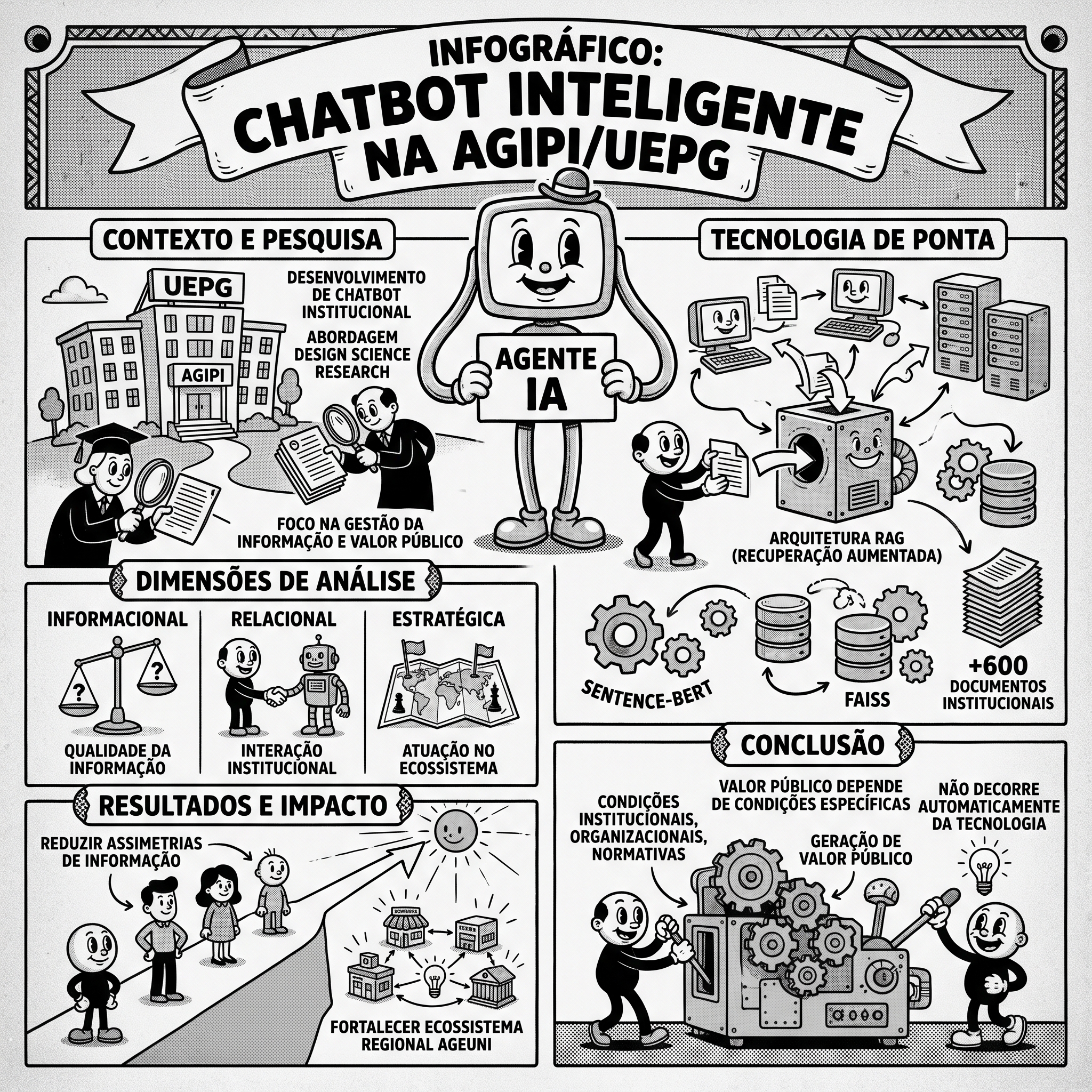
The article analyzes the development and implementation of an institutional artificial intelligence-based chatbot at the Innovation and Intellectual Property Agency of the State University of Ponta Grossa (AGIPI/UEPG), examining its contributions to improving information management and generating public value. The research adopts the Design Science Research approach, with a case study conducted at AGIPI/UEPG. The system employs a Retrieval-Augmented Generation (RAG) architecture using Sentence-BERT and FAISS, based on a corpus of more than six hundred institutional documents. The analysis encompasses three dimensions: informational, relational, and strategic. The partial results demonstrate the feasibility of the solution and indicate its potential to reduce information access asymmetries, improve institutional interaction, and strengthen AGIPI’s role within the regional Ageuni ecosystem. It is concluded that AI-driven public value generation depends on specific institutional, organizational, and regulatory conditions and does not automatically result from technological adoption.
Downloads
References
Bardin, L. (2011). Análise de conteúdo (L. A. Reto, Trad.). Edições 70.
Brasil. (2004). Lei nº 10.973, de 2 de dezembro de 2004: Dispõe sobre incentivos à inovação e à pesquisa científica e tecnológica no ambiente produtivo e dá outras providências. Diário Oficial da União. https://www.planalto.gov.br/ccivil_03/_ato2004-2006/2004/lei/l10.973.htm
Brasil. (2016). Lei nº 13.243, de 11 de janeiro de 2016: Dispõe sobre estímulos ao desenvolvimento científico, à pesquisa, à capacitação científica e tecnológica e à inovação e altera a Lei nº 10.973, de 2 de dezembro de 2004, a Lei nº 6.815, de 19 de agosto de 1980, a Lei nº 8.666, de 21 de junho de 1993, a Lei nº 12.462, de 4 de agosto de 2011, a Lei nº 8.745, de 9 de dezembro de 1993, a Lei nº 8.958, de 20 de dezembro de 1994, a Lei nº 8.010, de 29 de março de 1990, a Lei nº 8.032, de 12 de abril de 1990, e a Lei nº 12.772, de 28 de dezembro de 2012, nos termos da Emenda Constitucional nº 85, de 26 de fevereiro de 2015. Diário Oficial da União. https://www.planalto.gov.br/ccivil_03/_ato2015-2018/2016/lei/l13243.htm
Brasil. (2018). Lei nº 13.709, de 14 de agosto de 2018: Lei Geral de Proteção de Dados Pessoais (LGPD). Diário Oficial da União. https://www.planalto.gov.br/ccivil_03/_ato2015-2018/2018/lei/l13709.htm
Bryson, J. M., Crosby, B. C., & Bloomberg, L. (2014). Public value governance: Moving beyond traditional public administration and the new public management. Public Administration Review, 74(4), 445–456. https://doi.org/10.1111/puar.12238
Cavalcante, P., Camões, M. R. S., Cunha, B. Q., & Severo, W. O. (Eds.). (2017). Inovação no setor público: Teoria, tendências e casos no Brasil. IPEA/ENAP.
Centro Latino-Americano de Administração para o Desenvolvimento. (2022). Carta Ibero-Americana de Inteligência Artificial na Administração Pública. CLAD. https://clad.org/
Chesbrough, H. (2003). Open innovation: The new imperative for creating and profiting from technology. Harvard Business School Press.
Cortés-Cediel, M. E., Segura-Tinoco, A., Cantador, I., & Rodríguez Bolívar, M. P. (2023). Trends and challenges of e-government chatbots: Advances in exploring open government data and citizen participation content. Government Information Quarterly, 40(4), 101877. https://doi.org/10.1016/j.giq.2023.101877
Dunleavy, P., Margetts, H., Bastow, S., & Tinkler, J. (2006). Digital era governance: IT corporations, the state, and e-government. Oxford University Press.
Etzkowitz, H., & Leydesdorff, L. (2000). The dynamics of innovation: From national systems and “Mode 2” to a Triple Helix of university–industry–government relations. Research Policy, 29(2), 109–123. https://doi.org/10.1016/S0048-7333(99)00055-4
Gil, A. C. (2008). Métodos e técnicas de pesquisa social (6ª ed.). Atlas.
Hemesath, S., & Tepe, M. (2024). Public value positions and design preferences toward AI-based chatbots in e-government: Evidence from a conjoint experiment. Government Information Quarterly, 41(4), 101985. https://doi.org/10.1016/j.giq.2024.101985
Hevner, A. R., March, S. T., Park, J., & Ram, S. (2004). Design science in information systems research. MIS Quarterly, 28(1), 75–105.
Hjaltalin, I. T., & Sigurdarson, H. T. (2024). The strategic use of AI in the public sector: A public values analysis of national AI strategies. Government Information Quarterly, 41(1), 101914. https://doi.org/10.1016/j.giq.2024.101914
Johnson, J., Douze, M., & Jégou, H. (2021). Billion-scale similarity search with GPUs. IEEE Transactions on Big Data, 7(3), 535–547. https://doi.org/10.1109/TBDATA.2019.2921572
Jurafsky, D., & Martin, J. H. (2026). Speech and language processing (3rd ed.). Stanford University. https://web.stanford.edu/~jurafsky/slp3/
Kelly, G., Mulgan, G., & Muers, S. (2002). Creating public value: An analytical framework for public service reform. Cabinet Office.
Larsen, A. G., & Følstad, A. (2024). The impact of chatbots on public service provision: A qualitative interview study with citizens and public service providers. Government Information Quarterly, 41(2), 101927. https://doi.org/10.1016/j.giq.2024.101927
Lewis, P., Perez, E., Piktus, A., Petroni, F., Karpukhin, V., Goyal, N., Küttler, H., Lewis, M., Yih, W.-t., Rocktäschel, T., Riedel, S., & Kiela, D. (2020). Retrieval-augmented generation for knowledge-intensive NLP tasks. In H. Larochelle, M. Ranzato, R. Hadsell, M. F. Balcan & H. Lin (Eds.), NIPS ’20: Proceedings of the 34th International Conference on Neural Information Processing Systems (pp. 9459–9474). Curran Associates.
Lotta, G. (Ed.). (2019). Teoria e análises sobre implantação de políticas públicas no Brasil. ENAP.
Maragno, G., Tangi, L., Gastaldi, L., & Benedetti, M. (2023). Exploring the factors, affordances and constraints outlining the implementation of artificial intelligence in public sector organizations. International Journal of Information Management, 73, 102686. https://doi.org/10.1016/j.ijinfomgt.2023.102686
Margetts, H., & Dunleavy, P. (2024). The political economy of digital government: How Silicon Valley firms drove conversion to data science and artificial intelligence in public management. Public Money & Management. Advance online publication. https://doi.org/10.1080/09540962.2024.2389915
Mellouli, S., Janssen, M., & Ojo, A. (2024). Introduction to the issue on artificial intelligence in the public sector: Risks and benefits of AI for governments. Digital Government: Research and Practice, 5(1), 1. https://doi.org/10.1145/3636550
Minayo, M. C. S. (Ed.). (2010). O desafio do conhecimento: Pesquisa qualitativa em saúde (12ª ed.). Hucitec.
Moore, M. H. (1995). Creating public value: Strategic management in government. Harvard University Press.
Mowery, D. C., Nelson, R. R., Sampat, B. N., & Ziedonis, A. A. (2004). Ivory tower and industrial innovation: University-industry technology transfer before and after the Bayh-Dole Act. Stanford University Press.
Paraná. (2021). Lei nº 20.541, de 20 de abril de 2021: Dispõe sobre política pública de incentivo à inovação, à pesquisa e ao desenvolvimento científico e tecnológico [...]. Diário Oficial do Estado do Paraná.
Paraná. (2022). Decreto nº 10.769, de 12 de abril de 2022: Dispõe sobre a criação do Programa AGEUNI – Agências para o Desenvolvimento Regional Sustentável e dá outras providências. Diário Oficial do Estado do Paraná.
Pires, R. R. C., & Gomide, A. A. (2016). Governança e capacidades estatais: Uma análise comparativa de programas federais. Revista de Sociologia e Política, 24(58), 121–143. https://doi.org/10.1590/1678-987316245806
Reimers, N., & Gurevych, I. (2019). Sentence-BERT: Sentence embeddings using Siamese BERT-networks. In K. Inui, J. Jiang, V. Ng, & X. Wan (Eds.), Proceedings of the 2019 Conference on Empirical Methods in Natural Language Processing and the 9th International Joint Conference on Natural Language Processing (EMNLP-IJCNLP) (pp. 3982–3992). Association for Computational Linguistics. https://doi.org/10.18653/v1/D19-1410
Robles, P., & Mallinson, D. J. (2023). Catching up with AI: Pushing toward a cohesive governance framework. Politics & Policy, 51(3), 355–372. https://doi.org/10.1111/polp.12529
Scutella, M., Plewa, C., & Reaiche, C. (2024). Virtual agents in the public service: Examining citizens’ value-in-use. Public Management Review, 26(1), 73–88. https://doi.org/10.1080/14719037.2022.2044504
Sienkiewicz-Małyjurek, K. (2023). Whether AI adoption challenges matter for public managers? The case of Polish cities. Government Information Quarterly, 40(3), 101828. https://doi.org/10.1016/j.giq.2023.101828
Tangi, L., Rodriguez Müller, A. P., & Janssen, M. (2025). AI-augmented government transformation: Organisational transformation and the sociotechnical implications of AI in public administrations. Government Information Quarterly, 42(3), 102055. https://doi.org/10.1016/j.giq.2025.102055
Universidade Estadual de Ponta Grossa. (2011). Resolução UNIV nº 31, de 27 de julho de 2011: Aprova o Regulamento da Agência de Inovação e Propriedade Intelectual da Universidade Estadual de Ponta Grossa. UEPG.
Universidade Estadual de Ponta Grossa. (2013). Resolução CA nº 315, de 17 de junho de 2013: Regulamenta as atividades de incubação da INPROTEC. UEPG.
Universidade Estadual de Ponta Grossa. (2026). Relatório de atividades 2025. Agência de Inovação e Propriedade Intelectual.
van Noordt, C., & Tangi, L. (2023). The dynamics of AI capability and its influence on public value creation of AI within public administration. Government Information Quarterly, 40(4), 101860. https://doi.org/10.1016/j.giq.2023.101860
Yin, R. K. (2015). Estudo de caso: Planejamento e métodos (5ª ed.; D. Grassi, Trad.). Bookman.
Zuiderwijk, A., Chen, Y.-C., & Salem, F. (2021). Implications of the use of artificial intelligence in public governance: A systematic literature review and a research agenda. Government Information Quarterly, 38(3), 101577. https://doi.org/10.1016/j.giq.2021.101577
Downloads
Published
Issue
Section
License
Copyright (c) 2026 Revista on line de Política e Gestão Educacional

This work is licensed under a Creative Commons Attribution-NonCommercial-ShareAlike 4.0 International License.
Manuscritos aceitos e publicados são de propriedade da Revista on line de Política e Gestão Educacional. É vedada a submissão integral ou parcial do manuscrito a qualquer outro periódico. A responsabilidade do conteúdo dos artigos é exclusiva dos autores. É vedada a tradução para outro idioma sem a autorização escrita do Editor ouvida a Comissão Editorial Científica.