
Implicações educacionais para a pedagogia penitenciária, a reabilitação e a ressocialização
DOI:
https://doi.org/10.22633/rpge.v30iesp2.21377Palavras-chave:
Educação correcional, Pedagogia penitenciária, Ressocialização, Política educacionalResumo
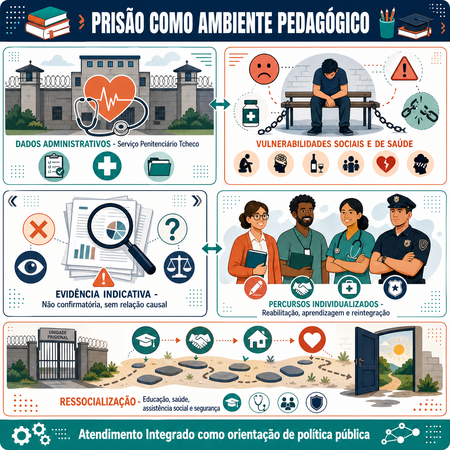
O estudo analisa dados administrativos agregados do Serviço Penitenciário Tcheco, incluindo estado de saúde, intervenções médicas e indicadores de comportamento em situações de crise. Utilizando uma abordagem descritiva e exploratória, avalia quais conclusões podem ser legitimamente extraídas desses dados. Os resultados indicam um alto nível de acumulação e interligação de vulnerabilidades sociais e de saúde entre os detentos. No entanto, os dados não estabelecem relações causais entre a fragmentação dos serviços e resultados específicos, nem confirmam a eficácia dos modelos de atendimento integrado. O artigo argumenta que os dados agregados devem ser interpretados como evidências indicativas, e não confirmatórias. Ele contribui para o debate ao esclarecer os limites analíticos das fontes de dados comumente utilizadas e ao enquadrar o atendimento integrado como uma orientação de política que requer validação empírica adicional. Para reforçar sua relevância educacional, a análise também enquadra a prisão como um ambiente pedagógico e de ressocialização, envolvendo educadores, assistentes sociais, profissionais de saúde e equipe de segurança em percursos individualizados de reabilitação, aprendizagem e reintegração.
Downloads
Referências
Act No. 38/2025 Coll. (2025). Act amending Act No. 108/2006 Coll., on social services, as amended, and other related acts. Collection of Laws of the Czech Republic. https://www.zakonyprolidi.cz/cs/2025-38
Act No. 48/1997 Coll. (1997). Act on public health insurance and on amendments and supplements to certain related acts. Collection of Laws of the Czech Republic.
Act No. 108/2006 Coll. (2006). Act on social services. Collection of Laws of the Czech Republic. https://www.zakonyprolidi.cz/cs/2006-108
Bačová, V. (2025). Implementation of the RRRR methodology in education: Impacts on students’ socio-emotional skills and teachers’ well-being. Journal of School Health, 95(11), 978–987. https://doi.org/10.1111/josh.70066
Bartůněk, P., & Ptáček, R. (Eds.). (2023). Soucit v medicíně. Grada.
Ben-Moshe, L. (2017). Why prisons are not “the new asylums.” Punishment & Society, 19(3), 272–289. https://doi.org/10.1177/1462474517704852
Citoreš, F. K. (2024). Řešení pro sociálně-zdravotní pomezí. Možná už od roku 2025. Medical Tribune. https://www.tribune.cz/nase-tituly/medical-tribune
Council of Europe. (2013). Prison health care and medical ethics. Council of Europe.
Council of Europe. (2020). European prison rules: Recommendation Rec(2006)2-rev. Council of Europe.
Czech Statistical Office. (2025). Kriminalita 2024. Czech Statistical Office.
Daněk, A., & Klugerová, J. (2023). Inclusive education as an instrument for preventing social exclusion. Ad Alta, 13(2), 142–144. https://doi.org/10.33543/1302
Eichelberger, M., Wertli, M. M., & Tran, N. T. (2023). Equivalence of care, confidentiality, and professional independence must underpin the hospital care of individuals experiencing incarceration. BMC Medical Ethics, 24, Article 13. https://doi.org/10.1186/s12910-023-00891-3
Gormley, C. (2022). The hidden harms of prison life for people with learning disabilities. The British Journal of Criminology, 62(2), 261–278. https://doi.org/10.1093/bjc/azab061
Holmerová, I. (2015). Dlouhodobá péče: Geriatrické aspekty a kvalita. Grada. https://www.bookport.cz/kniha/dlouhodoba-pece-2460/
Jůzl, M. (2010). Základy pedagogiky. IMS.
Jůzl, M. (2017). Penitenciaristika jako věda žalářní. UJAK.
Kučerová, J. (2013). Historický vývoj zdravotnické služby ve vězeňství se zřetelem na činnost pankrácké nemocnice v letech 1918–1998 (Bachelor’s thesis). Vysoká škola zdravotníctva a sociálnej práce sv. Alžbety.
Larsen, B. K., Dale, K. Y., & Odegard, A. (2022). Interprofessional collaboration in reintegration after prison for prisoners with substance abuse issues: A scoping review. International Journal for Crime, Justice and Social Democracy, 11(2), 174–190.
Miller, K. E. M., Shen, K., Yang, Y., Williams, B., & Wolff, J. L. (2024). Prevalence of disability among older adults in prison. JAMA Network Open, 7(12), e2452334. https://doi.org/10.1001/jamanetworkopen.2024.52334
Ministry of Labour and Social Affairs of the Czech Republic. (2024a). MPSV a MZ představila změnový zákon o sociálně-zdravotním pomezí. https://www.mpsv.cz/mpsv-a-mzd-predstavila-zmenovy-zakon-o-socialne-zdravotnim-pomezi-navrhuji-efektivnejsi-zpusob-poskytovani-sluzeb-v-teto-oblasti-a-aktualizaci-systemu
Ministry of Health of the Czech Republic. (2024b). Vláda schválila změnový zákon o sociálně-zdravotním pomezí. https://mzd.gov.cz/tiskove-centrum-mz/vlada-dnes-schvalila-zmenovy-zakon-o-socialne-zdravotnim-pomezi/
Ondrašek, S., Kozlová, L., Hricová, A., & Urban, D. (2024). Sociální politika. Grada.
Průša, L. (2021). Dlouhodobá péče nejen v České republice. Asociace poskytovatelů sociálních služeb ČR.
Řezáč, F. J. (1995). Vězenství v posavádních spůsobech svých s návrhem o zdárnější trestání a polepšování zločinců. České vězeňství, (4–5).
Spreat, S. (2020). Persons with intellectual disability in prison. Journal of Intellectual Disabilities and Offending Behaviour, 11(4), 233–237. https://doi.org/10.1108/JIDOB-03-2020-0006
Stárek, L., Klugerová, J., Chrzová, D., & Roubalová, A. (2025). Perspectivas educacionais e éticas sobre a eugenia: Impacto em indivíduos com deficiência do século XIX a meados do século XX. Revista on line de Política e Gestão Educacional, 29(spe. 1), e025041. https://doi.org/10.22633/rpge.v29iesp1.20476
Prison Service of the Czech Republic. (2016–2024). Statistická ročenka Vězeňské služby České republiky. https://www.vs.gov.cz/sekce/statisticke-rocenky-vezenske-sluzby
Tomeš, I., & Šámalová, K. (Eds.). (2017). Sociální souvislosti aktivního stáří. Karolinum.
United Nations Office on Drugs and Crime. (2015). United Nations Standard Minimum Rules for the Treatment of Prisoners (the Nelson Mandela Rules).
Válková, M. (2015). Dlouhodobá péče v ošetřovatelství. Institut postgraduálního vzdělávání ve zdravotnictví.
Vlach, F., Klugerová, J., & Daněk, A. (2025). Behind bars and beyond limits: Psychological strain on professional prison staff in the Czech Republic. Interacción y Perspectiva, 16(1), 294–316. https://doi.org/10.5281/zenodo.17643075
World Health Organization Regional Office for Europe. (2014). Prisons and health. WHO Regional Office for Europe.
World Health Organization Regional Office for Europe. (2021). The WHO prison health framework: A framework for assessment of prison health system performance. WHO Regional Office for Europe.
Downloads
Publicado
Como Citar
Edição
Seção
Licença
Copyright (c) 2026 Revista on line de Política e Gestão Educacional

Este trabalho está licenciado sob uma licença Creative Commons Attribution-NonCommercial-ShareAlike 4.0 International License.
Manuscritos aceitos e publicados são de propriedade da Revista on line de Política e Gestão Educacional. É vedada a submissão integral ou parcial do manuscrito a qualquer outro periódico. A responsabilidade do conteúdo dos artigos é exclusiva dos autores. É vedada a tradução para outro idioma sem a autorização escrita do Editor ouvida a Comissão Editorial Científica.