Democracy, social media, and artificial intelligence
DOI:
https://doi.org/10.47284/cdc.v25iesp1.20480Keywords:
Democracy, Social media, Artificial intelligenceAbstract
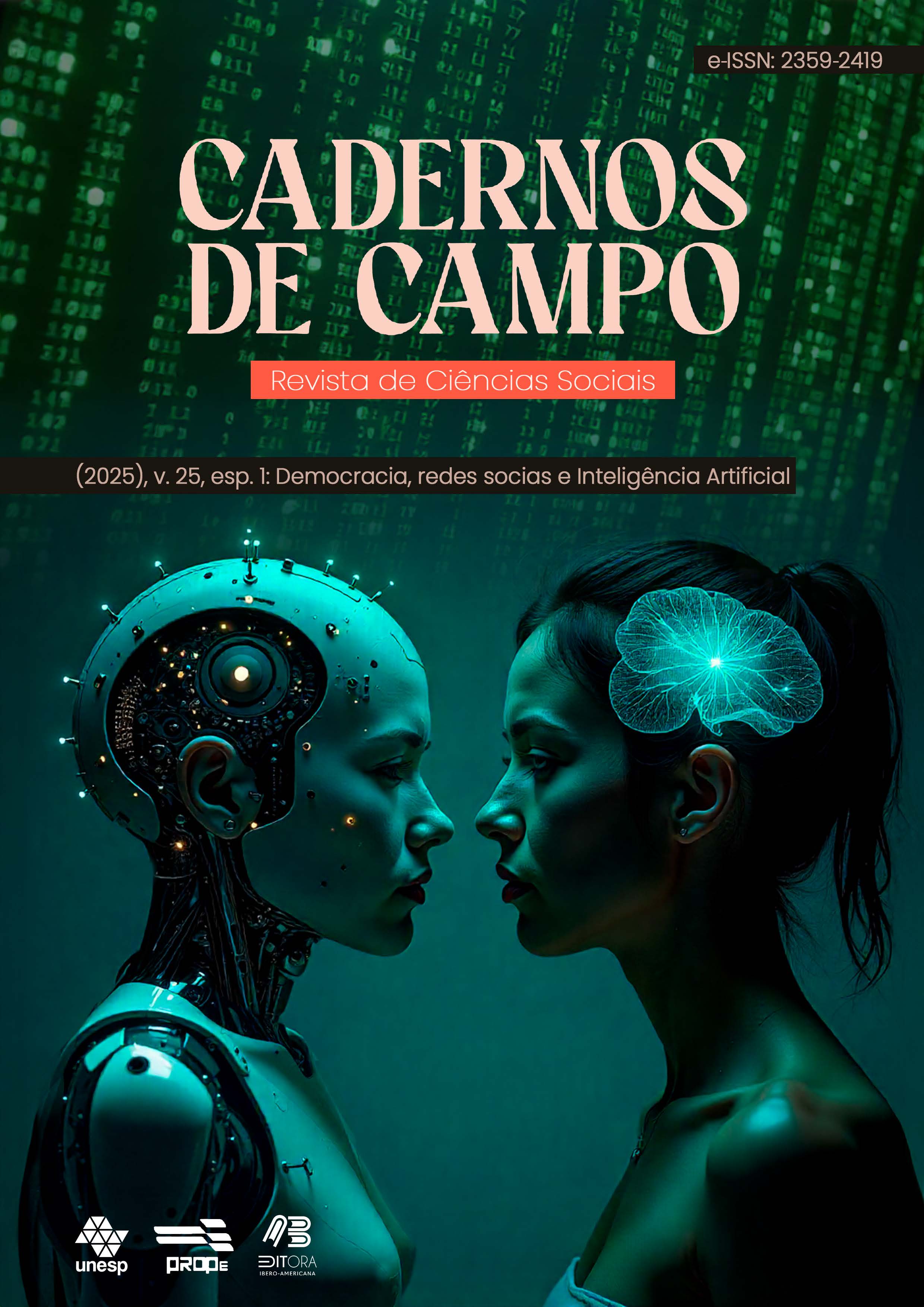
Democracy is also communication. Those who act and operate in democratic regimes need to communicate. There has been a long historical trajectory, from the speeches delivered in the Greek Agora or the Roman Senate, through to the Modern Era and its printed newspapers, radio, television, and the beginning of the 21st century, with its digital social networks and artificial intelligence (AI), in which there has been a considerable expansion in the creation, flow, and access to information. Currently, one of the central dilemmas in politics is the ability of people to select their sources according to the integrity of the transformation of facts into journalistic or scientific content. The rise of social media has rapidly transformed political communication, altering the logic of conflict and modifying the behavior of actors and institutions. A new information culture is gaining prominence in contemporary democracies, deconstructing and leaving behind the logic of traditional communication flows.
Downloads
References
ALLEN, D.; WEYL, G. The real dangers of generative AI. Journal of Democracy, v. 35, n. 1, p. 147-162, 2024. Disponível em: https://www.journalofdemocracy.org/articles/the-real-dangers-of-generative-ai/. Acesso em: 15 jan. 2025.
DEIBERT, R. J. Reset: reclaiming the internet for civil society. Toronto: House of Anansi Press, 2020.
KREPS, S.; McCAIN, R. M.; BRUNDAGE, M. All the news that’s fit to fabricate: AI-Generated text as a tool of media misinformation. Journal of Experimental Political Science, v. 9, n. 1, p. 104-117, 2022. DOI: 10.1017/XPS.2020.37. Disponível em: https://www.cambridge.org/core/journals/journal-of-experimental-political-science/article/abs/all-the-news-thats-fit-to-fabricate-aigenerated-text-as-a-tool-of-media-misinformation/40F27F0661B839FA47375F538C19FA59. Acesso em: 15 jan. 2025.
THOMPSON, J. B. Ideologia e cultura moderna: teoria social crítica na era dos meios de comunicação de massa. Petrópolis: Vozes, 2011.
Downloads
Published
Issue
Section
License
Copyright (c) 2025 Cadernos de Campo: Revista de Ciências Sociais

This work is licensed under a Creative Commons Attribution 4.0 International License.