Determinantes comportamentais da fidelidade da intervenção na saúde mental escolar
um estudo do modelo COM-B de sistemas de suporte multinível no Chile
DOI:
https://doi.org/10.30715/doxa.v27i00.20595Palavras-chave:
Sistemas de suporte multiníveis (MTSS), Fidelidade de intervenção, Saúde mental escolar, Estrutura COM-BResumo
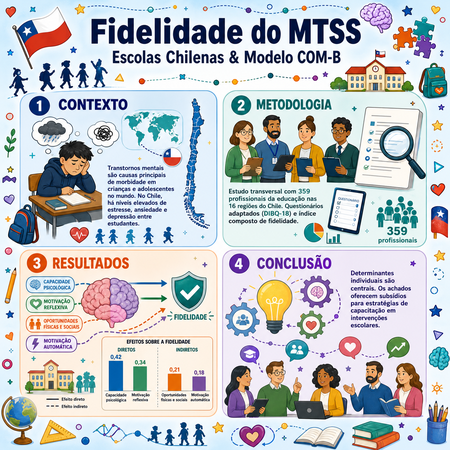
Os transtornos mentais figuram entre as principais causas de morbidade em crianças e adolescentes no mundo, sendo que, no Chile, há níveis elevados de estresse, ansiedade e depressão entre estudantes. Os Sistemas de Suporte Multinível (MTSS) oferecem um marco estruturado para intervenções em saúde mental escolar, mas a manutenção da fidelidade da implementação continua sendo um desafio. Este estudo transversal investigou como as dimensões do modelo COM-B (capacidade, oportunidade e motivação) se relacionam com a fidelidade em escolas públicas chilenas. Foram aplicados questionários a 359 profissionais da educação nas 16 regiões administrativas, com uso da versão adaptada do DIBQ-18 e de um índice composto de fidelidade. Os resultados indicaram que a capacidade psicológica e a motivação reflexiva predizem diretamente a fidelidade, enquanto oportunidades físicas e sociais e motivação automática exercem efeitos indiretos. Os achados ressaltam o papel central dos determinantes individuais e oferecem subsídios para estratégias de capacitação em intervenções escolares.
Downloads
Referências
Arora, P. G., Collins, T. A., Dart, E. H., Hernández, S., Fetterman, H., & Doll, B. (2019). Multitiered systems of support for school-based mental health: A systematic review of depression interventions. School Mental Health, 11(3), 240–264. https://doi.org/10.1007/s12310-019-09314-4
Birken, S. A., Bunger, A. C., Powell, B. J., Turner, K., Clary, A. S., Klaman, S. L., Yu, Y., Whitaker, D. J., Self, S. R., Rostad, W. L., Chatham, J. R. S., & Weiner, B. J. (2017). Organizational theory for dissemination and implementation research. Implementation Science, 12(1), 62. https://doi.org/10.1186/s13012-017-0592-x
Caqueo-Urízar, A., Flores, J., Escobar, C., Urzúa, A., & Irarrázaval, M. (2020). Psychiatric disorders in children and adolescents in a middle-income Latin American country. BMC Psychiatry, 20(1), 104. https://doi.org/10.1186/s12888-020-02512-4
Carlock, K., Nygaard, M. A., & Ormiston, H. E. (2023). School principals' perceived barriers and facilitators to the normalization of school-based mental health services: A multimethod investigation. School Mental Health, 15(3), 940–954. https://doi.org/10.1007/s12310-023-09597-8
Creaser, A. V., Clemes, S. A., Bingham, D. D., & Costa, S. (2023). Applying the COM-B model to understand wearable activity tracker use in children and adolescents. Journal of Public Health, 31(12), 2103–2114. https://doi.org/10.1007/s10389-022-01763-7
Domitrovich, C. E., Bradshaw, C. P., Poduska, J. M., Hoagwood, K., Buckley, J. A., Olin, S., Romanelli, L. H., Leaf, P. J., Greenberg, M. T., & Ialongo, N. S. (2008). Maximizing the implementation quality of evidence-based preventive interventions in schools: A conceptual framework. Advances in School Mental Health Promotion, 1(3), 6–28. https://doi.org/10.1080/1754730X.2008.9715730
Dulaney, S. K., Hallam, P. R., & Wall, G. (2013). Superintendent perceptions of multitiered systems of support (MTSS): Obstacles and opportunities for school system reform. AASA Journal of Scholarship and Practice, 10(2), 30–45.
Fixsen, D. L., Blasé, K. A., & Van Dyke, M. K. (2019). Implementation practice & science. Active Implementation Research Network.
Forman, S. G., Olin, S. S., Hoagwood, K., Crowe, M., & Saka, N. (2009). Evidence-based interventions in schools: Developers' views of implementation barriers and facilitators. School Mental Health, 1(1), 26–36. https://doi.org/10.1007/s12310-008-9002-5
Gong, G., Dong, A., Zhang, Z., & Mao, J. (2024). Medication adherence and predictive factors among patients with rheumatoid arthritis: A COM-B model guided structural equation modeling analysis. Patient Education and Counseling, 119, 108080. https://doi.org/10.1016/j.pec.2023.108080
Guzman, J., & Aguiñaga, S. (2024). The COM-B model: A cross-sectional survey assessing capability, opportunities, and motivation to follow the MIND diet among informal female caregivers of people with Alzheimer's disease and related dementias. Frontiers in Dementia, 3, 1451310. https://doi.org/10.3389/frdem.2024.1451310
Hair, J. F., Risher, J. J., Sarstedt, M., & Ringle, C. M. (2019). When to use and how to report the results of PLS-SEM. European Business Review, 31(1), 2–24. https://doi.org/10.1108/EBR-11-2018-0203
Hoover, S., & Bostic, J. (2021). Schools as a vital component of the child and adolescent mental health system. Psychiatric Services, 72(1), 37–48. https://doi.org/10.1176/appi.ps.201900575
Kearney, C. A., & Graczyk, P. A. (2020). A multidimensional, multitiered system of supports model to promote school attendance and address school absenteeism. Clinical Child and Family Psychology Review, 23(3), 316–337. https://doi.org/10.1007/s10567-020-00317-1
Kieling, C., Buchweitz, C., Caye, A., Silvani, J., Ameis, S. H., Brunoni, A. R., Cost, K. T., Courtney, D. B., Georgiades, K., Merikangas, K. R., Henderson, J. L., Polanczyk, G. V., Rohde, L. A., Salum, G. A., & Szatmari, P. (2024). Worldwide prevalence and disability from mental disorders across childhood and adolescence: Evidence from the Global Burden of Disease Study. JAMA Psychiatry, 81(4), 347–356. https://doi.org/10.1001/jamapsychiatry.2023.5051
Locke, J., Lee, K., Cook, C. R., Frederick, L., Vázquez-Colón, C., Ehrhart, M., Aarons, G. A., Davis, C., & Lyon, A. R. (2019). Understanding the organizational implementation context of schools: A qualitative study of school district administrators, principals, and teachers. School Mental Health, 11(3), 379–399. https://doi.org/10.1007/s12310-018-9292-1
Lyon, A. R., Connors, E. H., Lawson, G. M., Nadeem, E., & Owens, J. S. (2024). Implementation science in school mental health: A 10-year progress update and development of a new research agenda. School Mental Health, 16(4), 1013–1037. https://doi.org/10.1007/s12310-024-09731-0
Marsh, R. J., & Mathur, S. R. (2020). Mental health in schools: An overview of multitiered systems of support. Intervention in School and Clinic, 56(2), 67–73. https://doi.org/10.1177/1053451220914896
Martínez-Líbano, J., & Yeomans-Cabrera, M. M. (2024). Depression, anxiety, and stress in the Chilean educational system: Children and adolescents post-pandemic prevalence and variables. Frontiers in Education, 9, 1407021. https://doi.org/10.3389/feduc.2024.1407021
McKenna, J. W., Flower, A., & Ciullo, S. (2014). Measuring fidelity to improve intervention effectiveness. Intervention in School and Clinic, 50(1), 15–21. https://doi.org/10.1177/1053451214532348
Memon, M. A., Ramayah, T., Cheah, J.-H., Ting, H., Chuah, F., & Cham, T.-H. (2021). PLS-SEM statistical programs: A review. Journal of Applied Structural Equation Modeling, 5(1), i–xiv. https://doi.org/10.47263/JASEM.5(1)06
Michie, S., Atkins, L., & West, R. (2014a). The behaviour change wheel: A guide to designing interventions. Silverback Publishing.
Michie, S., van Stralen, M. M., & West, R. (2011). The behaviour change wheel: A new method for characterising and designing behaviour change interventions. Implementation Science, 6, 42. https://doi.org/10.1186/1748-5908-6-42
Michie, S., West, R., Campbell, R., Brown, J., & Gainforth, H. (2014b). ABC of behaviour change theories. Silverback Publishing.
Mineduc. (2024). Política nacional de convivencia educativa. Ministerio de Educación.
Mineduc, & Minsal. (2022). Comprender y cuidar la salud mental en las comunidades educativas. Cartilla 1: Estrategia de salud mental en comunidades educativas: Enfoques y conceptos fundamentales. Ministerio de Salud.
Moore, S. A., Cooper, J. M. G., Malloy, J. A., & Lyon, A. R. (2023). Core components and implementation determinants of multilevel service delivery frameworks across child mental health service settings. Administration and Policy in Mental Health and Mental Health Services Research, 51, 172–195. https://doi.org/10.1007/s10488-023-01320-8
Nilsen, P. (2015). Making sense of implementation theories, models and frameworks. Implementation Science, 10, 53. https://doi.org/10.1186/s13012-015-0242-0
Nilsen, P., & Bernhardsson, S. (2019). Context matters in implementation science: A scoping review of determinant frameworks that describe contextual determinants for implementation outcomes. BMC Health Services Research, 19(1), 189. https://doi.org/10.1186/s12913-019-4015-3
Nitz, J., Brack, F., Hertel, S., Krull, J., Stephan, H., Hennemann, T., & Hanisch, C. (2023). Multitiered systems of support with focus on behavioral modification in elementary schools: A systematic review. Heliyon, 9(6), e17506. https://doi.org/10.1016/j.heliyon.2023.e17506
Owens, J. S., Lyon, A. R., Brandt, N. E., Warner, C. M., Nadeem, E., Spiel, C., & Wagner, M. (2014). Implementation science in school mental health: Key constructs in a developing research agenda. School Mental Health, 6(2), 99–111. https://doi.org/10.1007/s12310-013-9115-3
Rojas-Andrade, R. M., Aranguren Zurita, S. A., Jaque Morales, F., Prosser Bravo, G. I., & Norambuena Meléndez, E. (2024). Implementation facilitators and barriers of the Chilean Skills for Life Program according to the Consolidated Framework for Implementation Research. Limite, 19, e24014.
Schultes, M.-T., Aijaz, M., Klug, J., & Fixsen, D. L. (2021). Competences for implementation science: What trainees need to learn and where they learn it. Advances in Health Sciences Education, 26(1), 19–35. https://doi.org/10.1007/s10459-020-09969-8
Verdonschot, A., Beauchamp, M. R., Brusseau, T. A., Chinapaw, M. J. M., Christiansen, L. B., Daly-Smith, A., ... & demais autores. (2024). Development and evaluation of the capability, opportunity, and motivation to deliver physical activity in school scale (COM-PASS). International Journal of Behavioral Nutrition and Physical Activity, 21(1), 93. https://doi.org/10.1186/s12966-024-01640-4
Weist, M., Eber, L., Horner, R., Splett, J., Putnam, R., Barrett, S., Perales, K., Fairchild, A. J., & Hoover, S. (2018). Improving multitiered systems of support for students with "internalizing" emotional/behavioral problems. Journal of Positive Behavior Interventions, 20(3), 172–184. https://doi.org/10.1177/1098300717753832
Weist, M., Hoover, S. A., Daly, B. P., Short, K. H., & Bruns, E. J. (2023). Propelling the global advancement of school mental health. Clinical Child and Family Psychology Review, 26(4), 851–864. https://doi.org/10.1007/s10567-023-00434-7
Weist, M., McQuillin, S. D., & Kern, L. (2024). Key themes for scaling effective school mental health programs. In M. Weist, S. D. McQuillin, & L. Kern (Eds.), Scaling effective school mental health interventions: Practice and implementation (pp. 1–18). Springer. https://doi.org/10.1007/978-3-031-68168-4_1
Zurita Arangurén, A. (2023). Validación del cuestionario de determinantes del comportamiento de implementación en profesionales de la salud mental escolar en Chile (Tese de doutorado, Universidad Alberto Hurtado).
Downloads
Publicado
Como Citar
Edição
Seção
Licença
Copyright (c) 2026 DOXA: Revista Brasileira de Psicologia e Educação

Este trabalho está licenciado sob uma licença Creative Commons Attribution-NonCommercial-ShareAlike 4.0 International License.
Manuscritos aceitos e publicados são de propriedade da Doxa. É vedada a submissão integral ou parcial do manuscrito a qualquer outro periódico. A responsabilidade do conteúdo dos artigos é exclusiva dos autores. É vedada a tradução para outro idioma sem a autorização escrita do Editor ouvida a Comissão Editorial.