Desigualdade educacional e deslocamento
trajetórias educacionais de alunos afetados pela guerra
DOI:
https://doi.org/10.22633/rpge.v30iesp2.21363Palavras-chave:
Ucrânia, Desigualdade educacional, Trajetórias dos alunos, Inovação, CompetênciaResumo
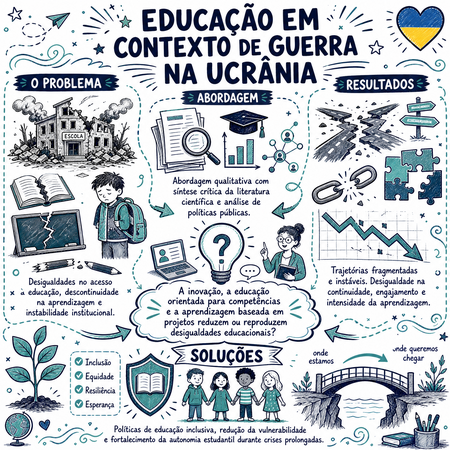
Em tempos de guerra, os alunos enfrentam desigualdades no acesso à educação, na continuidade da aprendizagem e na manutenção do desempenho acadêmico em contextos institucionais e sociais instáveis. Este estudo objetiva analisar como a guerra na Ucrânia transforma as trajetórias educacionais dos alunos e verificar se a inovação, a educação orientada para competências e a aprendizagem baseada em projetos reduzem ou reproduzem desigualdades educacionais. A pesquisa adota uma abordagem qualitativa, fundamentada na síntese crítica da literatura científica, documentos de políticas públicas e fontes analíticas secundárias sobre a educação em contexto de guerra na Ucrânia. Os resultados evidenciam que as trajetórias educacionais tornam-se fragmentadas, instáveis e contingentes. Além do acesso, a desigualdade manifesta-se na continuidade dos estudos, na intensidade da aprendizagem, no engajamento e no apoio educacional disponível. O estudo oferece subsídios para políticas de educação inclusiva voltadas à continuidade da aprendizagem, à redução da vulnerabilidade e ao fortalecimento da autonomia estudantil durante crises prolongadas.
Downloads
Referências
Beregszászi, A., Dudics Lakatos, K., & Gazdag, V. (2025). Research results on mother tongue education in the schools with the Hungarian language of instruction in Transcarpathia (Ukraine). Diaspora, Indigenous, and Minority Education, 1–12. https://doi.org/10.1080/15595692.2025.2553585
Bilaniuk, L., & Melnyk, S. (2008). A tense and shifting balance: Bilingualism and education in Ukraine. International Journal of Bilingual Education and Bilingualism, 11(3–4), 340–372. https://doi.org/10.1080/13670050802148731
Brooks, R., & Rensimer, L. (2025). Higher education actors’ responses to the Ukraine-Russia conflict: An analysis of geopolitical spatial imaginaries. Journal of Education Policy, 40(1), 111–129. https://doi.org/10.1080/02680939.2024.2334945
Chudzicka-Czupała, A., Hao, F., Hapon, N., Dubniak, Z., Różycka, W., Ostafińska-Molik, B., & Ho, R. (2025). Well-being of Ukrainian and Polish college students during the Russo-Ukrainian war and coping strategies as predictors of mental health disorders. Critical Public Health, 35(1), Article 2460996. https://doi.org/10.1080/09581596.2025.2460996
Gaweł, A., Mroczek-Dąbrowska, K., Głodowska, A., & Wach, K. (2025). Caught in suspension: The pivotal shift in the career intentions of international students in times of geopolitical tumult: Ukrainians at universities in Poland. Globalisation, Societies and Education, 1–15. https://doi.org/10.1080/14767724.2025.2468650
Gorokhova, T., Oleinikova, O., Matveieva, O., & Navumau, V. (2025). "War took my home, but not my future": Adaptation of war-affected Ukrainian students in Australia and Germany. Innovation, 38(1), 50–69. https://doi.org/10.1080/13511610.2025.2469667
Holovchak, M., Berezovska, I., & Karkovska, V. (2026). Addressing challenges in the higher education system during a prolonged war: The case of Ukraine. Journal of Further and Higher Education, 1–18. https://doi.org/10.1080/0309877X.2026.2651726
Jakubakynov, B., Tolegenuly, N., Naribai, R., Nurzhanova, Z., Shcherban, T., & Nebelenchuk, I. (2024). Innovative technologies in higher education: Developing international cooperation in professional training. Globalisation, Societies and Education, 24(4), 1–14. https://doi.org/10.1080/14767724.2024.2339309
Kokun, O., & Bezverkhyi, O. (2024). Ukrainian students’ personal resources and resistance to war stress: A cross-sectional survey. Journal of Loss and Trauma, 29(8), 976–993. https://doi.org/10.1080/15325024.2024.2325084
Kokun, O., & Bezverkhyi, O. (2026). Mental and physical health indicators and psychological support needs among Ukrainian students during the war: A one-year longitudinal study. Journal of Aggression, Maltreatment & Trauma, 35(4), 559–578. https://doi.org/10.1080/10926771.2026.2637967
Kolesnyk, L., & Biseth, H. (2024). Professional development in teacher education through international collaboration: When education reform hits Ukraine. Professional Development in Education, 50(2), 347–359. https://doi.org/10.1080/19415257.2023.2193197
Kolisnyk, L., & Mehlsen, M. Y. (2025). Tracking changes in anxiety, depression, and stress among Ukrainian university students: A three-wave study from the COVID-19 pandemic to two years of ongoing full-scale war. European Journal of Psychotraumatology, 16(1), Article 2543616. https://doi.org/10.1080/20008066.2025.2543616
Krawchuk, A. (2024). Rethinking Ukraine’s culture and history during the war. Canadian Slavonic Papers, 66(1–2), 179–202. https://doi.org/10.1080/00085006.2024.2357471
Kruszewska, A., & Lavrenova, M. (2024). The educational opportunities of Ukrainian children at the time of the Russian invasion: Perspectives from teachers. Education 3-13, 52(2), 213–226. https://doi.org/10.1080/03004279.2022.2083211
Lavrysh, Y., Watanabe, M., Lytovchenko, I., Lukianenko, V., Synekop, O., & Chugai, O. (2026). Education as emotional support: Coping, connection and resilience among Ukrainian students in wartime. Teaching in Higher Education, 31(3), 386–407. https://doi.org/10.1080/13562517.2026.2614962
Matiushchenko, I., Omelianovych, I., Bondar, N., Mykhailenko, V., & Herashchenko, S. (2025). Fostering self-awareness in inclusive education: Strategies for students with special needs in Ukraine. International Journal of Inclusive Education, 1–22. https://doi.org/10.1080/13603116.2025.2555400
Nazaruk, S., Ruszkowska, M., Budnyk, O., Dąbrowska, I., & Sokołowska, B. (2026). Experiences of Polish teachers of primary schools in working with war refugee students from Ukraine: Selected problems, limitations and implications for pedagogical practice. Education 3-13, 54(3), 623–636. https://doi.org/10.1080/03004279.2024.2336968
Oleksiyenko, A., Shchepetylnykova, I., & Furiv, U. (2023). Internationalization of higher education in tumultuous times: Transformative powers and problems in embattled Ukraine. Higher Education Research & Development, 42(5), 1103–1118. https://doi.org/10.1080/07294360.2023.2193727
Olumba, E. E. (2025). From students to refugees: Students’ (im)mobility in the wake of the Russian invasion of Ukraine. Journal of Ethnic and Migration Studies, 51(19), 4879–4900. https://doi.org/10.1080/1369183X.2025.2519424
Papastephanou, M. (2023). Coming full circle: A pamphlet on Ukraine, education and catastrophe. Educational Philosophy and Theory, 55(1), 77–88. https://doi.org/10.1080/00131857.2022.2071260
Petryk, K., Nesterenko, M., Mytsyk, H., Kovachov, S., Kryvylova, O., & Suchikova, Y. (2024). A cross-specialization study of pre-service teachers’ perception of STEM education. International Journal of Science Education, 48(8), 1220–1246. https://doi.org/10.1080/09500693.2024.2432489
Proshkin, V., & Foster, C. (2025). Challenges faced by Ukrainian students learning mathematics in UK schools. Cambridge Journal of Education, 55(1), 39–71. https://doi.org/10.1080/0305764X.2024.2444453
Shalgimbekova, K., Smagliy, T., Kalimzhanova, R., & Suleimenova, Z. (2024). Innovative teaching technologies in higher education: Efficiency and student motivation. Cogent Education, 11(1), Article 2425205. https://doi.org/10.1080/2331186X.2024.2425205
Shlenova, M., Konoplenko, N., Yuryeva, K., Korneiko, Y., & Hlukhovska, M. (2024). Comparative analysis of the distance learning implementation in the Ukrainian system of higher education during the COVID-19 pandemic and martial law. Interactive Learning Environments, 32(9), 4968–4977. https://doi.org/10.1080/10494820.2023.2207196
Suprun, K. (2026). Implementation of the performance-based funding policy in Ukrainian higher education: Impact on institutional behaviour? Policy Reviews in Higher Education, 1–27. https://doi.org/10.1080/23322969.2026.2622677
Downloads
Publicado
Como Citar
Edição
Seção
Licença
Copyright (c) 2026 Revista on line de Política e Gestão Educacional

Este trabalho está licenciado sob uma licença Creative Commons Attribution-NonCommercial-ShareAlike 4.0 International License.
Manuscritos aceitos e publicados são de propriedade da Revista on line de Política e Gestão Educacional. É vedada a submissão integral ou parcial do manuscrito a qualquer outro periódico. A responsabilidade do conteúdo dos artigos é exclusiva dos autores. É vedada a tradução para outro idioma sem a autorização escrita do Editor ouvida a Comissão Editorial Científica.