Conhecimento de professores em formação sobre a dislexia
DOI:
https://doi.org/10.30715/doxa.v27i00.21091Palavras-chave:
Dislexia, Formação de professores, Conhecimento docente, Dificuldades de aprendizagem, Educação superiorResumo
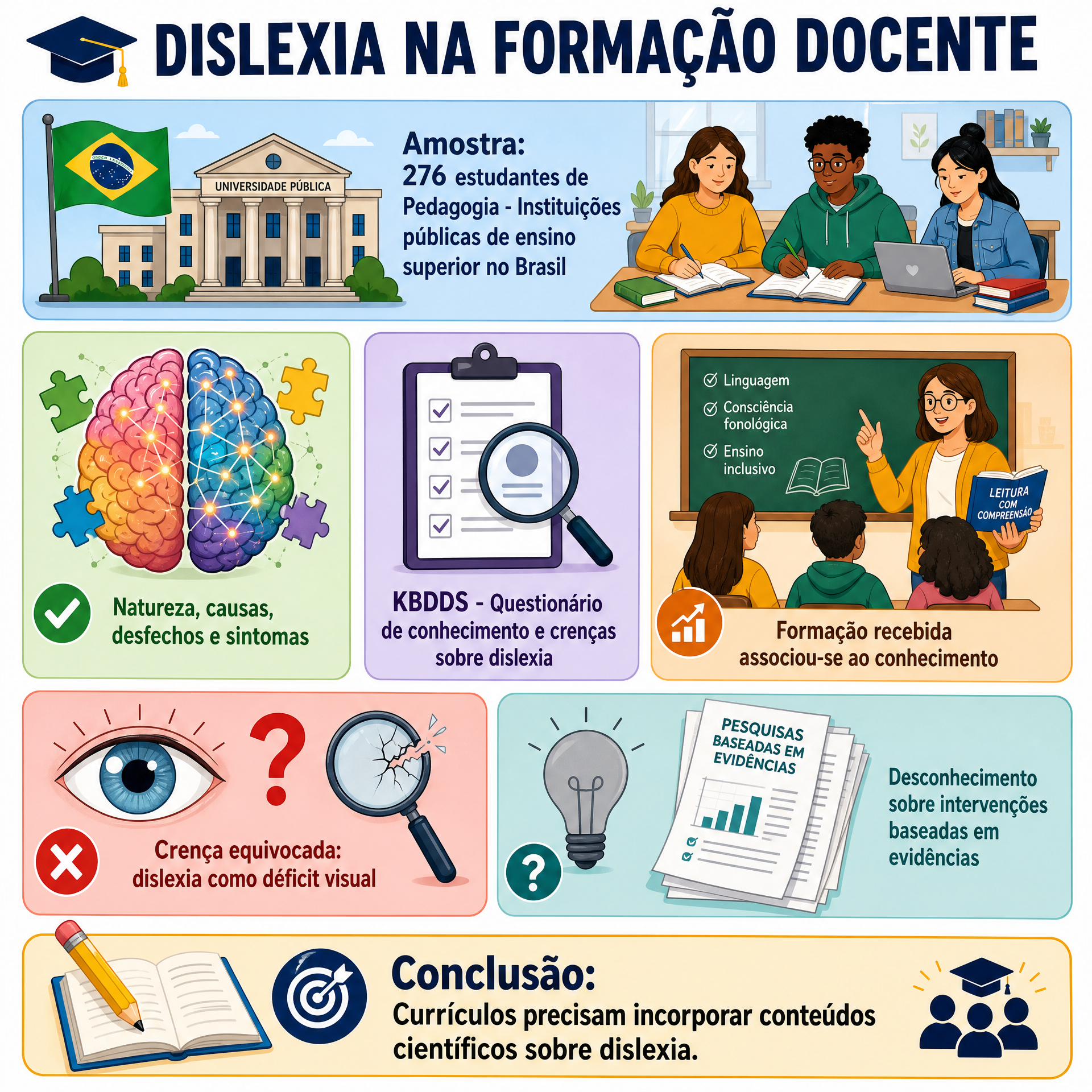
Este estudo avaliou o conhecimento dos professores em formação sobre a dislexia e verificou se a formação recebida sobre o transtorno durante a graduação associa-se com o conhecimento sobre a condição. A amostra incluiu 276 estudantes de Pedagogia de instituições públicas de ensino superior no Brasil. Todos responderam um questionário sociodemográfico e uma versão traduzida do Knowledge and Beliefs about Developmental Dyslexia Scale (KBDDS). Segundo os resultados, os participantes apresentaram conhecimentos precisos sobre a natureza, causas, desfechos e a sintomatologia da dislexia. Contudo, concepções equivocadas, como a crença de que a dislexia é resultado de déficits visuais, e desconhecimento sobre intervenções baseadas em evidências também foram identificadas. A formação em dislexia recebida durante o curso de Pedagogia associou-se significativamente ao conhecimento sobre o transtorno. Esses achados evidenciam lacunas na formação inicial dos futuros professores e sugerem que os currículos dos cursos de Pedagogia incorporem conteúdos científicos sobre a dislexia.
Downloads
Referências
Abed, M. G., & Shackelford, T. K. (2022). Saudi public primary school teachers’ knowledge and beliefs about developmental dyslexia. Dyslexia, 28(2), 244–251. https://doi.org/10.1002/dys.1705
American Psychiatric Association. (2023). Manual diagnóstico e estatístico de transtornos mentais: DSM-5-TR (M. I. C. Nascimento et al., Trads.; 5ª ed., texto rev.). Artmed.
Brasil. (2021). Lei nº 14.254, de 30 de novembro de 2021. Dispõe sobre o acompanhamento integral para educandos com dislexia ou transtorno do déficit de atenção com hiperatividade (TDAH) ou outro transtorno de aprendizagem. https://www.planalto.gov.br/ccivil_03/_ato2019-2022/2021/lei/L14254.htm
Bollig, B., Coverdale, G., Bayliss, D., MacArthur, G., & Badcock, N. A. (2026). What parents, teachers, and clinicians know about the features of developmental dyslexia and its intervention: A scoping review. Dyslexia, 32(1), e70017. https://doi.org/10.1002/dys.70017
Cozby, P. C., & Bates, S. C. (2020). Methods in behavioral research (14th ed.). McGraw-Hill Education.
Dodur, H. M. S., & Kumaş, Ö. A. (2020). Knowledge and beliefs of classroom teachers about dyslexia: The case of teachers in Turkey. European Journal of Special Needs Education, 35(4), 489–502. https://doi.org/10.1080/08856257.2019.1666121
Dymock, S., & Nicholson, T. (2023). Dyslexia seen through the eyes of teachers: An exploratory survey. Reading Research Quarterly, 58(2), 333–344. https://doi.org/10.1002/rrq.490
Echegaray-Bengoa, J. A., Soriano-Ferrer, M., & Joshi, R. M. (2017). Knowledge and beliefs about developmental dyslexia: A comparison between pre-service and in-service Peruvian teachers. Journal of Learning Disabilities, 50(4), 498–510. https://doi.org/10.1177/1538192717697591
Ehri, L. C., Nunes, S. R., Stahl, S. A., & Willows, D. M. (2001). Systematic phonics instruction helps students learn to read: Evidence from the National Reading Panel’s meta-analysis. Review of Educational Research, 71(3), 393–447. https://doi.org/10.3102/00346543071003393
Erbeli, F., Rice, M., & Paracchini, S. (2022). Insights into dyslexia genetics research from the last two decades. Brain Sciences, 12(1), Article 27. https://doi.org/10.3390/brainsci12010027
Gaab, N., & Petscher, Y. (2022). Screening for early literacy milestones and reading disabilities: The why, when, whom, how, and where. Harvard Graduate School of Education.
Galimzhanova, G. (2025). Teachers’ knowledge of dyslexia in one of the largest regions of Kazakhstan. Journal of Research in Special Educational Needs, 25(3), 555–568. https://doi.org/10.1111/1471-3802.12745
Geertsema, S., Le Roux, M., Bhorat, A., Carrim, A., Valley, M., & Graham, M. (2022). Developmental dyslexia in private schools in South Africa: Educators’ perspectives. South African Journal of Education, 42(4), 1–12. https://doi.org/10.15700/saje.v42n4a1992
Gemio, A. B., Navas, A. L., Azoni, C. A. S., Borges, J. P. A., & Ciboto, T. (Eds.). (2023). Dislexia e a lei: Os direitos garantidos pela Lei nº 14.254/21 [E-book]. Instituto ABCD. https://www.institutoabcd.org.br/wp-content/uploads/2019/04/ebook-lei.pdf
George, D., & Mallery, P. (2019). IBM SPSS statistics 25 step by step: A simple guide and reference (15th ed.). Routledge.
Gialluisi, A., Andlauer, T. F. M., Mirza-Schreiber, N., Moll, K., Becker, J., Hoffmann, P., Ludwig, K. U., Czamara, D., St Pourcain, B., Honbolygó, F., Tóth, D., Csépe, V., Huguet, G., Chaix, Y., Iannuzzi, S., Demonet, J.-F., Morris, A. P., Hulslander, J., Willcutt, E. G., ... Schulte-Körne, G. (2021). Genome-wide association study reveals new insights into the heritability and genetic correlates of developmental dyslexia. Molecular Psychiatry, 26(7), 3004–3017. https://doi.org/10.1038/s41380-020-00898-x
Gil, A. C. (2022). Métodos e técnicas de pesquisa social (7ª ed.). Atlas.
Giroto, C. R. M., & Castro, R. M. de. (2011). A formação de professores para a educação inclusiva: Alguns aspectos de um trabalho colaborativo entre pesquisadores e professores da educação infantil. Revista Educação Especial, 24(41), 441–451.
Gonçalves, T. S., & Crenitte, P. A. P. (2014). Conceptions of elementary school teachers about learning disorders. Revista CEFAC, 16(3), 817–829.
Gonzalez, M. (2021). Dyslexia knowledge, perceived preparedness, and professional development needs of in-service educators. Annals of Dyslexia, 71(3), 547–567. https://doi.org/10.1007/s11881-021-00235-z
Gonzalez, M. (2026). The impact of dyslexia legislation: An analysis of knowledge and preparedness among in-service educators. Journal of Educational and Learning, 15(1), 12–31. https://doi.org/10.5539/jel.v15n1p12
Green, E. A. (2022). Continuing the debate: A response to the Literacy Research Association’s dyslexia research report. International Journal of Education and Literacy Studies, 10(3), 72–79. https://doi.org/10.7575/aiac.ijels.v.10n.3p.72
Hall, C., Dahl-Leonard, K., Cho, E., Solari, E. J., Capin, P., Conner, C. L., Henry, A. R., Cook, L., Hayes, L., Vargas, I., Richmond, C. L., & Kehoe, K. F. (2023). Forty years of reading intervention research for elementary students with or at risk for dyslexia: A systematic review and meta-analysis. Reading Research Quarterly, 58(2), 285–312. https://doi.org/10.1002/rrq.477
International Dyslexia Association. (2025). Definition of dyslexia. https://dyslexiaida.org/definition-of-dyslexia/
Joshi, R. M., & Wijekumar, K. (2020). Introduction to the special issue: Teacher knowledge of literacy skills: International perspectives. Dyslexia, 26(3), 245–246. https://doi.org/10.1002/dys.1665
Knight, C. (2018). What is dyslexia? An exploration of the relationship between teachers’ understandings of dyslexia and their training experiences. Dyslexia, 24(3), 207–219. https://doi.org/10.1002/dys.1593
Lyon, G. R., & Weiser, B. (2009). Teacher knowledge, instructional expertise, and the development of reading proficiency. Reading and Writing, 22(4), 475–493. https://doi.org/10.1007/s11145-009-9166-1
Medeiros, M. C. G. (2015). O que os professores conhecem sobre dislexia e o transtorno de déficit de atenção/hiperatividade (Coleção Prata da Casa). SESI-SP Editora.
McArthur, G. M., Filardi, N., Francis, D. A., Boyes, M. E., & Badcock, N. A. (2020). Self-concept in poor readers: A systematic review and meta-analysis. PeerJ, 8, e8772. https://doi.org/10.7717/peerj.8772
Morrison, D., & Hessler, T. (2016). Teaching the teachers: Eliminating gaps to better serve children with dyslexia. Perspectives on Language and Literacy, 42(4), 7–11.
Mullikin, K., Stransky, M., Tendulkar, S., Casey, M., & Kosinski, K. (2021). Informal preparation and years of experience: Key correlates of dyslexia knowledge among Massachusetts early elementary teachers. Dyslexia, 27(4), 510–524. https://doi.org/10.1002/dys.1701
Nadelson, L. S., Beavers, A., Eppes, B., Rogers, A., Sergeant, K., Turner, S., & Van Winkle, A. (2019). A comparison of teachers’ perceptions, misconceptions, and teaching students with dyslexia. World Journal of Educational Research, 6(4), 442–462. https://doi.org/10.22158/wjer.v6n4p442
Nascimento, I. S. do, Rosal, A. G. C., & Queiroga, B. A. M. de. (2018). Elementary school teachers’ knowledge on dyslexia. Revista CEFAC, 20(1), 87–94. https://doi.org/10.1590/1982-021620182019117
Parrila, R., Dudley, D., Song, S., & Georgiou, G. K. (2020). A meta-analysis of reading-level match dyslexia studies in consistent alphabetic orthographies. Annals of Dyslexia, 70(1), 1–26. https://doi.org/10.1007/s11881-019-00187-5
Peltier, T., Washburn, E. K., Heddy, B. C., & Binks-Cantrell, E. (2022). What do teachers know about dyslexia? It’s complicated. Reading and Writing, 35(9), 2077–2107. https://doi.org/10.1007/s11145-022-10264-8
Sanfilippo, J., Ness, M., Petscher, Y., Rappaport, L., Zuckerman, B., & Gaab, N. (2020). Reintroducing dyslexia: Early identification and implications for pediatric practice. Pediatrics, 146(1), e20193046. https://doi.org/10.1542/peds.2019-3046
Solheim, O. J., Arntzen, J., & Foldnes, N. (2024). Norwegian classroom teachers’ and specialized “resource” teachers’ dyslexia knowledge. Reading and Writing, 37(10), 2619–2641. https://doi.org/10.1007/s11145-023-10486-4
Soriano-Ferrer, M., Echegaray-Bengoa, J., & Joshi, R. M. (2016). Knowledge and beliefs about developmental dyslexia in preservice and in-service Spanish-speaking teachers. Annals of Dyslexia, 66(1), 91–110. https://doi.org/10.1007/s11881-015-0111-1
Tabaquim, M. de L. M., Dauruiz, S., Prudenciatti, S. M., & Niquerito, A. V. (2016). The conception of primary education teachers about developmental dyslexia. Revista Brasileira de Estudos Pedagógicos, 97(245), 131–146. https://doi.org/10.1590/S2176-6681/368214020
Wagner, R. K., Zirps, F. A., Edwards, A. A., Wood, S. G., Joyner, R. E., Becker, B. J., Liu, G., & Beal, B. (2020). The prevalence of dyslexia: A new approach to its estimation. Journal of Learning Disabilities, 53(5), 354–365. https://doi.org/10.1177/0022219420920377
Washburn, E. K., Mulcahy, C. A., Joshi, R. M., & Binks-Cantrell, E. (2016). Teacher knowledge of dyslexia. Perspectives on Language and Literacy, 42(4), 9–13.
Worthy, J., DeJulio, S., Svrcek, N., Villarreal, D. A., Derbyshire, C., LeeKeenan, K., Wiebe, M. T., Lammert, C., Rubin, J. C., & Salmerón, C. (2016). Teachers’ understandings, perspectives, and experiences of dyslexia. Literacy Research: Theory, Method, and Practice, 65(1), 436–453. https://doi.org/10.1177/2381336916661529
Yang, L., Li, C., Li, X., Zhai, M., An, Q., Zhang, Y., Zhao, J., & Weng, X. (2022). Prevalence of developmental dyslexia in primary school children: A systematic review and meta-analysis. Brain Sciences, 12(2), Article 240. https://doi.org/10.3390/brainsci12020240
Yin, L., Joshi, R. M., & Yan, H. (2020). Knowledge about dyslexia among early literacy teachers in China. Dyslexia, 26(3), 247–265. https://doi.org/10.1002/dys.1635
Publicado
Como Citar
Edição
Seção
Licença
Copyright (c) 2026 DOXA: Revista Brasileira de Psicologia e Educação

Este trabalho está licenciado sob uma licença Creative Commons Attribution-NonCommercial-ShareAlike 4.0 International License.
Manuscritos aceitos e publicados são de propriedade da Doxa. É vedada a submissão integral ou parcial do manuscrito a qualquer outro periódico. A responsabilidade do conteúdo dos artigos é exclusiva dos autores. É vedada a tradução para outro idioma sem a autorização escrita do Editor ouvida a Comissão Editorial.