A arte como ferramenta para desenvolver a inteligência emocional na educação inclusiva
DOI:
https://doi.org/10.22633/rpge.v30iesp1.20892Palavras-chave:
Inteligência emocional, Arte, Desenvolvimento, Educacação inclusiva, Educação secundária socialResumo
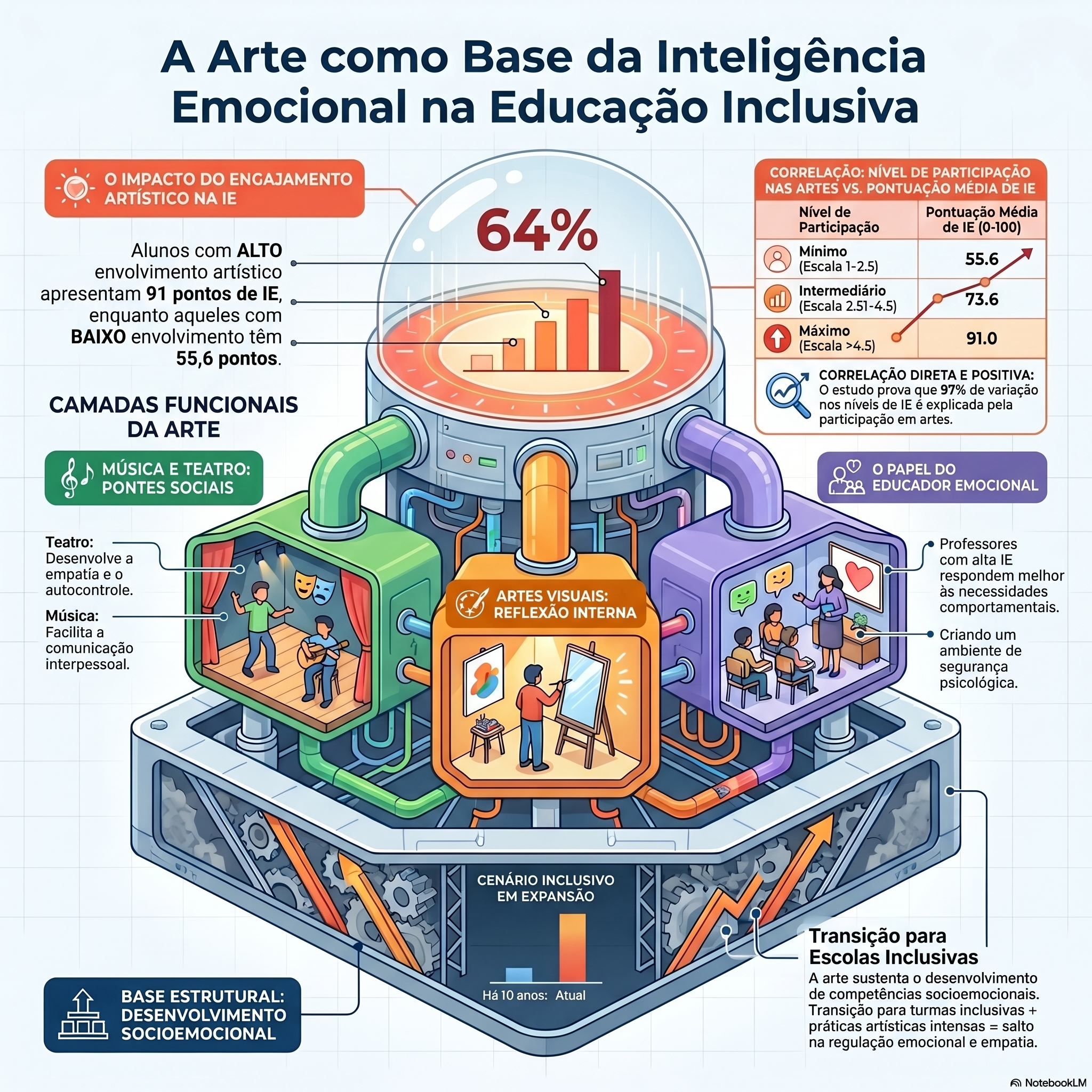
Este estudo aborda o crescente número de estudantes com NEE em escolas regulares e a necessidade de ferramentas eficazes para o desenvolvimento da IE. O objetivo é avaliar o desenvolvimento criativo e emocional combinado de crianças com NEE por meio de metodologias baseadas em arte e analisar seu impacto na IE. Os métodos incluíram análises de regressão e correlação, estatística descritiva e sistematização. Os resultados mostram que o número de estudantes com NEE influencia significativamente a prevalência da escolarização inclusiva, enquanto a carga de trabalho docente e a proporção de crianças fora da escola correlacionam-se com os níveis de inclusão. As regiões da Ucrânia foram agrupadas em clusters com altas e baixas taxas de inclusão. Foi identificada uma relação negativa entre a matrícula em instituições especiais e o potencial de desenvolvimento de competências sociais e emocionais. Destaca-se que uma maior participação em práticas artísticas inclusivas esteve associada ao aumento da IE, que passou de 55,6 para 91,0 pontos.
Downloads
Referências
Assad, Z. (2025). STEM education and freelance teaching: Bridging innovation and accessibility. Central Asian Journal of Innovations on Tourism Management and Finance, 6(1), 41–44. https://cajitmf.casjournal.org/index.php/CAJITMF/article/download/821/849
Baral, P. K. (2024). Emotional intelligence as a predictor to enhance teacher effectiveness in inclusive education. International Journal of Latest Research in Humanities and Social Science, 7(1), 188–195. http://ijlrhss.com/paper/volume-7-issue-1/22-HSS-2545.pdf
Cabinet of Ministers of Ukraine. (2021). Resolution No. 957 on approval of the procedure for organizing inclusive education in general secondary education institutions. https://zakon.rada.gov.ua/laws/show/957-2021-%D0%BF
Coronado-Maldonado, I., & Benítez-Márquez, M. D. (2023). Emotional intelligence, leadership, and work teams: A hybrid literature review. Heliyon, 9(10), e20356. https://doi.org/10.1016/j.heliyon.2023.e20356
Elfenbein, H. A., & MacCann, C. (2017). A closer look at ability emotional intelligence (EI): What are its component parts, and how do they relate to each other? Social and Personality Psychology Compass, 11(7), e12324. https://doi.org/10.1111/spc3.12324
Fleming, T. (2025). Transformative learning reconceptualized: Integrating reading literature and social imagination. International Journal of Lifelong Education, 1–18. https://doi.org/10.1080/02601370.2025.2577202
George, O. J., Okon, S. E., & Akaighe, G. (2022). Emotional intelligence and work engagement: A serial mediation model. Journal of Organizational Effectiveness: People and Performance, 9(2), 193–211. https://doi.org/10.1108/JOEPP-02-2021-0025
Gulla, A. N., Fairbank, H. C., & Noonan, S. M. (2022). Maxine Greene: An approach to aesthetic education and a vision of social imagination. Beijing International Review of Education, 4(3), 479–490. https://doi.org/10.1163/25902539-04030014
Institute of Educational Analytics. (2024). General secondary education institutions of the Ministry of Education and Science of Ukraine, other ministries and agencies, and private institutions (2023/2024 academic year). https://iea.gov.ua/wp-content/uploads/2024/02/byuleten-zzso-2023-2024.xlsx
Institute of Educational Analytics. (n.d.). Analytics. https://iea.gov.ua/diyalnist/naukovo-analitichna-diyalnist/analitika/
Iryhina, S., Sbruieva, A., Chystiakova, I., & Chernyakova, Z. (2020). Implementation of emotional intelligence theory in future musical art teachers training. Journal of History Culture and Art Research, 9(2), 50–60. https://doi.org/10.7596/taksad.v9i2.2575
Jardinez, M. J., & Natividad, L. R. (2024). The advantages and challenges of inclusive education: Striving for equity in the classroom. Shanlax International Journal of Education, 12, 57–65. https://doi.org/10.34293/education.v12i2.7182
Jasubhai, S. (2025). Personality and emotional intelligence: The role of extraversion in self-control and managing emotions among undergraduate and postgraduate students. International Journal of Innovative Science and Research Technology, 10(4), 1775–1780. https://doi.org/10.38124/ijisrt/25apr1693
Khattak, M., Ullah, Z., Imran, S., & Khattak, W. (2025). Bridging emotional intelligence and inclusive education: Empowering teachers to support diverse classrooms. The Critical Review of Social Sciences Studies, 3, 1755–1765. https://doi.org/10.59075/vzqhyx73
Khilmiyah, A., & Wiyono, G. (2021). Emotional and social intelligence assessment model for student character reinforcement. International Journal of Educational Management, 35(4), 789–802. https://doi.org/10.1108/IJEM-02-2020-0046
Krishnan, H., & Awang, S. R. (2024). Navigating emotional intelligence: A comprehensive review of theories, models and applications. Information Management and Business Review, 16(4), 74–85. https://doi.org/10.22610/imbr.v16i4(I).4242
Mahire, V. Y., & Ahire, S. U. (2024). Study of emotional intelligence and stress among college teachers. International Journal of Indian Psychology, 12(4), 858–862. https://doi.org/10.25215/1204.079
Mgaiwa, S. J., & Milinga, J. R. (2024). Teacher preparation and continuous professional development: A review of “missing links.” Social Sciences & Humanities Open, 10, 1–11. https://doi.org/10.1016/j.ssaho.2024.100990
Mrisho, D. H., & Mseti, S. (2024). Emotional intelligence: Concept, theoretical perspectives, and its relevance to job performance. East African Journal of Interdisciplinary Studies, 7(1), 28–37. https://doi.org/10.37284/eajis.7.1.1817
Rachmad, Y. E. (2022). Emotional intelligence theory. Antibes Méditerranée Éditions Internationales. https://doi.org/10.17605/osf.io/ue76k
Stuckey, H. L., & Nobel, J. (2010). The connection between art, healing, and public health: A review of current literature. American Journal of Public Health, 100(2), 254–263. https://doi.org/10.2105/AJPH.2008.156497
UNESCO Institute for Statistics. (2025). SDG 4 monitoring: Education data and indicators. https://databrowser.uis.unesco.org/browser/EDUCATION/UIS-SDG4Monitoring
United Nations. (2024). Indicator 4.7.3: Share of full-time secondary schools with inclusive education (%). Sustainable Development Goals. https://sdg.ukrstat.gov.ua/4-7-3/
Zhi, R., Wang, Y., & Wang, Y. (2024). The role of emotional intelligence and self-efficacy in EFL teachers’ technology adoption. The Asia-Pacific Education Researcher, 33, 845–856. https://doi.org/10.1007/s40299-023-00782-6
Publicado
Como Citar
Edição
Seção
Licença
Copyright (c) 2026 Revista on line de Política e Gestão Educacional

Este trabalho está licenciado sob uma licença Creative Commons Attribution-NonCommercial-ShareAlike 4.0 International License.
Manuscritos aceitos e publicados são de propriedade da Revista on line de Política e Gestão Educacional. É vedada a submissão integral ou parcial do manuscrito a qualquer outro periódico. A responsabilidade do conteúdo dos artigos é exclusiva dos autores. É vedada a tradução para outro idioma sem a autorização escrita do Editor ouvida a Comissão Editorial Científica.