El arte como herramienta para desarrollar la inteligencia emocional en la educación inclusiva
DOI:
https://doi.org/10.22633/rpge.v30iesp1.20892Palabras clave:
Inteligencia Emocional, Arte, Desarrollo, Educación Inclusiva, Educación Secundaria GeneralResumen
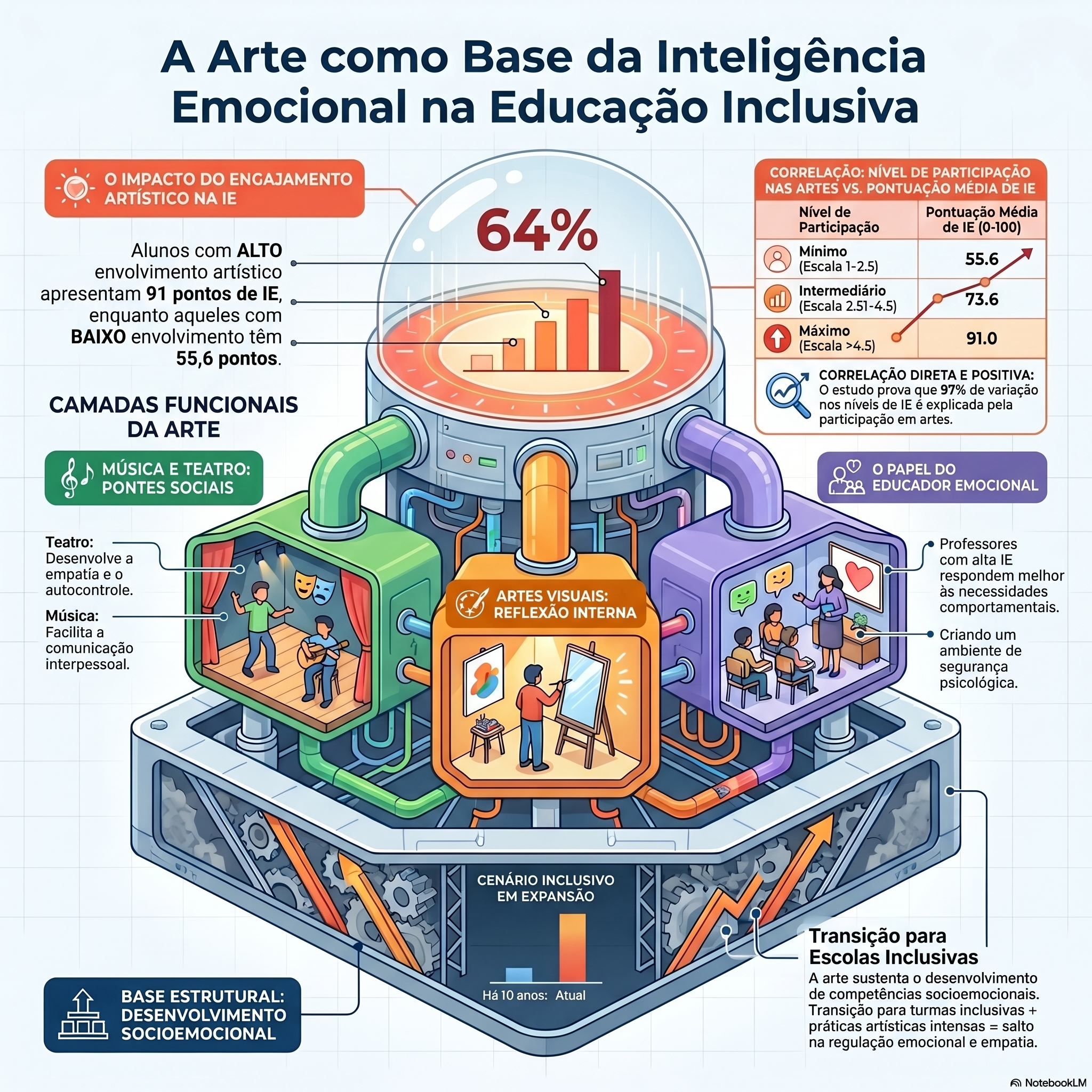
Este estudio aborda el creciente número de estudiantes con NEE en escuelas regulares y la necesidad de herramientas eficaces para el desarrollo de la IE. El objetivo es evaluar el desarrollo creativo y emocional combinado de los niños con NEE mediante metodologías basadas en el arte y analizar su impacto en la IE. Los métodos incluyeron análisis de regresión y correlación, estadística descriptiva y sistematización. Los resultados muestran que el número de estudiantes con NEE influye significativamente en la prevalencia de la escolarización inclusiva, mientras que la carga laboral docente y la proporción de niños fuera de la escuela se correlacionan con los niveles de inclusión. Las regiones de Ucrania fueron agrupadas en clusters con altas y bajas tasas de inclusión. Se encontró una relación negativa entre la matrícula en instituciones especiales y el potencial de desarrollo de competencias sociales y emocionales. Cabe destacar que una mayor participación en prácticas artísticas inclusivas se asoció con un aumento de la IE, pasando de 55,6 a 91,0 puntos.
Descargas
Citas
Assad, Z. (2025). STEM education and freelance teaching: Bridging innovation and accessibility. Central Asian Journal of Innovations on Tourism Management and Finance, 6(1), 41–44. https://cajitmf.casjournal.org/index.php/CAJITMF/article/download/821/849
Baral, P. K. (2024). Emotional intelligence as a predictor to enhance teacher effectiveness in inclusive education. International Journal of Latest Research in Humanities and Social Science, 7(1), 188–195. http://ijlrhss.com/paper/volume-7-issue-1/22-HSS-2545.pdf
Cabinet of Ministers of Ukraine. (2021). Resolution No. 957 on approval of the procedure for organizing inclusive education in general secondary education institutions. https://zakon.rada.gov.ua/laws/show/957-2021-%D0%BF
Coronado-Maldonado, I., & Benítez-Márquez, M. D. (2023). Emotional intelligence, leadership, and work teams: A hybrid literature review. Heliyon, 9(10), e20356. https://doi.org/10.1016/j.heliyon.2023.e20356
Elfenbein, H. A., & MacCann, C. (2017). A closer look at ability emotional intelligence (EI): What are its component parts, and how do they relate to each other? Social and Personality Psychology Compass, 11(7), e12324. https://doi.org/10.1111/spc3.12324
Fleming, T. (2025). Transformative learning reconceptualized: Integrating reading literature and social imagination. International Journal of Lifelong Education, 1–18. https://doi.org/10.1080/02601370.2025.2577202
George, O. J., Okon, S. E., & Akaighe, G. (2022). Emotional intelligence and work engagement: A serial mediation model. Journal of Organizational Effectiveness: People and Performance, 9(2), 193–211. https://doi.org/10.1108/JOEPP-02-2021-0025
Gulla, A. N., Fairbank, H. C., & Noonan, S. M. (2022). Maxine Greene: An approach to aesthetic education and a vision of social imagination. Beijing International Review of Education, 4(3), 479–490. https://doi.org/10.1163/25902539-04030014
Institute of Educational Analytics. (2024). General secondary education institutions of the Ministry of Education and Science of Ukraine, other ministries and agencies, and private institutions (2023/2024 academic year). https://iea.gov.ua/wp-content/uploads/2024/02/byuleten-zzso-2023-2024.xlsx
Institute of Educational Analytics. (n.d.). Analytics. https://iea.gov.ua/diyalnist/naukovo-analitichna-diyalnist/analitika/
Iryhina, S., Sbruieva, A., Chystiakova, I., & Chernyakova, Z. (2020). Implementation of emotional intelligence theory in future musical art teachers training. Journal of History Culture and Art Research, 9(2), 50–60. https://doi.org/10.7596/taksad.v9i2.2575
Jardinez, M. J., & Natividad, L. R. (2024). The advantages and challenges of inclusive education: Striving for equity in the classroom. Shanlax International Journal of Education, 12, 57–65. https://doi.org/10.34293/education.v12i2.7182
Jasubhai, S. (2025). Personality and emotional intelligence: The role of extraversion in self-control and managing emotions among undergraduate and postgraduate students. International Journal of Innovative Science and Research Technology, 10(4), 1775–1780. https://doi.org/10.38124/ijisrt/25apr1693
Khattak, M., Ullah, Z., Imran, S., & Khattak, W. (2025). Bridging emotional intelligence and inclusive education: Empowering teachers to support diverse classrooms. The Critical Review of Social Sciences Studies, 3, 1755–1765. https://doi.org/10.59075/vzqhyx73
Khilmiyah, A., & Wiyono, G. (2021). Emotional and social intelligence assessment model for student character reinforcement. International Journal of Educational Management, 35(4), 789–802. https://doi.org/10.1108/IJEM-02-2020-0046
Krishnan, H., & Awang, S. R. (2024). Navigating emotional intelligence: A comprehensive review of theories, models and applications. Information Management and Business Review, 16(4), 74–85. https://doi.org/10.22610/imbr.v16i4(I).4242
Mahire, V. Y., & Ahire, S. U. (2024). Study of emotional intelligence and stress among college teachers. International Journal of Indian Psychology, 12(4), 858–862. https://doi.org/10.25215/1204.079
Mgaiwa, S. J., & Milinga, J. R. (2024). Teacher preparation and continuous professional development: A review of “missing links.” Social Sciences & Humanities Open, 10, 1–11. https://doi.org/10.1016/j.ssaho.2024.100990
Mrisho, D. H., & Mseti, S. (2024). Emotional intelligence: Concept, theoretical perspectives, and its relevance to job performance. East African Journal of Interdisciplinary Studies, 7(1), 28–37. https://doi.org/10.37284/eajis.7.1.1817
Rachmad, Y. E. (2022). Emotional intelligence theory. Antibes Méditerranée Éditions Internationales. https://doi.org/10.17605/osf.io/ue76k
Stuckey, H. L., & Nobel, J. (2010). The connection between art, healing, and public health: A review of current literature. American Journal of Public Health, 100(2), 254–263. https://doi.org/10.2105/AJPH.2008.156497
UNESCO Institute for Statistics. (2025). SDG 4 monitoring: Education data and indicators. https://databrowser.uis.unesco.org/browser/EDUCATION/UIS-SDG4Monitoring
United Nations. (2024). Indicator 4.7.3: Share of full-time secondary schools with inclusive education (%). Sustainable Development Goals. https://sdg.ukrstat.gov.ua/4-7-3/
Zhi, R., Wang, Y., & Wang, Y. (2024). The role of emotional intelligence and self-efficacy in EFL teachers’ technology adoption. The Asia-Pacific Education Researcher, 33, 845–856. https://doi.org/10.1007/s40299-023-00782-6
Descargas
Publicado
Cómo citar
Número
Sección
Licencia
Derechos de autor 2026 Revista on line de Política e Gestão Educacional

Esta obra está bajo una licencia internacional Creative Commons Atribución-NoComercial-CompartirIgual 4.0.
Manuscritos aceitos e publicados são de propriedade da Revista on line de Política e Gestão Educacional. É vedada a submissão integral ou parcial do manuscrito a qualquer outro periódico. A responsabilidade do conteúdo dos artigos é exclusiva dos autores. É vedada a tradução para outro idioma sem a autorização escrita do Editor ouvida a Comissão Editorial Científica.