Inteligência artificial e o futuro da profissão jurídica
implicações para a formação jurídica no Vietnã
DOI:
https://doi.org/10.22633/rpge.v30iesp2.21370Palavras-chave:
Inteligência Artificial, Educação jurídica, Transformação digital, Formação jurídica, VietnãResumo
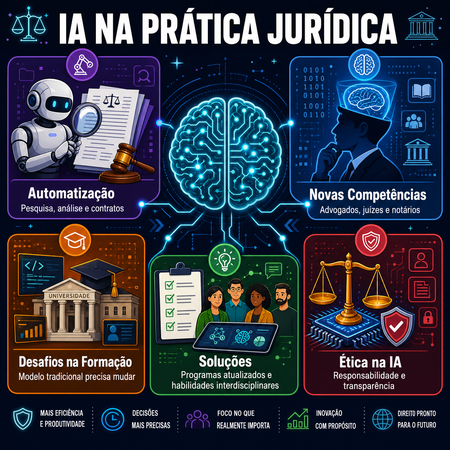
O rápido desenvolvimento da Inteligência Artificial (IA) está gerando mudanças profundas em muitas áreas da vida socioeconômica, incluindo a profissão jurídica. A IA não apenas automatiza muitas atividades jurídicas tradicionais, como a pesquisa de jurisprudência, a análise de textos jurídicos, a elaboração de contratos e a previsão de resultados de litígios, mas também altera o conjunto de competências e as funções profissionais de advogados, juízes, notários e outros profissionais do direito. Nesse contexto, a formação jurídica precisa de ajustes adequados para preparar os alunos para se adaptarem ao novo ambiente profissional. Este artigo analisa o impacto da IA na prática jurídica e identifica as tendências de transformação no mercado de trabalho jurídico. Com base nisso, o artigo avalia os desafios enfrentados pelo modelo tradicional de educação jurídica. Propõem-se várias direções para a inovação na educação jurídica no Vietnã, incluindo a atualização dos programas de formação, o fortalecimento das competências interdisciplinares, o aprimoramento das capacidades digitais e a conscientização sobre a ética e a responsabilidade jurídica no uso da IA.
Downloads
Referências
Balan, A. (2024). AI and legal education: Ethical and sustainable approaches. Routledge.
Bucher, A. (2025). Navigating the power of artificial intelligence in the legal field. Houston Law Review, 62(4), 819–842.
Carrel, A. (2019). Legal intelligence through artificial intelligence requires emotional intelligence: A new competency model for the 21st-century legal professional. Georgia State University Law Review, 35(4), 1153–1183.
Clio. (2026). 2025 Clio legal trends report. https://www.clio.com/resources/legal-trends/read-online/
Flynn, S. (2019, September 26). Melbourne Law School offers a law tech design pop-up course. Artificial Lawyer. https://www.artificiallawyer.com/2019/09/26/melbourne-law-school-offers-law-tech-design-pop-up-course/
Ho, H. B. T. (2025). Law students and artificial intelligence in legal research. Russin & Vecchi. https://www.russinvecchi.com.vn/publication/sinh-vien-luat-va-tri-tue-nhan-tao-trong-nghien-cuu-phap-luat/
Le, T. M. (2026). Vietnam’s first standalone AI law: An overview of key provisions and future implications. International Association of Privacy Professionals. https://iapp.org/news/a/vietnam-s-first-standalone-ai-law-an-overview-of-key-provisions-future-implications
Eliadi, M. (2025). The T-shaped lawyer: A new model for corporate legal excellence. Axiom Law. https://www.axiomlaw.com/blog/t-shaped-lawyer-model-for-corporate-legal-excellence
Melbourne Law School. (2026). Technology, innovation, design, and the law at MLS. https://law.unimelb.edu.au/about/technology-innovation-and-the-law
Miller, K. W. (2026). The 15 best legal AI software tools for 2025. Ironclad. https://ironcladapp.com/resources/articles/best-legal-ai-software
Moppett, S. A. (2025). Preparing students for the artificial intelligence era: The crucial role of critical thinking skills. Mitchell Hamline Law Review, 52(1), Article 7.
Morris, I. (2025, March 24). 7 ways AI is changing law school & legal careers. The Colleges of Law. https://www.collegesoflaw.edu/blog/2025/03/24/7-ways-artificial-intelligence-is-already-changing-law-school-and-legal-careers/
Nguyen, D. T. T. (2025). Legal education in the digital era: Theoretical and practical issues. Hanoi Open University Journal of Science, (9A). https://doi.org/10.59256/houjs.2025.1029
Nguyen, L., & Dinh, H. (2023). Foreign Trade University: Combining training with practice for law students. Dai Bieu Nhan Dan Newspaper. https://daibieunhandan.vn/truong-dh-ngoai-thuong-ket-hop-dao-tao-voi-thuc-hanh-cho-sinh-vien-nganh-luat-10324276.html
Nguyen, T. T. H., & Do, T. D. L. (2025). Legal education in the context of digital technology development. Vietnam Lawyers Journal. https://lsvn.vn/dao-tao-cu-nhan-luat-trong-boi-canh-phat-trien-cong-nghe-so-a164255.html
OECD. (2021). Artificial intelligence in society. OECD Publishing.
Richter, M. (2025). How AI is transforming the legal profession. Thomson Reuters. https://legal.thomsonreuters.com/blog/how-ai-is-transforming-the-legal-profession/
Singapore Management University. (2026a). Centre for AI & Data Governance (2019–2025). https://ink.library.smu.edu.sg/caidg/
Singapore Management University. (2026b). Generative artificial intelligence (AI) guidance. https://www.smu.edu/oit/ai
Susskind, R. (2022). Tomorrow’s lawyers: An introduction to your future (3rd ed.). Oxford University Press.
Tran, V. (2025). The Ministry of Education and Training promulgates the undergraduate legal education curriculum. Vietnam Lawyers Electronic Journal. https://lsvn.vn/bo-gd-dt-ban-hanh-chuong-trinh-dao-tao-linh-vuc-phap-luat-trinh-do-dai-hoc-a155121.html
Tran, V. N., & Pham, T. N. (2021). Strengthen the training skills of law practice at the higher education level in Vietnam. International Journal of Legal Studies, 2(10), 233–242. https://doi.org/10.5281/zenodo.5866018
UNESCO. (2021). Recommendation on the ethics of artificial intelligence (SHS/BIO/PI/2021/1).
Vanderbilt Law School. (2026, March 5). How AI is impacting the legal profession. https://law.vanderbilt.edu/master-legal-studies/articles/how-is-ai-impacting-the-legal-profession/
Wachter, S. (2020). Responsibility in AI: Ethics and the future of education. Technology and Education Review, 9(2), 22–33.
Downloads
Publicado
Como Citar
Edição
Seção
Licença
Copyright (c) 2026 Revista on line de Política e Gestão Educacional

Este trabalho está licenciado sob uma licença Creative Commons Attribution-NonCommercial-ShareAlike 4.0 International License.
Manuscritos aceitos e publicados são de propriedade da Revista on line de Política e Gestão Educacional. É vedada a submissão integral ou parcial do manuscrito a qualquer outro periódico. A responsabilidade do conteúdo dos artigos é exclusiva dos autores. É vedada a tradução para outro idioma sem a autorização escrita do Editor ouvida a Comissão Editorial Científica.