
Artificial intelligence and the future of the legal profession
implications for legal education in Vietnam
DOI:
https://doi.org/10.22633/rpge.v30iesp2.21370Keywords:
Artificial Intelligence, Legal education, Digital transformation, Legal training, VietnamAbstract
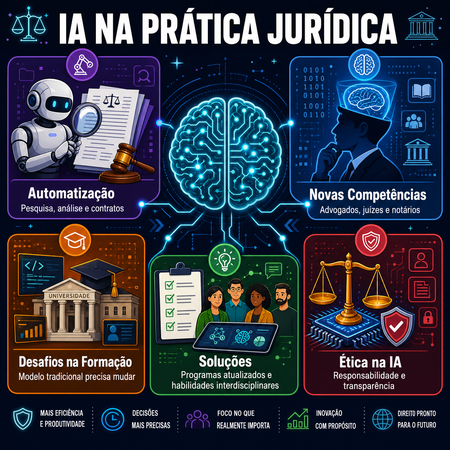
The rapid development of Artificial Intelligence (AI) is creating profound changes in many areas of socio-economic life, including the legal profession. AI not only automates many traditional legal activities, such as searching case law, analyzing legal texts, drafting contracts, and predicting dispute outcomes, but also changes the skill sets and professional roles of lawyers, judges, notaries, and other legal professionals. In this context, legal education needs appropriate adjustments to prepare learners to adapt to the new professional environment. This article analyzes the impact of AI on legal practice and identifies changing trends in the legal labor market. Based on this, the article assesses the challenges facing the traditional legal education model. It proposes several directions for innovation in legal education in Vietnam, including updating training programs, strengthening interdisciplinary skills, enhancing digital capabilities, and raising awareness of ethics and legal responsibility in the use of AI.
Downloads
References
Balan, A. (2024). AI and legal education: Ethical and sustainable approaches. Routledge.
Bucher, A. (2025). Navigating the power of artificial intelligence in the legal field. Houston Law Review, 62(4), 819–842.
Carrel, A. (2019). Legal intelligence through artificial intelligence requires emotional intelligence: A new competency model for the 21st-century legal professional. Georgia State University Law Review, 35(4), 1153–1183.
Clio. (2026). 2025 Clio legal trends report. https://www.clio.com/resources/legal-trends/read-online/
Flynn, S. (2019, September 26). Melbourne Law School offers a law tech design pop-up course. Artificial Lawyer. https://www.artificiallawyer.com/2019/09/26/melbourne-law-school-offers-law-tech-design-pop-up-course/
Ho, H. B. T. (2025). Law students and artificial intelligence in legal research. Russin & Vecchi. https://www.russinvecchi.com.vn/publication/sinh-vien-luat-va-tri-tue-nhan-tao-trong-nghien-cuu-phap-luat/
Le, T. M. (2026). Vietnam’s first standalone AI law: An overview of key provisions and future implications. International Association of Privacy Professionals. https://iapp.org/news/a/vietnam-s-first-standalone-ai-law-an-overview-of-key-provisions-future-implications
Eliadi, M. (2025). The T-shaped lawyer: A new model for corporate legal excellence. Axiom Law. https://www.axiomlaw.com/blog/t-shaped-lawyer-model-for-corporate-legal-excellence
Melbourne Law School. (2026). Technology, innovation, design, and the law at MLS. https://law.unimelb.edu.au/about/technology-innovation-and-the-law
Miller, K. W. (2026). The 15 best legal AI software tools for 2025. Ironclad. https://ironcladapp.com/resources/articles/best-legal-ai-software
Moppett, S. A. (2025). Preparing students for the artificial intelligence era: The crucial role of critical thinking skills. Mitchell Hamline Law Review, 52(1), Article 7.
Morris, I. (2025, March 24). 7 ways AI is changing law school & legal careers. The Colleges of Law. https://www.collegesoflaw.edu/blog/2025/03/24/7-ways-artificial-intelligence-is-already-changing-law-school-and-legal-careers/
Nguyen, D. T. T. (2025). Legal education in the digital era: Theoretical and practical issues. Hanoi Open University Journal of Science, (9A). https://doi.org/10.59256/houjs.2025.1029
Nguyen, L., & Dinh, H. (2023). Foreign Trade University: Combining training with practice for law students. Dai Bieu Nhan Dan Newspaper. https://daibieunhandan.vn/truong-dh-ngoai-thuong-ket-hop-dao-tao-voi-thuc-hanh-cho-sinh-vien-nganh-luat-10324276.html
Nguyen, T. T. H., & Do, T. D. L. (2025). Legal education in the context of digital technology development. Vietnam Lawyers Journal. https://lsvn.vn/dao-tao-cu-nhan-luat-trong-boi-canh-phat-trien-cong-nghe-so-a164255.html
OECD. (2021). Artificial intelligence in society. OECD Publishing.
Richter, M. (2025). How AI is transforming the legal profession. Thomson Reuters. https://legal.thomsonreuters.com/blog/how-ai-is-transforming-the-legal-profession/
Singapore Management University. (2026a). Centre for AI & Data Governance (2019–2025). https://ink.library.smu.edu.sg/caidg/
Singapore Management University. (2026b). Generative artificial intelligence (AI) guidance. https://www.smu.edu/oit/ai
Susskind, R. (2022). Tomorrow’s lawyers: An introduction to your future (3rd ed.). Oxford University Press.
Tran, V. (2025). The Ministry of Education and Training promulgates the undergraduate legal education curriculum. Vietnam Lawyers Electronic Journal. https://lsvn.vn/bo-gd-dt-ban-hanh-chuong-trinh-dao-tao-linh-vuc-phap-luat-trinh-do-dai-hoc-a155121.html
Tran, V. N., & Pham, T. N. (2021). Strengthen the training skills of law practice at the higher education level in Vietnam. International Journal of Legal Studies, 2(10), 233–242. https://doi.org/10.5281/zenodo.5866018
UNESCO. (2021). Recommendation on the ethics of artificial intelligence (SHS/BIO/PI/2021/1).
Vanderbilt Law School. (2026, March 5). How AI is impacting the legal profession. https://law.vanderbilt.edu/master-legal-studies/articles/how-is-ai-impacting-the-legal-profession/
Wachter, S. (2020). Responsibility in AI: Ethics and the future of education. Technology and Education Review, 9(2), 22–33.
Downloads
Published
How to Cite
Issue
Section
License
Copyright (c) 2026 Revista on line de Política e Gestão Educacional

This work is licensed under a Creative Commons Attribution-NonCommercial-ShareAlike 4.0 International License.
Manuscritos aceitos e publicados são de propriedade da Revista on line de Política e Gestão Educacional. É vedada a submissão integral ou parcial do manuscrito a qualquer outro periódico. A responsabilidade do conteúdo dos artigos é exclusiva dos autores. É vedada a tradução para outro idioma sem a autorização escrita do Editor ouvida a Comissão Editorial Científica.