
O impacto dos jogos cooperativos em realidade virtual no bem-estar social de estudantes universitários
um estudo transversal sobre entretenimento, interação e atividade física
DOI:
https://doi.org/10.22633/rpge.v30iesp1.20941Palavras-chave:
Realidade virtual, Componentes de interação, Jogos digitais, Contextos de entretenimentoResumo
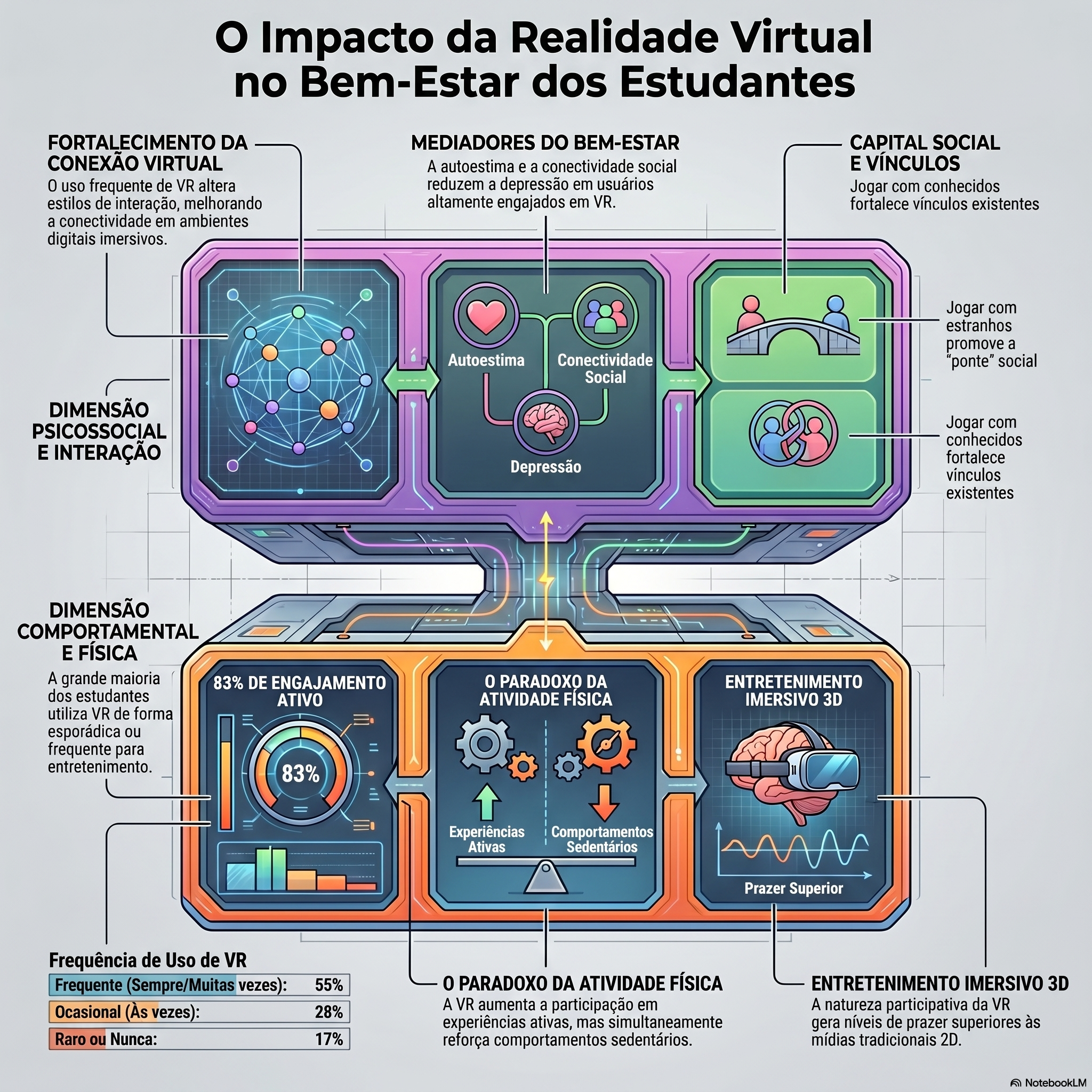
Este estudo investigou como os recursos de interação social em jogos de realidade virtual baseados em movimento contribuem para a orientação profissional em grupo, ao promover comunicação, cooperação, engajamento emocional e reflexão sobre carreira. Diante do aumento do sofrimento psicológico entre estudantes universitários, a pesquisa analisou as relações entre a participação em jogos e fatores como bem-estar, depressão, autoestima e conexão social no contexto dos jogos sociais em realidade virtual. Uma amostra aleatória estratificada de 658 estudantes participou de um levantamento transversal explicativo, utilizando um questionário validado para avaliar os efeitos da realidade virtual sobre entretenimento, interação social e atividade física. Os dados foram analisados por meio de estatísticas descritivas e análise fatorial. Os resultados evidenciam o impacto multifacetado da realidade virtual no bem-estar estudantil, além de apontar implicações teóricas e práticas, reconhecer limitações e sugerir direções para pesquisas futuras.
Downloads
Referências
Bayram, A. (2022). MetaEntertainment: Entertainment time habits to be changed with metaverse. Journal of Metaverse, 2(1), 1–7.
Beard, K. S. (2015). Theoretically speaking: An interview with Mihaly Csikszentmihalyi on flow theory development and its usefulness in addressing contemporary challenges in education. Educational Psychology Review, 27(2), 353–364. https://doi.org/10.1007/s10648-014-9291-1
Bian, Y., Zhou, C., Zhang, Y., Liu, J., Sheng, J., & Liu, Y. J. (2023). Focus on cooperation: A face-to-face VR serious game for relationship enhancement. IEEE Transactions on Affective Computing.
Billieux, J., Flayelle, M., Rumpf, H.-J., & Stein, D. J. (2019). High involvement versus pathological involvement in video games: A crucial distinction for ensuring the validity and utility of gaming disorder. Current Addiction Reports, 6(3), 323–330. https://doi.org/10.1007/s40429-019-00259-x
Borgogna, N. C., Duncan, J., & McDermott, R. C. (2018). Is scrupulosity behind the relationship between problematic pornography viewing and depression, anxiety, and stress? Sexual Addiction & Compulsivity, 25(4), 293–318. https://doi.org/10.1080/10720162.2019.1567410
Brand, J. E. (2012). National research prepared by Bond University for the Interactive Games and Entertainment Association. Bond University.
Brimelow, R. E., Dawe, B., & Dissanayaka, N. (2020). Preliminary research: Virtual reality in residential aged care to reduce apathy and improve mood. Cyberpsychology, Behavior, and Social Networking, 23(3), 165–170. https://doi.org/10.1089/cyber.2019.0286
Campo-Prieto, P., Cancela-Carral, J. M., Alsina-Rey, B., & Rodríguez-Fuentes, G. (2022). Immersive VR as a novel physical therapy approach for nonagenarians: Usability and effects on balance outcomes of a game-based exercise program. Journal of Clinical Medicine, 11(13), Article 3911. https://doi.org/10.3390/jcm11133911
Canale, N., Marino, C., Griffiths, M. D., Scacchi, L., Monaci, M. G., & Vieno, A. (2019). The association between problematic online gaming and perceived stress: The moderating effect of psychological resilience. Journal of Behavioral Addictions, 8(1), 174–180. https://doi.org/10.1556/2006.8.2019.01
De Bérail, P., Guillon, M., & Bungener, C. (2019). The relations between YouTube addiction, social anxiety and parasocial relationships with YouTubers: A moderated-mediation model based on a cognitive behavioral framework. Computers in Human Behavior, 99, 190–204. https://doi.org/10.1016/j.chb.2019.05.007
Domahidi, E., Breuer, J., Kowert, R., Festl, R., & Quandt, T. (2018). A longitudinal analysis of gaming- and non-gaming-related friendships and social support among social online game players. Media Psychology, 21(2), 288–307. https://doi.org/10.1080/15213269.2016.1257393
Gao, Z., & Lee, J. E. (2019). Emerging technology in promoting physical activity and health: Challenges and opportunities. Journal of Clinical Medicine, 8(11), Article 1830. https://doi.org/10.3390/jcm8111830
García-Cabrera, E., Luna-Perejón, F., Pertegal-Vega, M. Á., Muñoz-Saavedra, L., Sevillano-Ramos, J. L., & Miró-Amarante, L. (2025). Video game player profiles among university students: Impact of game preferences and academic background. Computers and Education Open, Article 100280.
Graf, L., Dossena, G. L., & Masuch, M. (2025). I feel you: The impact of emotional virtual characters on emotional state, player experience, and connectedness in VR games. In Proceedings of the 31st ACM Symposium on Virtual Reality Software and Technology (pp. 1–11).
Griffiths, M. D., Lewis, A. M., de Gortari, A. B. O., & Kuss, D. J. (2017). The use of online forum data in the study of gaming behavior. SAGE. https://doi.org/10.4135/9781473994812
Hartmann, T., Jung, Y., & Vorderer, P. (2012). What determines video game use? The impact of users’ habits, addictive tendencies, and intentions to play. Journal of Media Psychology, 24(1), 19–30. https://doi.org/10.1027/1864-1105/a000059
Hartstein, A. J., Verkuyl, M., Zimney, K., Yockey, J., & Berg-Poppe, P. (2022). Virtual reality instructional design in orthopedic physical therapy education: A mixed-methods usability test. Simulation & Gaming, 53(2), 111–134. https://doi.org/10.1177/10468781211073646
Hutson, J. (2022). Social virtual reality: Neurodivergence and inclusivity in the metaverse. Societies, 12(4), Article 102. https://doi.org/10.3390/soc12040102
Imam, B., & Jarus, T. (2014). Virtual reality rehabilitation from social cognitive and motor learning theoretical perspectives in stroke population. Rehabilitation Research and Practice, 2014, 1–11. https://doi.org/10.1155/2014/594
Kardefelt-Winther, D. (2015). A critical account of DSM-5 criteria for internet gaming disorder. Addiction Research & Theory, 23(2), 93–98. https://doi.org/10.3109/16066359.2014.935350
Kim, S., Park, S., Uhm, J. P., & Ahn, S. (2025). Exploring the social dimensions of virtual/augmented reality sport gaming: Interplay among game involvement, interpersonal relationships, social capital, and psychological well-being. International Journal of Human–Computer Interaction, 1–11.
King, D. L., Billieux, J., Carragher, N., & Delfabbro, P. H. (2020). Face validity evaluation of screening tools for gaming disorder: Scope, language, and overpathologizing issues. Journal of Behavioral Addictions, 9(1), 1–13. https://doi.org/10.1556/2006.2020.00001
Kneer, J., Munko, D., Glock, S., & Bente, G. (2012). Defending the doomed: Implicit strategies concerning protection of first-person shooter games. Cyberpsychology, Behavior, and Social Networking, 15(5), 251–256. https://doi.org/10.1089/cyber.2011.0583
Kökönyei, G., Kocsel, N., Király, O., Griffiths, M. D., Galambos, A., Magi, A., Paksi, B., & Demetrovics, Z. (2019). The role of cognitive emotion regulation strategies in problem gaming among adolescents: A nationally representative survey study. Frontiers in Psychiatry, 10, Article 273. https://doi.org/10.3389/fpsyt.2019.00273
Korkeila, H., & Hamari, J. (2020). Avatar capital: The relationships between player orientation and their avatar’s social, symbolic, economic and cultural capital. Computers in Human Behavior, 102, 14–21.
Lee, H. W., Kim, S., & Uhm, J. P. (2021). Social virtual reality (VR) involvement affects depression when social connectedness and self-esteem are low: A moderated mediation on well-being. Frontiers in Psychology, 12, Article 753019.
Lemmens, J. S., Valkenburg, P. M., & Gentile, D. A. (2015). The internet gaming disorder scale. Psychological Assessment, 27(2), 567–582. https://doi.org/10.1037/pas0000062
Lopez-Fernandez, O., Williams, A. J., Griffiths, M. D., & Kuss, D. J. (2019). Female gaming, gaming addiction, and the role of women within gaming culture: A narrative literature review. Frontiers in Psychiatry, 10, Article 454.
Malighetti, C., Bernardelli, L., Pancini, E., Riva, G., & Villani, D. (2023). Promoting emotional and psychological well-being during COVID-19 pandemic: A self-help virtual reality intervention for university students. Cyberpsychology, Behavior, and Social Networking, 26(4), 309–317.
Marder, B., Gattig, D., Collins, E., Pitt, L., Kietzmann, J., & Erz, A. (2019). The avatar’s new clothes: Understanding why players purchase non-functional items in free-to-play games. Computers in Human Behavior, 91, 72–83.
Omair, A. (2015). Selecting the appropriate study design for your research: Descriptive study designs. Journal of Health Specialties, 3(3), 153. https://doi.org/10.4103/1658-600x.159892
Przybylski, A. K., Weinstein, N., Ryan, R. M., & Rigby, C. S. (2009). Having to versus wanting to play: Background and consequences of harmonious versus obsessive engagement in video games. Cyberpsychology & Behavior, 12(5), 485–492. https://doi.org/10.1089/cpb.2009.0083
Quandt, T. (2013). Problematic computer game use among adolescents, younger and older adults. Addiction, 108(3), 592–599. https://doi.org/10.1111/add.12016
Reer, F., & Kramer, N. C. (2019). Are online role-playing games more social than multiplayer first-person shooters? Investigating how online gamers’ motivations and playing habits are related to social capital acquisition and social support. Entertainment Computing, 29, 1–9.
Riner, A., Hur, J. W., & Kohlmeier, J. (2022). Virtual reality integration in social studies classroom: Impact on student knowledge, classroom engagement, and historical empathy development. Journal of Educational Technology Systems, 51(2), 146–168. https://doi.org/10.1177/00472395221132582
Rothmund, T., Klimmt, C., & Gollwitzer, M. (2016). Low temporal stability of excessive video game use in German adolescents. Journal of Media Psychology, 1–13. https://doi.org/10.1027/1864-1105/a000177
Ruggiero, T. E. (2017). Uses and gratifications theory in the 21st century. In Refining milestone mass communications theories for the 21st century (pp. 36–70). Routledge.
Ryan, R. M., Rigby, C. S., & Przybylski, A. (2006). The motivational pull of video games: A self-determination theory approach. Motivation and Emotion, 30(4), 344–360. https://doi.org/10.1007/s11031-006-9051-8
Sarda, E., Bègue, L., Bry, C., & Gentile, D. (2016). Internet gaming disorder and well-being: A scale validation. Cyberpsychology, Behavior, and Social Networking, 19, 674–679.
Sergeeva, O. V., & Zheltukhina, M. R. (2025). Psychological well-being as a predictor of cyberbullying victimization in university students: A Bayesian approach. Frontiers in Education, 10, Article 1563122.
Shen, C., & Williams, D. (2011). Unpacking time online: Connecting internet and massively multiplayer online game use with psychosocial well-being. Communication Research, 38, 123–149.
Uchida, Y., & Kitayama, S. (2009). Happiness and unhappiness in east and west: Themes and variations. Emotion, 9, 441–456.
Uchida, Y., & Ogihara, Y. (2012). Cultural construal of happiness: Cultural psychological perspectives and future direction of happiness research. Japanese Psychological Review, 55, 26–42.
Uchida, Y., Ogihara, Y., & Fukushima, S. (2015). Cultural construal of wellbeing: Theories and empirical evidence. In W. Glatzer, L. Camfield, V. Møller, & M. Rojas (Eds.), Global handbook of quality of life (pp. 823–837). Springer. https://doi.org/10.1007/978-94-017-9178-6
Yalon-Chamovitz, S., & Weiss, P. L. T. (2008). Virtual reality as an entertainment activity for young adults with physical and intellectual disabilities. Research in Developmental Disabilities, 29(3), 273–287. https://doi.org/10.1016/j.ridd.2007.05.004
Yeh, T. M., Pai, F. Y., & Jeng, M. Y. (2019). The factors affecting older adults’ intention toward ongoing participation in virtual reality entertainment activities. International Journal of Environmental Research and Public Health, 16(3), Article 333. https://doi.org/10.3390/ijerph16030333
Zhang, B., Benton, S., Pearson, W., LeMoine, J., Herbertson, N., Williams, H., & Goodman, L. (2016). Playing 3D: Digital technologies and novel 3D virtual environments to support the needs of Chinese learners in Western education. IEEE.
Zhang, Q., Yu, L., & Yu, Z. (2021). A content analysis and meta-analysis on the effects of Classcraft on gamification learning experiences in terms of learning achievement and motivation. Education Research International, 2021(1), Article 9429112.
Publicado
Como Citar
Edição
Seção
Licença
Copyright (c) 2026 Revista on line de Política e Gestão Educacional

Este trabalho está licenciado sob uma licença Creative Commons Attribution-NonCommercial-ShareAlike 4.0 International License.
Manuscritos aceitos e publicados são de propriedade da Revista on line de Política e Gestão Educacional. É vedada a submissão integral ou parcial do manuscrito a qualquer outro periódico. A responsabilidade do conteúdo dos artigos é exclusiva dos autores. É vedada a tradução para outro idioma sem a autorização escrita do Editor ouvida a Comissão Editorial Científica.