Formation of information competence of pedagogical education specialists in the process of studying professional training disciplines
DOI:
https://doi.org/10.22633/rpge.v30iesp2.21357Keywords:
Information competence, Teacher digital competence, Self-efficacy, Professional development, Basic educationAbstract
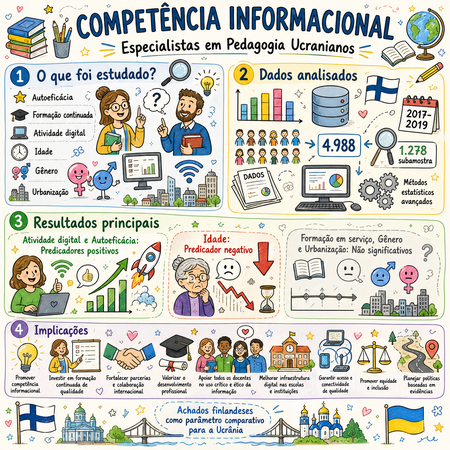
This study investigates factors associated with information competence using Finnish evidence as an analytical reference for Ukrainian pedagogical specialists, focusing on self-efficacy, in-service training adequacy, digital activity, age, gender, and urbanization level. The empirical analysis is based on the Finnish Basic Education Teacher ICT Skills and Usage Dataset (N = 4,988) collected between 2017 and 2019, a subsample of 1,278 teachers with complete data was analysed using descriptive statistics, correlation analysis, multiple linear regression, and ANOVA with post-hoc comparisons in Stata. The results show that digital activity and self-efficacy are significant positive predictors of information competence, while age is a significant negative predictor. In-service training adequacy, gender, and urbanization level were not significant in the regression model. Rather than claiming direct measurement of Ukrainian teachers, the article interprets Finnish findings as a benchmark for Ukraine and formulates implications for practice-oriented teacher education, differentiated professional development, and equitable digital infrastructure.
Downloads
References
Afzal, A., Khan, S., Daud, S., Ahmad, Z., & Butt, A. (2023). Addressing the digital divide: Access and use of technology in education. Journal of Social Sciences Review, 3(2), 883–895. https://doi.org/10.54183/jssr.v3i2.326
Alieksieienko, T., Kryshtanovych, S., Noskova, M., Burdun, V., & Semenenko, A. (2022). The use of modern digital technologies for the development of the educational environment in the system for ensuring the sustainable development of the region. International Journal of Sustainable Development and Planning, 17(8), 2427–2434. https://doi.org/10.18280/ijsdp.170810
Almulla, M. A. (2022). Using digital technologies for testing online teaching skills and competencies during the COVID-19 pandemic. Sustainability, 14(9), Article 5455. https://doi.org/10.3390/su14095455
Astuti, M., Arifin, Z., Mutohhari, F., & Nurtanto, M. (2021). Competency of digital technology: The maturity levels of teachers and students in vocational education in Indonesia. Journal of Education Technology, 5(2), 254–262.
Demissie, E. B., Labiso, T. O., & Thuo, M. W. (2022). Teachers' digital competencies and technology integration in education: Insights from secondary schools in Wolaita Zone, Ethiopia. Social Sciences & Humanities Open, 6(1), Article 100355. https://doi.org/10.1016/j.ssaho.2022.100355
Dolighan, T., & Owen, M. (2021). Teacher efficacy for online teaching during the COVID-19 pandemic. Brock Education Journal, 30(1), Article 95. https://doi.org/10.26522/brocked.v30i1.851
Fernández-Batanero, J. M., Montenegro-Rueda, M., Fernández-Cerero, J., & García-Martínez, I. (2020). Digital competences for teacher professional development: Systematic review. European Journal of Teacher Education, 45(4), 513–531. https://doi.org/10.1080/02619768.2020.1827389
Fraillon, J., Ainley, J., Schulz, W., Friedman, T., & Duckworth, D. (2020). Preparing for life in a digital world: IEA International Computer and Information Literacy Study 2018 international report. Springer. https://doi.org/10.1007/978-3-030-38781-5
González-Salamanca, J. C., Agudelo, O. L., & Salinas, J. (2020). Key competences, education for sustainable development, and strategies for the development of 21st-century skills: A systematic literature review. Sustainability, 12(24), Article 10366. https://doi.org/10.3390/su122410366
Kaarakainen, M.-T., & Saikkonen, L. (2020). Information skills of Finnish pedagogical teachers [Data set]. Zenodo. https://doi.org/10.5281/zenodo.3907855
Kalalahti, M., & Varjo, J. (2021). Revisiting universalism in the Finnish education system. Research on Finnish Society, 13, 25–40. https://doi.org/10.51815/fjsr.110792
Khan, F., & Vuopala, E. (2019). Digital competence assessment across generations. International Journal of Digital Literacy and Digital Competence, 10(2), 15–28. https://doi.org/10.4018/IJDLDC.2019040102
Kulyk, N., Masliuk, R., Kyselov, V., Voropai, S., & Koycheva, T. (2023). Formation of ICT competence in future specialists of physical education and sports in the conditions of distance learning. Amazonia Investiga, 12(70), 241–254. https://doi.org/10.34069/AI/2023.70.10.22
Li, M. (2024). Exploring the digital divide in primary education: A comparative study of urban and rural mathematics teachers' TPACK and attitudes towards technology integration in post-pandemic China. Education and Information Technologies, 30(2), 1913–1945. https://doi.org/10.1007/s10639-024-12890-x
Martín, S. C., González, M. C., & García-Peñalvo, F. J. (2019). Digital competence of early childhood education teachers: Attitude, knowledge, and use of ICT. European Journal of Teacher Education, 43(2), 210–223. https://doi.org/10.1080/02619768.2019.1681393
Pittman, J., Severino, L., DeCarlo-Tecce, M. J., & Kiosoglous, C. (2021). An action research case study: Digital equity and educational inclusion during an emergent COVID-19 divide. Journal for Multicultural Education, 15(1), 68–84. https://doi.org/10.1108/JME-09-2020-0099
Punie, Y. (Ed.). (2017). European framework for the digital competence of educators: DigCompEdu. Publications Office of the European Union. https://doi.org/10.2760/159770
Reis-Andersson, J. (2022). School organisers' expression on the expansion of the access and application of digital technologies in educational systems. International Journal of Information and Learning Technology, 40(1), 73–83. https://doi.org/10.1108/IJILT-03-2022-0070
Scherer, R., Siddiq, F., & Tondeur, J. (2019). The technology acceptance model (TAM): A meta-analytic structural equation modeling approach to explaining teachers' adoption of digital technology in education. Computers & Education, 128, 13–35. https://doi.org/10.1016/j.compedu.2018.09.009
Skakun, I. (2021). Digital competencies of the teacher of the future. Futurity Education, 1(2), 46–56. https://doi.org/10.57125/FED/2022.10.11.18
Stadler-Altmann, U. (2024). Using the European framework for the digital competence of educators to develop didactic tools on AI for early childhood settings. In U. Ward (Ed.), Supporting early childhood practice through difficult times: Looking towards a better future (pp. 42–55). Routledge.
Trixa, J., & Kaspar, K. (2024). Information literacy in the digital age: Information sources, evaluation strategies, and perceived teaching competences of pre-service teachers. Frontiers in Psychology, 15, Article 1336436. https://doi.org/10.3389/fpsyg.2024.1336436
UNESCO. (2023, October 11). Ukraine: UNESCO trains 50,000 teachers on digital pedagogy. https://www.unesco.org/en/articles/ukraine-unesco-trains-50000-teachers-digital-pedagogy
Williamson, B., Eynon, R., & Potter, J. (2020). Pandemic politics, pedagogies, and practices: Digital technologies and distance education during the coronavirus emergency. Learning, Media and Technology, 45(2), 107–114. https://doi.org/10.1080/17439884.2020.1761641
Downloads
Published
How to Cite
Issue
Section
License
Copyright (c) 2026 Revista on line de Política e Gestão Educacional

This work is licensed under a Creative Commons Attribution-NonCommercial-ShareAlike 4.0 International License.
Manuscritos aceitos e publicados são de propriedade da Revista on line de Política e Gestão Educacional. É vedada a submissão integral ou parcial do manuscrito a qualquer outro periódico. A responsabilidade do conteúdo dos artigos é exclusiva dos autores. É vedada a tradução para outro idioma sem a autorização escrita do Editor ouvida a Comissão Editorial Científica.