Evaluation of Social Studies teachers in terms of their ability to make daily lesson plans
DOI:
https://doi.org/10.22633/rpge.v30iesp2.21383Keywords:
Social Studies, Teacher skills, Daily lesson plan, SufficiencyAbstract
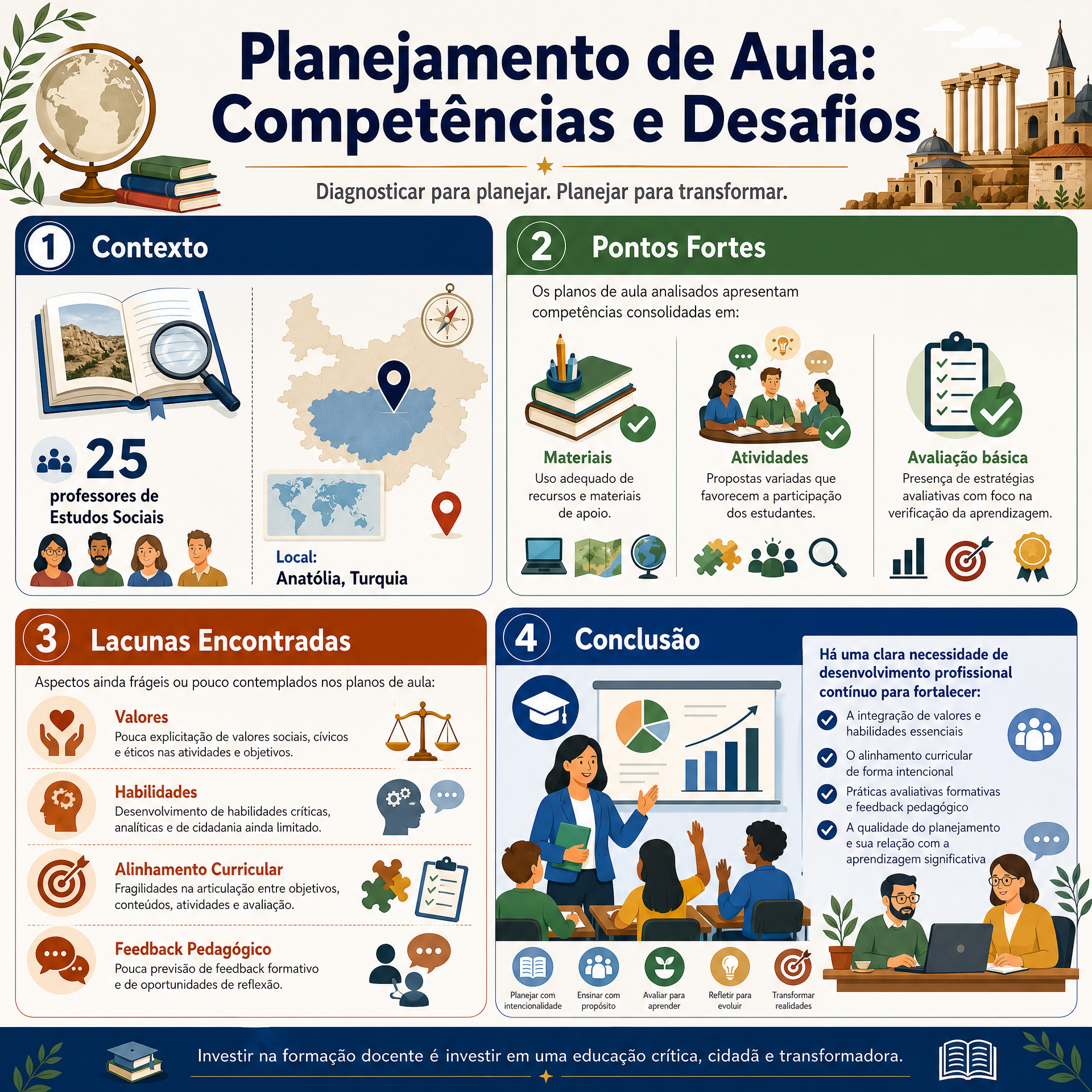
This study evaluates the competence of Social Studies teachers in preparing daily lesson plans. Grounded in discussions on instructional planning as a core dimension of teaching practice, the research used qualitative document analysis. Daily lesson plans prepared by 25 Social Studies teachers working in a metropolitan province in Eastern Anatolia, Turkey, were examined through content and descriptive analysis with the support of the Social Studies Daily Lesson Plan Evaluation Form. The findings indicate that teachers generally included basic components such as course title, learning outcomes, instructional activities, materials, and assessment. However, values and skills, curriculum alignment, methodological diversity, visual materials, feedback, and end-of-lesson evaluation were insufficiently addressed. The study concludes that, although teachers are familiar with the general structure of lesson plans, further professional development is needed to strengthen coherence, pedagogical detail, and the functional use of planning in classroom practice.
Downloads
References
Aghazadeh, M. (2014). A guide to new teaching methods (Based on brain-based research, constructivism of learning through cooperation, metacognition, etc.). Aeizh Publications.
Alanazi, M. H. (2019). A study of the pre-service trainee teachers problems in designing lesson plans. Arab World English Journal, 10(1), 166–182. https://doi.org/10.24093/awej/vol10no1.15
Arastaman, G., Öztürk Fidan, İ., & Fidan, T. (2018). Nitel araştırmada geçerlik ve güvenirlik: Kuramsal bir inceleme [Validity and reliability in qualitative research: A theoretical review]. Van Yüzüncü Yıl Üniversitesi Eğitim Fakültesi Dergisi, 15(1), 37–75.
Aşçı, H., & Erturan İlker, G. (2018). Algılanan öğretmen geribildirimi ve güdüsel iklimin beden eğitimi ve spor derslerinde zevk alma ve güdülenme üzerine yordayıcı etkisi. Ondokuz Mayıs Üniversitesi Eğitim Fakültesi Dergisi, 37(2), 123–138.
Aykaç, N. (2014). Öğretim ilke ve yöntemleri. Pegem Akademi Yayıncılık.
Azungah, T. (2018). Qualitative research: Deductive and inductive approaches to data analysis. Qualitative Research Journal, 18(4), 383–400. https://doi.org/10.1108/QRJ-D-18-00035
Bieda, K. N., Lane, J., Evert, K., Hu, S., Opperman, A., & Ellefson, N. (2020). A large-scale study of how districts’ curriculum policies and practices shape teachers’ mathematics lesson planning. Journal of Curriculum Studies, 52(6), 770–799. https://doi.org/10.1080/00220272.2020.1754921
Bowen, G. A. (2009). Document analysis as a qualitative research method. Qualitative Research Journal, 9(2), 27–40. https://doi.org/10.3316/QRJ0902027
Bremholm, J., & Skott, C. K. (2019). Teacher planning in a learning outcome perspective: A multiple case study of mathematics and L1 Danish teachers. Acta Didactica Norge, 13(1), 1–22. https://doi.org/10.5617/adno.5540
Cevikbas, M., König, J., & Rothland, M. (2024). Empirical research on teacher competence in mathematics lesson planning: Recent developments. ZDM – Mathematics Education, 56(1), 101–113. https://doi.org/10.1007/s11858-023-01487-2
Creswell, J. W. (2013). Research design: Qualitative, quantitative, and mixed methods approaches (4th ed.). Sage.
Darling-Hammond, L. (2006). Constructing 21st-century teacher education. Journal of Teacher Education, 57(3), 300–314. https://doi.org/10.1177/0022487105285962
Farhang, Q., Hashemi, S. S. A., & Ghorianfar, S. M. (2023). Lesson plan and its importance in teaching process. International Journal of Current Science Research and Review, 6(8), 5901–5913. https://doi.org/10.47191/ijcsrr/V6-i8-57
Feu, S., García-Rubio, J., Gamero, M. D. G., & Ibáñez, S. J. (2019). Task planning for sports learning by physical education teachers in the pre-service phase. PLoS ONE, 14(3), Article e0212833. https://doi.org/10.1371/journal.pone.0212833
Forster, N. (1994). The analysis of company documentation. In C. Cassell & G. Symon (Eds.), Qualitative methods in organizational research: A practical guide (pp. 147–166). Sage.
Geçici, F. (2023). Türkçe öğretmeni adaylarının yazma becerisine yönelik hazırladıkları ders planlarının ders işleme süreci açısından incelenmesi. Ana Dili Eğitimi Dergisi, 11(1), 47–63.
Gezer, B., & Oruç, Ş. (2020). Sosyal bilgiler öğretmenleri tarafından 5E modeline göre hazırlanan ders planlarının incelenmesi. Türkiye Eğitim Dergisi, 7(2), 528–561.
Güneş, B., Mirzeoğlu, A. D., Karadağ, O., Atlı, K., & Yalçınkaya, N. (2022). Beden eğitimi ve spor öğretmenlerinin günlük ders planı yapma yeterliliklerinin incelenmesi. Journal of Qualitative Research in Education, 32, 188–212. https://doi.org/10.14689/enad.32.1550
Guo, C., Chen, X., & Chen, J. (2025). Enhancing prospective teachers’ professional development through shared collaborative lesson planning. Behavioral Sciences, 15(6), Article 753. https://doi.org/10.3390/bs15060753
Haslip, M. J., & Terry, N. (2023). A mixed methods study of the relationship between individualized lesson planning and social-emotional outcomes in young children. Early Childhood Education Journal, 51(5), 875–888. https://doi.org/10.1007/s10643-022-01347-w
Holm, L., & Horn, C. (2003). Bridging the gap between schools of education and the needs of 21st century teachers. The Phi Delta Kappan, 84(5), 376–380. https://doi.org/10.1177/003172170308400511
Iqbal, M. H., Siddiqie, S. A., & Mazid, M. A. (2021). Rethinking theories of lesson plan for effective teaching and learning. Social Sciences & Humanities Open, 4(1), Article 100172. https://doi.org/10.1016/j.ssaho.2021.100172
Janssen, N., & Lazonder, A. W. (2016). Supporting pre-service teachers in designing technology-infused lesson plans. Journal of Computer Assisted Learning, 32(5), 456–467. https://doi.org/10.1111/jcal.12146
Klafki, W. (1995). Didactic analysis as the core of preparation of instruction (Didaktische Analyse als Kern der Unterrichtsvorbereitung). Journal of Curriculum Studies, 27(1), 13–30. https://doi.org/10.1080/0022027950270103
König, J., Heine, S., Jäger-Biela, D., & Rothland, M. (2024). ICT integration in teachers’ lesson plans: A scoping review of empirical studies. European Journal of Teacher Education, 47(4), 821–849. https://doi.org/10.1080/02619768.2022.2138323
Krepf, M., & König, J. (2023). Structuring the lesson: An empirical investigation of pre-service teacher decision-making during the planning of a demonstration lesson. Journal of Education for Teaching, 49(5), 911–926. https://doi.org/10.1080/02607476.2022.2151877
Kuran, K. (2011). Sınıfta öğrenme-öğretme sürecinin yönetimi. In M. Şişman (Ed.), Sınıf yönetimi (pp. 165–183). Pegem Yayıncılık.
Melville, M. D., & Corey, D. L. (2021). Kyouzaikenkyuu: An exploration of Japanese mathematics teachers’ daily planning practices. Journal of Mathematics Teacher Education, 25, 371–383. https://doi.org/10.1007/s10857-021-09493-5
Merriam, S. B. (2009). Qualitative research: A guide to design and implementation. Jossey-Bass.
Merriam, S. B. (2023). Nitel araştırma, desen ve uygulama için bir rehber (S. Turan, Ed.). Nobel Yayınevi.
Miles, M. B., & Huberman, A. M. (1994). Qualitative data analysis: An expanded sourcebook (2nd ed.). Sage.
Morris, A. K., & Hiebert, J. (2011). Creating shared instructional products: An alternative approach to improving teaching. Educational Researcher, 40(1), 5–14. https://doi.org/10.3102/0013189X10393501
Nesusin, N., Intrarakhamhaeng, P., Supadol, P., Piengkes, N., & Poonpipathana, S. (2014). Development of lesson plans by the lesson study approach for the 6th grade students in social study subject based on open approach innovation. Procedia – Social and Behavioral Sciences, 116, 1411–1415. https://doi.org/10.1016/j.sbspro.2014.01.407
O’Leary, Z. (2017). The essential guide to doing your research project. Sage.
Oğuz, A. (1994). Fen öğretiminde ipuçları ve dönüt-düzeltme işlemlerinin erişi düzeyine etkisi. Eğitim ve Bilim, 18(94), 49–56.
Oğuz, A. (2009). Öğretmen adaylarının öğretmen özyeterlik inançlarının incelenmesi. Dumlupınar Üniversitesi Sosyal Bilimler Dergisi, 24, 281–290.
Özcan, G., & Mirzeoğlu, A. D. (2014). Beden eğitimi öğretim programına ilişkin öğrenci, veli ve beden eğitimi öğretmenlerinin görüşleri. Amasya Üniversitesi Eğitim Fakültesi Dergisi, 3(1), 98–121. https://doi.org/10.17539/aej.41060
Özyildirim-Gümüş, F. (2022). Preservice elementary mathematics teachers’ use of patterns and pattern problems when planning and implementing lessons. International Journal of Mathematical Education in Science and Technology, 53(8), 2152–2175. https://doi.org/10.1080/0020739X.2021.1952325
Pang, M. (2016). Companion guides for lesson planning: A planning template and the lesson plan pro forma. English Language Teaching Journal, 70(4), 444–454. https://doi.org/10.1093/elt/ccw053
Penso, S., & Shoham, E. (2003). Student teachers’ reasoning while making pedagogical decisions. European Journal of Teacher Education, 26(3), 313–328. https://doi.org/10.1080/0261976032000128166
Pepin, B., Kohanová, I., & Lada, M. (2025). Developing pre-service teachers’ capacity for lesson planning with the support of curriculum resources. ZDM – Mathematics Education, 57(5), 1003–1017. https://doi.org/10.1007/s11858-025-01685-0
Pham, H. T. T., Le, N. M. T., Doan, H. T. T., & Luong, H. T. (2023). Examining philology teachers’ lesson planning competencies in Vietnam. International Journal of Learning, Teaching and Educational Research, 22(6), 121–136. https://doi.org/10.26803/ijlter.22.6.7
Placek, J. (1984). A multi-case study of teacher planning in physical education. Journal of Teaching in Physical Education, 4(1), 39–49. https://doi.org/10.1123/jtpe.4.1.39
Sağın, A. E., & Karabulut, Ö. (2020). Beden eğitimi ve spor öğretmenlerinin aldıkları hizmet öncesi eğitime ilişkin algılarının belirlenmesi. Gaziantep Üniversitesi Spor Bilimleri Dergisi, 5(2), 121–133. https://doi.org/10.31680/gaunjss.728004
Saldana, J. (2011). Fundamentals of qualitative research. Oxford University Press.
Senemoğlu, N. (2013). Gelişim, öğrenme ve öğretim: Kuramdan uygulamaya (23. baskı). Yargı Yayınevi.
Shaabani, H. (2011). Education skills: Teaching methods and techniques (25th ed.). Samt Publications.
Shenton, A. K. (2004). Strategies for ensuring trustworthiness in qualitative research projects. Education for Information, 22(2), 63–75. https://doi.org/10.3233/EFI-2004-22201
Stănescu, M. (2013). Planning physical education: From theory to practice. Procedia – Social and Behavioral Sciences, 76, 790–794. https://doi.org/10.1016/j.sbspro.2013.04.207
Stender, A., Brückmann, M., & Neumann, K. (2017). Transformation of topic-specific professional knowledge into personal pedagogical content knowledge through lesson planning. International Journal of Science Education, 39(12), 1690–1714. https://doi.org/10.1080/09500693.2017.1351645
Şirinkan, A., & Gündoğdu, K. (2011). Öğretmenlerin ilköğretim beden eğitimi ve spor dersi öğretim programı ve planlarına ilişkin algıları. İlköğretim Online, 10(1), 144–159.
Tanrıseven, I. (2015). Öğretimde planlama. In T. Yanpar-Yelken & C. Akay (Eds.), Öğretim ilke ve yöntemleri (pp. 43–76). Anı Yayıncılık.
Tataroglu-Taşdan, B., Tekin Dede, A., & Yiğit Koyunkaya, M. (2022). Examining pre-service mathematics teachers’ argumentation supported lesson plans and their noticing during planning. International Journal of Mathematical Education in Science and Technology, 55(6), 1309–1329. https://doi.org/10.1080/0020739X.2022.2054741
Uğraş, S. (2018). Beden eğitimi öğretmenleri kendilerini hangi konularda yetersiz hissediyor? Çanakkale Onsekiz Mart Üniversitesi Spor Bilimleri Dergisi, 1(1), 1–16.
Uğraş, S., Güllü, M., Eroğlu, E., & Özen, G. (2017). Ortaokulda çalışan beden eğitimi öğretmenlerinin okullarda tutulan evrak ve dosyalar hakkındaki düşünceleri. Marmara Üniversitesi Spor Bilimleri Dergisi, 2(2), 8–20.
Vakkasoğlu, N., & Tekerek, B. (2023). Bağlam temelli öğrenmeye dayalı ders planı hazırlama sürecindeki bağlam düzeylerinin incelenmesi. Ahmet Keleşoğlu Eğitim Fakültesi Dergisi, 5(1), 287–312. https://doi.org/10.38151/akef.2023.55
van den Berg, G., & Du Plessis, E. (2023). ChatGPT and generative AI: Possibilities for its contribution to lesson planning, critical thinking and openness in teacher education. Education Sciences, 13(10), Article 998. https://doi.org/10.3390/educsci13100998
Yli-Piipari, S., Watt, A., Jaakkola, T., Luikkonen, J., & Nurmi, J. E. (2009). Relationships between physical education students’ motivational profiles, enjoyment, state anxiety and self-reported physical activity. Journal of Sports Science and Medicine, 8(3), 327–336.
Yıldırım, A., & Öztürk, E. (2002). Sınıf öğretmenlerinin günlük planlarla ilgili algıları: Öncelikler, sorunlar ve öneriler. İlköğretim Online, 1(1), 17–27.
Yıldırım, A., & Şimşek, H. (2013). Sosyal bilimlerde nitel araştırma yöntemleri (9. baskı). Seçkin Yayıncılık.
Yıldırım, A., & Şimşek, H. (2016). Sosyal bilimlerde nitel araştırma yöntemleri (10. baskı). Seçkin Yayıncılık.
Yıldırım, B. (2015). Eğitsel oyun ve dönüt-düzeltmenin öğrenme düzeyi ve kalıcılığa etkisi [Yüksek lisans tezi, Necmettin Erbakan Üniversitesi].
Yıldırım, E., & Yıldırım, Ö. (2020). İlkokul ve ortaokul öğretmenlerinin ders planlama yeterliklerinin incelenmesi. Milli Eğitim Dergisi, 49(228), 7–37. https://doi.org/10.37669/milliegitim.824820
Zaragoza, A., Seidel, T., & Santagata, R. (2023). Lesson analysis and plan template: Scaffolding preservice teachers’ application of professional knowledge to lesson planning. Journal of Curriculum Studies, 55(2), 138–152. https://doi.org/10.1080/00220272.2023.2182650
Downloads
Published
How to Cite
Issue
Section
License
Copyright (c) 2026 Revista on line de Política e Gestão Educacional

This work is licensed under a Creative Commons Attribution-NonCommercial-ShareAlike 4.0 International License.
Manuscritos aceitos e publicados são de propriedade da Revista on line de Política e Gestão Educacional. É vedada a submissão integral ou parcial do manuscrito a qualquer outro periódico. A responsabilidade do conteúdo dos artigos é exclusiva dos autores. É vedada a tradução para outro idioma sem a autorização escrita do Editor ouvida a Comissão Editorial Científica.