O efeito do aconselhamento religioso na inteligência espiritual e na motivação para o desempenho acadêmico entre alunos do ensino médio na Jordânia
DOI:
https://doi.org/10.22633/rpge.v30iesp2.21379Palavras-chave:
Inteligência espiritual, Motivação para o desempenho acadêmico, Orientação psicológica religiosa, Design quasi-experimental, Ensino médio na JordâniaResumo
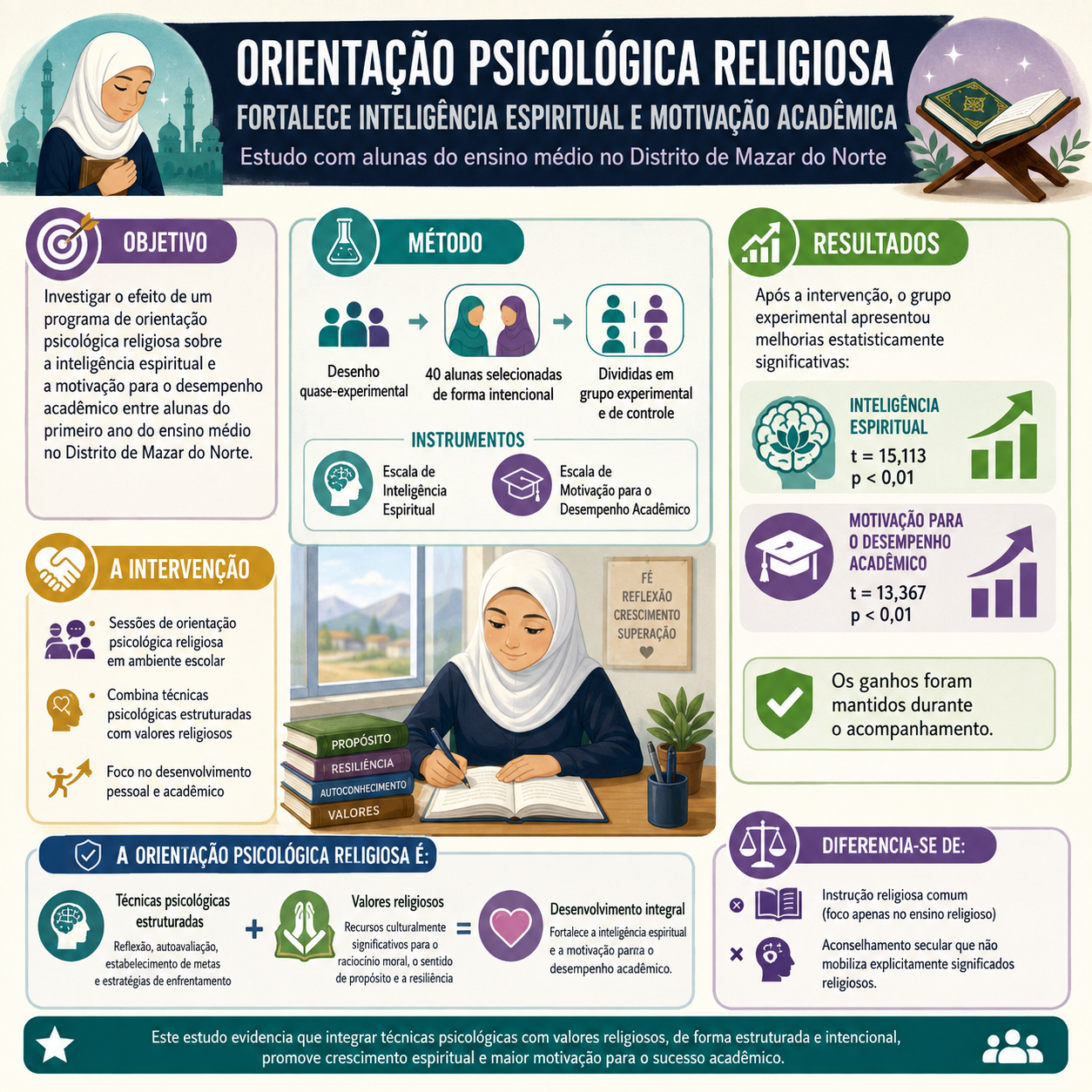
Este estudo investigou o efeito de um programa de orientação psicológica religiosa sobre a inteligência espiritual e a motivação para o desempenho acadêmico entre alunas do primeiro ano do ensino médio no Distrito de Mazar do Norte. Utilizando um desenho quase-experimental, 40 alunas foram selecionadas de forma intencional e divididas em grupos experimental e de controle. Os dados foram coletados por meio da Escala de Inteligência Espiritual e da Escala de Motivação para o Desempenho Acadêmico. Após a intervenção, o grupo experimental apresentou melhorias estatisticamente significativas na inteligência espiritual (t = 15,113, p < 0,01) e na motivação para o desempenho acadêmico (t = 13,367, p < 0,01), com ganhos mantidos durante o acompanhamento. A orientação psicológica religiosa é definida como uma intervenção de aconselhamento em ambiente escolar que combina técnicas psicológicas estruturadas, como reflexão, autoavaliação, estabelecimento de metas e estratégias de enfrentamento, com valores religiosos como recursos culturalmente significativos para o raciocínio moral, o sentido de propósito e a resiliência. Ela difere da instrução religiosa comum e do aconselhamento secular que não mobiliza explicitamente significados religiosos.
Downloads
Referências
Abdurrahman, A. F., Sukari, S., & Sugiyat, S. (2026). The influence of religious activities on learning achievement in aqidah-akhlak among students of Madrasah Tsanawiyah Tahfizhul Qur'an Al-Fatah Sambi. Manazhim, 8(1), 73–97. https://doi.org/10.36088/manazhim.v8i1.6024
Afiah, N. (2026). Self-esteem and spiritual intelligence as predictors of students' understanding of sexual violence. Journal of Islamic Communication and Counseling, 5(1), 31–44. https://doi.org/10.18196/jicc.v5i1.131
Amer, M. A. B. (2025). Educational psychology in children in Jordan: Understanding cognitive, emotional, and social development in an Arab context. Jurnal Ilmu Psikologi dan Kesehatan, 3(3), 113–124. https://doi.org/10.47353/sikontan.v3i3.2780
Amram, Y., & Dryer, C. (2008, August 14–17). The Integrated Spiritual Intelligence Scale (ISIS): Development and preliminary validation [Paper presentation]. 116th Annual Convention of the American Psychological Association, Boston, MA, United States.
Arnilawati, A. (2026). Efforts to improve elementary school students' learning outcomes in Islamic religious education through the implementation of a cooperative learning model. Southeast Asian Journal of Global Trends and Issues in Education, 2(1), 28–35. https://doi.org/10.64420/sajgtie.v2i1.505
Atoum, M., Alhussami, M., & Rayan, A. (2018). Emotional and behavioral problems among Jordanian adolescents: Prevalence and associations with academic achievement. Journal of Child and Adolescent Psychiatric Nursing, 31(2–3), 70–78. https://doi.org/10.1111/jcap.12211
Basu, A., & Srividya, N. (2026). Intersections of spirituality and religion in Indian modern culture: A systematic review on the "spiritual but not religious" movement and its workplace mental health outcomes. Mental Health, Religion & Culture, 28(5), 447–461. https://doi.org/10.1080/13674676.2025.2527928
Darir, C., & Al-Shawi, S. B. I. (2012). Standardization of the Spiritual Intelligence Scale on the Saudi environment. Educational Journal Al-Azhar University, 2(150), 465–500.
Duffy, A., King, N., Rivera, D., Pankow, K., Cunningham, S., Tetzlaff, E., Kyone, K., Dephoure, E., Lyon, A., Robinson, L., Watkins, E., & Keown-Stoneman, C. (2026). A longitudinal quasi-experimental study of a pedagogical approach to supporting undergraduate well-being and mental health: Digital interdisciplinary accredited elective mental health literacy university course. BJPsych Open, 12(2), e64. https://doi.org/10.1192/bjo.2025.10960
Fuadi, A., Wider, W., Zulfadli, Z., & Ariani, A. (2026). How counselling services foster emotional intelligence among university students: Evidence from a mixed-methods study in an Islamic higher education context. G-Couns: Jurnal Bimbingan dan Konseling, 10(3), 2377–2391. https://doi.org/10.31316/g-couns.v10i03.9312
Harshita, & Maheshwari, N. (2026). Integrating spirituality in counselling: A bibliometric analysis and CIMO framework perspective. International Journal for the Advancement of Counselling, 48(1), Article 12. https://doi.org/10.1007/s10447-025-09623-1
Helali, M. M., & Alwaely, S. A. (2025). The effect of integrating educational strategies and psychological interventions in understanding learning difficulties among gifted students in Jordan. Journal of Posthumanism, 5(1), 902–918. https://doi.org/10.63332/joph.v5i1.621
Hidayat, H., Zas Pendi, H., & Warlizasusi, J. (2026). Faith-based ecological counselling: Integrating spirituality and sustainability for Muslim students. Studia Ecologiae et Bioethicae, 24(1), 45–60. https://doi.org/10.21697/seb.5873
Hyman, R. (1982). Quasi-experimentation: Design and analysis issues for field settings. Journal of Personality Assessment, 46(1), 96–97. https://doi.org/10.1207/S15327752JPA4601_16
Kos, Ž., & Tašner, V. (2025). The relationship between education and religion in Slovenia in the context of increasing cultural diversity: Insights from a pilot study on the visibility of minority pupils. Religions, 17(1), Article 27. https://doi.org/10.3390/rel17010027
Liwayanti, U., Nurcahyo, R. W., Sabirin, F., Sulistiyarini, D., & Talip, N. B. A. (2026). Gamification as a pedagogical strategy for religious moderation: Evidence from a quasi-experiment on Generation Z students. Jurnal Pendidikan MIPA, 27(1), 539–561. https://doi.org/10.23960/jpmipa.v27i1.pp539-561
Munasir, M., Hasan, M. Z. A., Rifki, M., & Januaripin, M. (2026). The role of Islamic education teachers in enhancing students' spiritual intelligence: A phenomenological study. Khazanah Pendidikan Islam, 8(1), 1–11. https://doi.org/10.15575/kpi.v8i1.50452
Niles, J. K., Ho, Y. J., & Kitching, E. (2026). A scoping review of spirituality and school counseling literature. Professional School Counseling, 30(1). https://doi.org/10.1177/2156759X251412864
Ntumi, S., Bulala, T., Yeboah, A., & Agbovor, D. (2026). Measuring the immeasurable: Designing and validating assessments of spiritual intelligence as a core component of SEL in faith-based school contexts in Ghana and Botswana. Psychology in the Schools, 63(1), 244–268. https://doi.org/10.1002/pits.70090
Putra, M. R., & Maisyaroh, S. (2025). Exploring the correlation of religious moderation, character education, and ethics with students' aqidah learning performance. Ar-Fachruddin: Journal of Islamic Education, 2(2), 121–137. https://doi.org/10.7401/6y96zh58
Reichardt, C. S. (2019). Quasi-experimentation: A guide to design and analysis. Guilford Press.
Setiawati, D., Christiana, E., Hariastuti, R. T., Widya, S. N., Winingsih, E., Ratnasari, D., & Ilhamuddin, F. (2026). Religious value-based guidance and counseling and its influence on students' emotional regulation: A descriptive qualitative inquiry. Konselor, 15(1), 56–64. https://doi.org/10.24036/02026151158-0-86
Syafii, H., Azhari, H., & Alaldaya, R. (2026). Pedagogical content knowledge, religious self-concept, and academic achievement: Mediation of intrinsic religious orientation. Journal in Teaching and Education Area, 3(1), 35–51. https://doi.org/10.69673/cpw07f84
Szilagyi, C., Palmer, P. K., Galchutt, P., Langstraat, K., & Fitchett, G. (2025). Emotional intelligence and counseling self-efficacy among clinical pastoral education students in a multicenter sample: A baseline analysis. Frontiers in Medicine, 12, Article 1578653. https://doi.org/10.3389/fmed.2025.1578653
Thyer, B. A. (2012). Quasi-experimental research designs. Oxford University Press.
Ubani, M. (2025). Religious literacy as a literacy? Conceptual elaboration in a 21st-century learning framework. Religious Education, 120(4), 386–402. https://doi.org/10.1080/00344087.2025.2510741
Wajdi, F., Aji, W., Nurpratiwi, S., Fatimah, A. N., & Mushlihin. (2026). Nurturing Islamic knowledge: The contribution of Jamaah Nur's religious literacy programs. Cogent Arts & Humanities, 13(1), Article 2629089. https://doi.org/10.1080/23311983.2026.2629089
Wathoni, L. M. N., Halim, A., & Munir, Z. A. H. (2025). Spiritual intelligence and the Islamic education worldview: Insights from Tafsir Fi Zhilalil Qur'an. In M. D. H. Rahiem (Ed.), Towards resilient societies: The synergy of religion, education, health, science, and technology (pp. 265–272). CRC Press.
Zulamri, Z., Rosmita, R., Miftahuddin, M., & Kodarni, K. (2026). Islamic counselling in the Generation Z era: Strategies for strengthening work ethic and youth resilience amid social and digital disruption. Al-Musyrif: Jurnal Bimbingan dan Konseling Islam, 9(1), 58–79. https://doi.org/10.38073/almusyrif.v9i1.4560
Downloads
Publicado
Como Citar
Edição
Seção
Licença
Copyright (c) 2026 Revista on line de Política e Gestão Educacional

Este trabalho está licenciado sob uma licença Creative Commons Attribution-NonCommercial-ShareAlike 4.0 International License.
Manuscritos aceitos e publicados são de propriedade da Revista on line de Política e Gestão Educacional. É vedada a submissão integral ou parcial do manuscrito a qualquer outro periódico. A responsabilidade do conteúdo dos artigos é exclusiva dos autores. É vedada a tradução para outro idioma sem a autorização escrita do Editor ouvida a Comissão Editorial Científica.