Formação da autorregulação através do kickboxing no componente educativo “Proteção da Ucrânia”
DOI:
https://doi.org/10.22633/rpge.v30iesp2.21380Palavras-chave:
Autorregulação, Kickboxing, Componente educativa “Proteção da Ucrânia”, Formação de especialistas, Educação físicaResumo
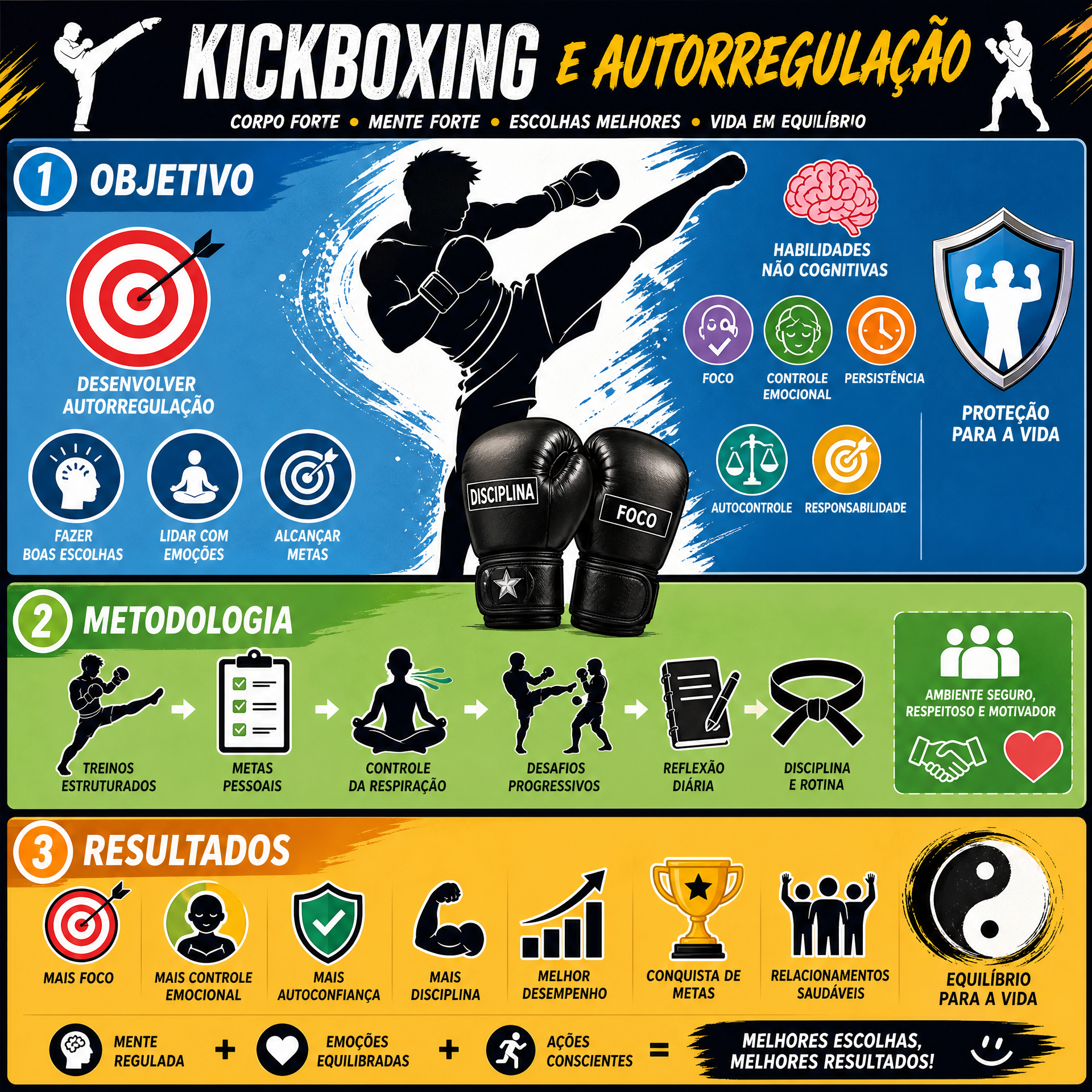
O objetivo do estudo é examinar a formação da autorregulação por meio do kickboxing no componente educativo “Proteção da Ucrânia”, no contexto do desenvolvimento de competências não cognitivas. A base metodológica do estudo é uma abordagem quase experimental que utiliza técnicas psicodiagnósticas, observação pedagógica e análise estatística das alterações no nível de autorregulação. Os resultados indicam que a utilização intencional de elementos do kickboxing contribui para um aumento estatisticamente significativo da autorregulação dos alunos. O efeito é sistêmico e manifesta-se no aumento do autocontrole, da estabilidade das reações e da disciplina. O estudo mostra que o kickboxing pode ser utilizado como ferramenta pedagógica na educação física e na formação de especialistas. As possíveis implicações econômicas são tratadas apenas como uma perspectiva indireta para pesquisas futuras, uma vez que a empregabilidade, a renda e a produtividade não foram medidas diretamente.
Downloads
Referências
Ambroży, T., Rydzik, Ł., Obmiński, Z., Klimek, A. T., Serafin, N., Litwiniuk, A., Czaja, R., & Czarny, W. (2021). The impact of reduced training activity of elite kickboxers on physical fitness, body build, and performance during competitions. International Journal of Environmental Research and Public Health, 18(8), 4342. https://doi.org/10.3390/ijerph18084342
Bielikov, I. (2022). Pedagogical modeling of the formation of organizational competence in future specialists in physical culture and sports of the Armed Forces of Ukraine. ScienceRise: Pedagogical Education, 5(50), 4–8. https://doi.org/10.15587/2519-4984.2022.265102
Cabinet of Ministers of Ukraine. (2024). On approval of the state standard of profile secondary education (Resolution No. 851, July 25, 2024). https://zakon.rada.gov.ua/go/851-2024-%D0%BF
Chen, X., & Wu, X. (2025). Non-cognitive skills and earnings of informal workers in China. Economic Modelling, 149, 107106. https://doi.org/10.1016/j.econmod.2025.107106
Cheng, L., Qin, H., Yang, Y., & Dang, J. (2025). Exploring the effects of long-term physical exercise on persistent and inhibitory self-control: Quasi-experimental research. Frontiers in Sports and Active Living, 7, 1543481. https://doi.org/10.3389/fspor.2025.1543481
Choi, S., & Min, I. (2025). The impact of cognitive and non-cognitive skills on occupational outcomes: Evidence from Indonesia. International Journal of Educational Research, 133, 102669. https://doi.org/10.1016/j.ijer.2025.102669
De Paola, M., & Skatova, E. (2024). Non-cognitive skills and social isolation in late childhood: An investigation of their impact on school performance in Italy. Economics of Education Review, 103, 102581. https://doi.org/10.1016/j.econedurev.2024.102581
Deming, D. J. (2017). The growing importance of social skills in the labor market. The Quarterly Journal of Economics, 132(4), 1593–1640. https://doi.org/10.1093/qje/qjx022
Gea-García, G. M., González-Gálvez, N., Espeso-García, A., Marcos-Pardo, P. J., González-Fernández, F. T., & Martínez-Aranda, L. M. (2020). Relationship between the practice of physical activity and physical fitness in physical education students: The integrated regulation as a mediating variable. Frontiers in Psychology, 11, 1910. https://doi.org/10.3389/fpsyg.2020.01910
Glewwe, P., Song, Y., & Zou, X. (2022). Labor market outcomes, cognitive skills, and noncognitive skills in rural China. Journal of Economic Behavior & Organization, 193, 294–311. https://doi.org/10.1016/j.jebo.2021.11.021
Hernandez-Martinez, J., Cid-Calfucura, I., Guzmán-Muñoz, E., Herrera-Valenzuela, T., Delgado-Floody, P., Nuñez-Espinosa, C., Branco, B. M., Mota, J., Nobari, H., Perez-Carcamo, J., Vásquez-Carrasco, E., & Valdés-Badilla, P. (2025). Effects of Olympic combat sports on physical fitness in non-athlete students: A systematic review with meta-analysis. Frontiers in Physiology, 16, 1620621. https://doi.org/10.3389/fphys.2025.1620621
Kanishevska, L. (2025). Strategic directions of military-patriotic education of senior school students in the conditions of martial law. Education: Modern Discourses, 8, 121–130. https://doi.org/10.37472/2617-3107-2025-8-11
Lakes, K. D., & Hoyt, W. T. (2004). Promoting self-regulation through school-based martial arts training. Journal of Applied Developmental Psychology, 25(3), 283–302. https://doi.org/10.1016/j.appdev.2004.04.002
Latinjak, A. T. (2025). Integrative self-regulation model for sport and exercise: Theory and implications for comprehensive training. Performance Enhancement & Health, 13(4), 100350. https://doi.org/10.1016/j.peh.2025.100350
Liu, Y., Tan, D., Wang, P., Xiao, T., Wang, X., & Zhang, T. (2024). Physical activity moderated the mediating effect of self-control between bullying victimization and mobile phone addiction among college students. Scientific Reports, 14, 20855. https://doi.org/10.1038/s41598-024-71797-2
Martusciello, F., Perazzetti, A., Kaçurri, A., Bushati, S., Muçalliu, A., & Tessitore, A. (2026). Short-term effects of a structured boxing program on technical skill acquisition in novice female students. Journal of Functional Morphology and Kinesiology, 11(1), 26. https://doi.org/10.3390/jfmk11010026
Ministry of Education and Science of Ukraine. (2024). Curricula for grades 10–11. https://mon.gov.ua/osvita-2/zagalna-serednya-osvita/osvitni-programi/navchalni-programi-dlya-10-11-klasiv
Morrone, M., Ventura, L., Roggio, I., Di Blasio, A., Ruiz, M., Deriu, F., Cugusi, L., Manca, A., & Robazza, C. (2024). Predicting performance of elite kickboxers using the multi-states theory framework. European Journal of Sport Science, 24(4), 405–414. https://doi.org/10.1002/ejsc.12031
OECD. (2019). Making physical education dynamic and inclusive for 2030: International curriculum analysis. OECD Publishing. https://doi.org/10.1787/7abe6b02-en
OECD. (2025). OECD skills outlook 2025: Building the skills of the 21st century for all. OECD Publishing. https://doi.org/10.1787/26163cd3-en
Potoczny, W., Herzog-Krzywoszanska, R., & Krzywoszanski, L. (2022). Self-control and emotion regulation mediate the impact of karate training on satisfaction with life. Frontiers in Behavioral Neuroscience, 15, 802564. https://doi.org/10.3389/fnbeh.2021.802564
Prabowo, T. A., Afifah, M., Indarto, A. V., Cahyo, F. D., & Zakaria, A. (2025). Validation of a self-discipline questionnaire for athletes. Journal of Anthropology of Sport and Physical Education, 9(3), 15–20. https://doi.org/10.26773/jaspe.250703
Ruiz-Ranz, E., & Asín-Izquierdo, I. (2025). Physical activity, exercise, and mental health of healthy adolescents: A review of the last 5 years. Sports Medicine and Health Science, 7(3), 161–172. https://doi.org/10.1016/j.smhs.2024.10.003
Schultz, T. W. (1993). The economic importance of human capital in modernization. Education Economics, 1(1), 13–19. https://doi.org/10.1080/09645299300000003
Synytsia, A., Koval, I., Kuzhelnyi, S., Dzhemesiuk, S., Kudin, S., Kuzhelnyi, A., & Zhula, L. (2025). The role of physical education in shaping soft skills and self-regulation in senior students: An economic perspective. Sport TK: Revista EuroAmericana de Ciencias del Deporte, 14, 6. https://doi.org/10.6018/sportk.644821
Tangney, J. P., Baumeister, R. F., & Boone, A. L. (2004). High self-control predicts good adjustment, less pathology, better grades, and interpersonal success. Journal of Personality, 72(2), 271–324. https://doi.org/10.1111/j.0022-3506.2004.00263.x
Tsos, A., Hylchuk, Y., Andreichuk, O., Pantik, V., & Tsymbaliuk, S. (2017). Physical and mental health components condition in the life quality of students who regularly practice kickboxing and yoga. Physical Activity Review, 5, 37–43. https://doi.org/10.16926/par.2017.05.06
van der Stouwe, E. C. D., de Vries, B., Aleman, A., Arends, J., Waarheid, C., Meerdink, A., van der Helm, E., van Busschbach, J. T., & Pijnenborg, G. H. M. (2016). BEATVIC, a body-oriented resilience training with elements of kickboxing for individuals with a psychotic disorder: Study protocol of a multi-center RCT. BMC Psychiatry, 16, 227. https://doi.org/10.1186/s12888-016-0918-2
Vlček, P., Bailey, R., Vašíčková, J., & Scheuer, C. (2021). Physical education and health enhancing physical activity: A European perspective. International Sports Studies, 43(1), 36–51. https://doi.org/10.30819/iss.43-1.04
Wang, F. (2025). Effects of physical activity on mobile phone addiction among university students: The mediating roles of self-control and resilience. Frontiers in Psychology, 16, 1503607. https://doi.org/10.3389/fpsyg.2025.1503607
Wang, Q., Chen, Y., & Li, L. (2024). Effects of physical activity and self-control on mobile phone addiction in college students: A cross-lagged study in China. Frontiers in Psychology, 15, 1417379. https://doi.org/10.3389/fpsyg.2024.1417379
Ying, L., & Yang, Q. (2025). The impact of combat sports on undergraduate students' subjective well-being: Chain mediation effects of emotional intelligence and self-esteem. Frontiers in Psychology, 16, 1659084. https://doi.org/10.3389/fpsyg.2025.1659084
Zormann, E., Foramitti, M., & Nater, U. M. (2026). Perceived health benefits of martial arts and combat sports. Frontiers in Psychology, 17, 1774069. https://doi.org/10.3389/fpsyg.2026.1774069
Downloads
Publicado
Como Citar
Edição
Seção
Licença
Copyright (c) 2026 Revista on line de Política e Gestão Educacional

Este trabalho está licenciado sob uma licença Creative Commons Attribution-NonCommercial-ShareAlike 4.0 International License.
Manuscritos aceitos e publicados são de propriedade da Revista on line de Política e Gestão Educacional. É vedada a submissão integral ou parcial do manuscrito a qualquer outro periódico. A responsabilidade do conteúdo dos artigos é exclusiva dos autores. É vedada a tradução para outro idioma sem a autorização escrita do Editor ouvida a Comissão Editorial Científica.