Adaptive strategies for educational continuity
assessing the potential of hybrid and asynchronous learning formats for inclusive settings during war times
DOI:
https://doi.org/10.22633/rpge.v30iesp1.20894Keywords:
Teacher at a general secondary education institution, Inclusive education, Distance learning, Martial law, Universal learning designAbstract
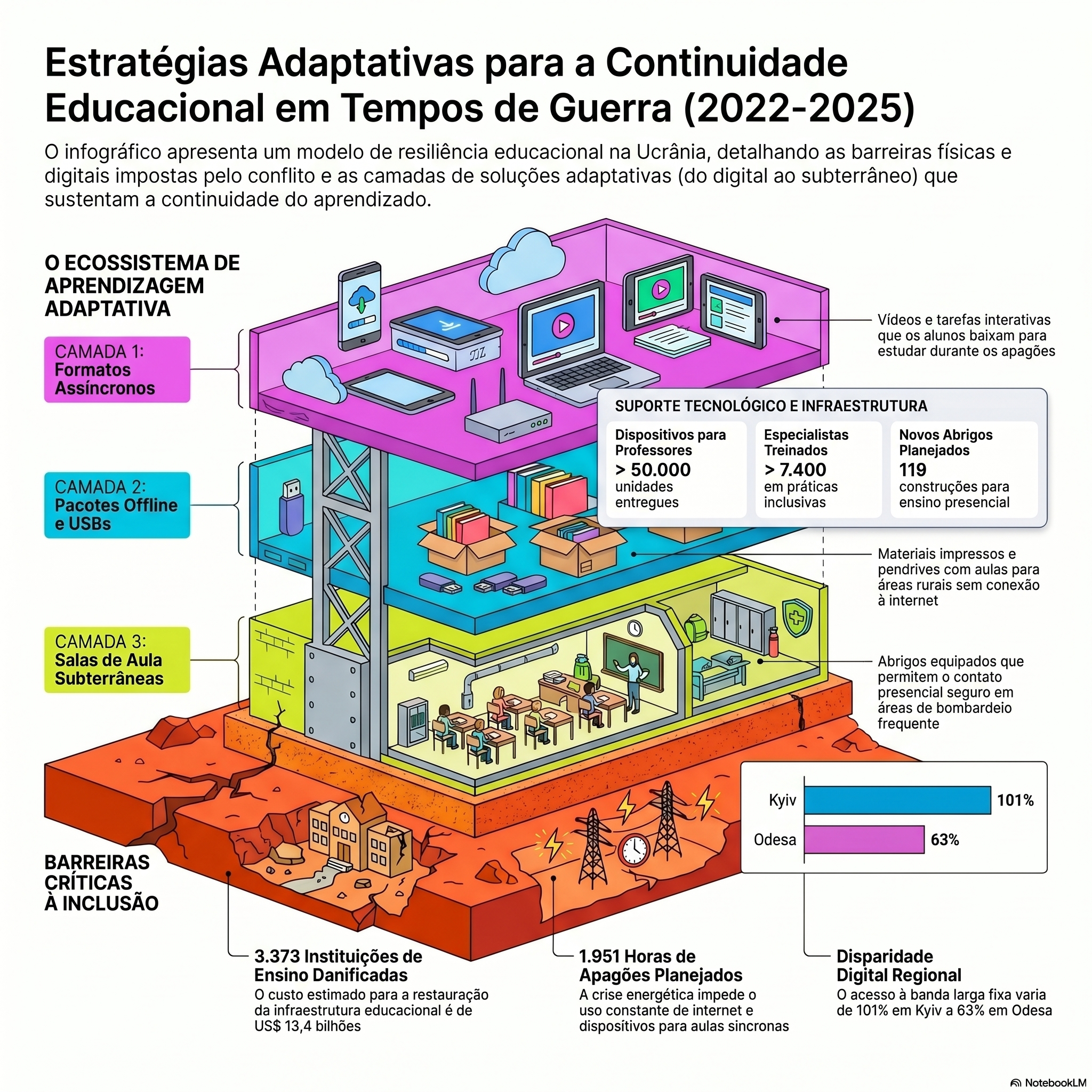
This study aims to systematically examine the opportunities and limitations of inclusive remote learning under martial law, based on a synthesis of official data for 2022–2025. The methodology combines content analysis of reports by UNESCO, UNHCR, the World Bank, ITU, UNICEF, and the Ministry of Education and Science of Ukraine with comparative analysis, descriptive statistics, and indicator classification across four dimensions: accessibility, inclusion barriers, support measures, and adaptive strategies. The findings show diverse participation patterns of Ukrainian students in European education and significant territorial digital inequality, alongside large-scale damage to educational infrastructure. Key obstacles include air raid interruptions and power outages, while adaptive responses involve asynchronous learning, hybrid schedules, and underground classrooms. The study concludes that inclusive remote education is enabled by technological support and organizational flexibility, but long-term policy responses are required to address persistent inequalities and psychological strain.
Downloads
References
Al Mazrooei, A. K., Almaki, S. H., Gunda, M., Alnoor, A., & Sulaiman, S. M. (2023). A systematic review of K–12 education responses to emergency remote teaching during the COVID-19 pandemic. International Review of Education, 68(6), 811–841. https://doi.org/10.1007/s11159-023-09986-w
Almeqdad, Q. I., Alodat, A. M., Alquraan, M. A., Mohaidat, M., & Al-Makhzoomy, A. (2023). The effectiveness of universal design for learning: A systematic review of the literature and meta-analysis. Cogent Education, 10(1), Article 2218191. https://doi.org/10.1080/2331186X.2023.2218191
Arhirova, H. (2025). Ukraine’s children start new school year in underground classrooms to avoid Russian bombs. Associated Press. https://apnews.com/article/a9c7eeeddacbcd1f72fe2e48d7e5f653
Buchanan, J., Gorbunova, Y., & Denber, R. (2023). “Tanks on the playground”: Attacks on schools and military use of schools in Ukraine. Human Rights Watch. https://www.hrw.org/report/2023/11/09/tanks-playground/attacks-schools-and-military-use-schools-ukraine
Eurydice. (2025). Ukraine – Digital transformation of education as a strategic path to resilience and innovation. European Commission. https://eurydice.eacea.ec.europa.eu/news/ukraine-digital-transformation-education-strategic-path-resilience-and-innovation
Fernández-Batanero, J. M., Román-Graván, P., Montenegro-Rueda, M., & López-Meneses, E. (2022). Assistive technology for the inclusion of students with disabilities in education: A systematic review. Education and Information Technologies, 27, 1911–1930. https://doi.org/10.1007/s11423-022-10127-7
International Telecommunication Union. (2025). Ukraine: Digital development country profile 2024 (Version 3.0). https://www.itu.int/en/ITU-D/Regional-Presence/Europe/Documents/Publications/2025/Final_Ukraine%20Digital%20Development%20Country%20Profile%20version%203.0.pdf
Letzel-Alt, V., & Pozas, M. (2024). Inclusive education for refugee students from Ukraine: An exploration of differentiated instruction in German schools. Support for Learning, 39(2), 290–306. https://doi.org/10.1111/1471-3802.12678
Lomellini, A., Lowenthal, P. R., Snelson, C., & Trespalacios, J. H. (2025). Accessible and inclusive online learning in higher education: A review of the literature. Journal of Computing in Higher Education, 37(4), 1306–1329. https://doi.org/10.1007/s12528-024-09424-2
Londar, S., Bosenko, O., & Gaiduk, T. (2025). Ensuring the resilience of Ukrainian education during the war as an experience for improving the education systems in the EU countries. Education Management, 6, 5–25. https://doi.org/10.32987/2617-8532-2024-6-5-25
Ministry of Education and Science of Ukraine. (2024). War and education: Two years of full-scale invasion – Report 2024. https://mon.gov.ua/static-objects/mon/sites/1/news/2024/02/10/Report.War.and.education.Two.years.of.full.scale.invasion.2024.eng-10.02.2024.pdf
Ministry of Education and Science of Ukraine. (2025). Education digest 2.0 (Policy highlights). https://mon.gov.ua/static-objects/mon/sites/1/mizhnarodna/2025/05/01/educatio-digest-2-0-2025.pdf
Mukhtarkyzy, K., Smagulova, L., Tokzhigitova, A., Serikbayeva, N., Sayakov, O., Turkmenbayev, A., & Assilbayeva, R. (2025). A systematic review of the utility of assistive technologies for SEND students in schools. Frontiers in Education, 10, Article 1523797. https://doi.org/10.3389/feduc.2025.1523797
Nadyukova, O., & Frenzel, A. C. (2025). Ukrainian teachers’ stress and coping during the war: Results from a mixed methods study. Teaching and Teacher Education, 157, Article 104941. https://doi.org/10.1016/j.tate.2025.104941
Organisation for Economic Co-operation and Development. (2023). OECD digital education outlook 2023: Towards an effective digital education ecosystem. OECD Publishing. https://doi.org/10.1787/c74f03de-en
Organisation for Economic Co-operation and Development. (2024). Education policy outlook 2024: Empowering education systems to deliver quality teaching. OECD Publishing. https://doi.org/10.1787/dd5140e4-en
Parmigiani, D., Spulber, D., Ambrosini, A., Molinari, A., Nicchia, E., Pario, M., Pedevilla, A., Sardi, I., & Silvaggio, C. (2023). Educational strategies to support the inclusion of displaced pupils from Ukraine in Italian schools. International Journal of Educational Research Open, 4, Article 100255. https://doi.org/10.1016/j.ijedro.2023.100255
Posternak, A. (2025). Power outages lasted up to 2,000 hours in 2024. UA–Energy / DiXi Group. https://ua-energy.org/en/posts/03-01-2025-e02c69f7-2841-4f9f-9b14-24e22d65b6ae
Profession of New Education. (2023). Educational losses due to the war in Ukraine. Trade Union of Education and Science Workers of Ukraine. https://pon.org.ua/info-english/engnews/10916-educational-losses-due-to-the-war-in-ukraine.html
Savisko, M., & Karakai, A. (2025). Lost lessons due to air raid alerts: How many and what can be done. VoxUkraine. https://voxukraine.org/en/lost-lessons-due-to-air-raid-alerts-how-many-and-what-can-be-done
The European Wergeland Centre. (2024). Narrative report 2024: Schools for democracy – Supporting education reforms in Ukraine. https://wergelandcentre.org/content/uploads/2024/09/Narrative-report-2024.pdf
UNESCO. (2024). Supporting continuity of learning in Ukraine through the Global Education Coalition (2023–2025 aggregated overview). https://www.unesco.org/en/global-education-coalition/ukraine-support
UNESCO. (2025a). New data insights reveal both progress and challenges for Ukrainian refugee students’ education in Europe. https://www.unesco.org/en/articles/new-data-insights-reveal-both-progress-and-challenges-ukrainian-refugee-students-education-europe
UNESCO. (2025b). Learning amid war: How UNESCO makes Ukrainian schools safer for children and teachers. https://www.unesco.org/en/articles/learning-amid-war-how-unesco-makes-ukrainian-schools-safer-children-and-teachers
UNHCR. (2025). New data insights: Progress and challenges for Ukrainian refugee students (Interagency dashboard analysis). United Nations High Commissioner for Refugees. https://www.unhcr.org/europe/news/announcements/new-data-insights-reveal-both-progress-and-challenges-ukrainian-refugee-students
UNHCR. (2024a). Quarterly update: Education (Q1 2024). United Nations High Commissioner for Refugees. https://www.unhcr.org/europe/publications/europe-region-quarterly-update-education-january-march-2024
UNHCR. (2024b). Despite progress in accessing education, hundreds of thousands of school-aged refugee children remain out of school. United Nations High Commissioner for Refugees. https://www.unhcr.org/europe/news/news/despite-progress-accessing-education-hundreds-thousands-school-aged-refugee-children
UNHCR. (2024c). Ukraine country operations: Situation overview and displacement data. United Nations High Commissioner for Refugees. https://www.unhcr.org/where-we-work/countries/ukraine
UNICEF. (2025). 4.6 million children in Ukraine face ongoing educational challenges as new school year begins. UNICEF Ukraine. https://www.unicef.org/ukraine/en/press-releases/back-to-school
United Nations Regional Information Centre. (2024). Over 6 million Ukrainian refugees spread across Europe. United Nations. https://unric.org/en/ukraine-over-6-million-refugees-spread-across-europe
Utami, I. S., Anshori, A., & Aisah, H. (2025). Universal design for learning in online education: A systematic review of evidence-based practice for supporting students with disabilities. International Journal of Learning, Teaching and Educational Research, 24(3), 1–22. https://www.ijlter.org/index.php/ijlter/article/view/12618
World Bank. (2025a). Learning and school reforms continue in Ukraine despite war challenges (LEARN program). World Bank Group. https://www.worldbank.org/en/news/feature/2025/03/25/learning-and-school-reforms-continue-in-ukraine-despite-war-challenges
World Bank. (2025b). Learning and school reforms continue in Ukraine despite war challenges (RDNA4 figures). World Bank Group. https://www.worldbank.org/en/news/feature/2025/03/25/learning-and-school-reforms-continue-in-ukraine-despite-war-challenges
Yang, M., Li, J., & Zhang, Y. (2024). Universal design in online education: A systematic review. Distance Education, 45(4), 503–526. https://doi.org/10.1080/01587919.2024.2303494
Downloads
Published
How to Cite
Issue
Section
License
Copyright (c) 2026 Revista on line de Política e Gestão Educacional

This work is licensed under a Creative Commons Attribution-NonCommercial-ShareAlike 4.0 International License.
Manuscritos aceitos e publicados são de propriedade da Revista on line de Política e Gestão Educacional. É vedada a submissão integral ou parcial do manuscrito a qualquer outro periódico. A responsabilidade do conteúdo dos artigos é exclusiva dos autores. É vedada a tradução para outro idioma sem a autorização escrita do Editor ouvida a Comissão Editorial Científica.