Preschool education curricula in the TRNC, New Zealand and Seychelles
a comparative analysis
DOI:
https://doi.org/10.22633/rpge.v30iesp1.20897Keywords:
Comparative curriculum analysis, Early childhood education, Te Whāriki, Educational policyAbstract
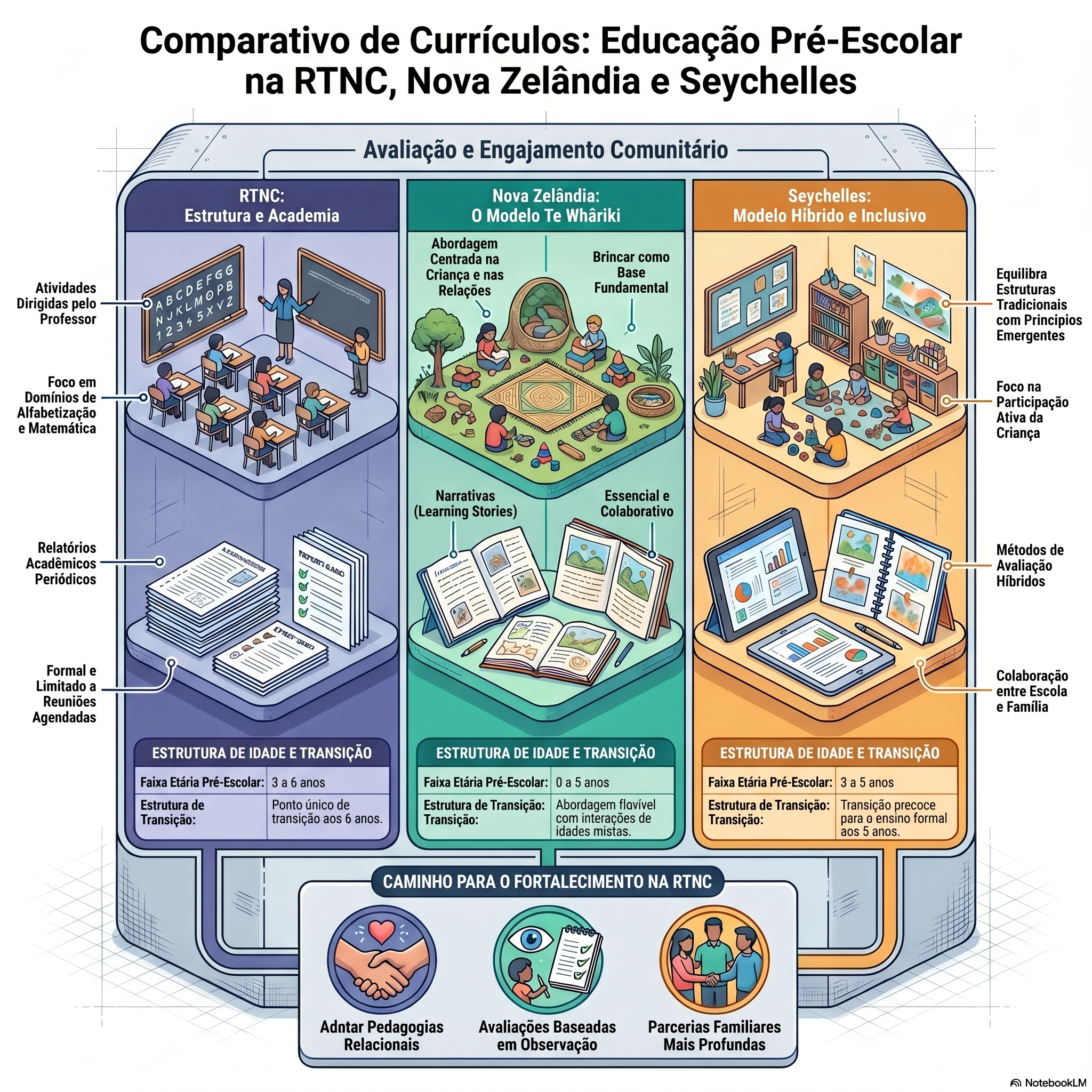
The study aims to compare and contrast the preschool education curricula in the Turkish Republic of Northern Cyprus (TRNC), New Zealand, and Seychelles focusing on the curriculum structure, pedagogical philosophies, instructional strategies, assessment practices, family and community involvement, and teacher qualifications in relation to the development of children’s social and interpersonal competencies. A qualitative document analysis approach was employed, involving a systematic review of official curriculum documents, legislative regulations, and reports published by international organizations. The findings show that all three countries adopt child-centered and play-based approaches that support children’s holistic development; however, the ways in which these approaches are conceptualized and implemented differ according to national, cultural, and educational priorities. Overall, the findings suggest that preschool education in the TRNC could be strengthened by drawing on internationally recognized practices observed in New Zealand and Seychelles, particularly those that emphasize relationship-centered pedagogy, strong family partnerships, and inclusive social learning environments.
Downloads
References
Africa, U. N. Economic Commission for Africa. (2016). Africa human development report 2016: Accelerating gender equality and women’s empowerment in Africa. https://doi.org/10.22004/ag.econ.267638
Aksoy, Y. Ü. (2024). Teachers’ perspectives on how exposure to foreign languages affects young children’s language development. Encuentro Journal, 32, 23–36. https://doi.org/10.37536/ej.2024.32.2444
Alayande, B., Chu, K. M., Jumbam, D. T., et al. (2022). Disparities in access to trauma care in sub-Saharan Africa: A narrative review. Current Trauma Reports, 8, 66–94. https://doi.org/10.1007/s40719-022-00229-1
Anshin, S. (2006). Foreign language teaching in children. D.U. Gokalp Faculty of Education Journal, 6, 9–20. https://dergipark.org.tr/en/pub/zgefd/issue/47964/606853
Astiwi, W., Siswanto, D. H., & Suryatama, H. (2024). Description regarding the influence of teacher qualifications and competence on early childhood learning achievement. Asian Journal of Applied Education, 3(3), 347–358. https://doi.org/10.55927/ajae.v3i3.10360
Barth, R. P. (2009). Preventing child abuse and neglect with parent training: Evidence and opportunities. The Future of Children, 19(2), 95–118. https://doi.org/10.1353/foc.0.0031
Baustad, A. G., & Bjørnestad, E. (2022). Everyday interactions between staff and children aged 1–5 in Norwegian ECEC. Early Years, 42(4–5), 557–571. https://doi.org/10.1080/09575146.2020.1819207
Bécares, L., & Atatoa-Carr, P. (2016). The association between maternal and partner experienced racial discrimination and prenatal perceived stress, prenatal and postnatal depression: Findings from the Growing Up in New Zealand cohort study. International Journal for Equity in Health, 15, Article 155. https://doi.org/10.1186/s12939-016-0443-4
Beck, T. (2000). Using gender-sensitive indicators: A reference manual for governments and other stakeholders. The Commonwealth Secretariat. https://doi.org/10.14217/9781848596825-en
Bialystok, E. (2006). Second-language acquisition and bilingualism at an early age and the impact on early cognitive development. York University.
Bierman, K. L. (2004). Peer rejection: Developmental processes and intervention strategies. Guilford Press.
Blaiklock, K. (2010). Te Whāriki, the New Zealand early childhood curriculum: Is it effective? International Journal of Early Years Education, 18(3), 201–212. https://doi.org/10.1080/09669760.2010.521296
Blair, C., & Raver, C. C. (2015). School readiness and self-regulation: A developmental psychobiological approach. Annual Review of Psychology, 66, 711–731. https://doi.org/10.1146/annurev-psych-010814-015221
Bone, J., Cullen, J., & Loveridge, J. (2007). Everyday spirituality: An aspect of the holistic curriculum in action. Contemporary Issues in Early Childhood, 8(4), 344–354. https://doi.org/10.2304/ciec.2007.8.4.344
Bowen, G. A. (2009). Document analysis as a qualitative research method. Qualitative Research Journal, 9(2), 27–40. https://doi.org/10.3316/QRJ0902027
Brown, S., Power, N., Bowmar, A., & Foster, S. (2018). Student engagement in a human anatomy and physiology course: A New Zealand perspective. Advances in Physiology Education, 42(4). https://doi.org/10.1152/advan.00035.2018
Choi, J., Dutz, M., & Usman, Z. (2020). The future of work in Africa: Harnessing the potential of digital technologies for all. World Bank. https://doi.org/10.1596/978-1-4648-1444-0
Cooper, M., & Hedges, H. (2014). Beyond participation: What we learned from Hunter about collaboration with Pasifika children and families. Contemporary Issues in Early Childhood, 15(2). https://doi.org/10.2304/ciec.2014.15.2.165
Erbay, F., Amca Toklu, D., Kuset, Ş., & Sıddık, H. (2021). Comparison of pre-school education curricula of Turkish Republic of Northern Cyprus, England, Finland, Southern Cyprus and India. Participatory Educational Research, 8(3), 385–401. https://doi.org/10.17275/per.21.72.8.3
García-Carrión, R., & Villardón-Gallego, L. (2016). Dialogue and interaction in early childhood education: A systematic review. Multidisciplinary Journal of Educational Research, 6(1), 51–76. https://doi.org/10.17583/remie.2016.1919
Government of Seychelles. (2010). National curriculum framework for early childhood. Ministry of Education.
Hahn, R. A., & Barnett, W. S. (2022). Early childhood education: Health, equity, and economics. Annual Review of Public Health, 44, 75–92. https://doi.org/10.1146/annurev-publhealth-071321-032337
Halfon, N., & Hochstein, M. (2002). Life course health development: An integrated framework for developing health, policy, and research. The Milbank Quarterly, 80, 433–479. https://doi.org/10.1111/1468-0009.00019
Johansson, E., & Rosell, Y. (2021). Social sustainability through children’s expressions of belonging in peer communities. Sustainability, 13(7), Article 3839. https://doi.org/10.3390/su13073839
Khalfaoui, A., García-Carrión, R., & Villardón-Gallego, L. (2021). A systematic review of the literature on aspects affecting positive classroom climate in multicultural early childhood education. Early Childhood Education Journal, 49, 71–81. https://doi.org/10.1007/s10643-020-01054-4
Kılıç, Z. (2023). Preschool teachers' opinions on movement activities. International Journal of Education, Technology and Science, 3(3), 931–951.
Kol, S., & Tunçeli, H. (2022). Legal foundations and comparative analysis of early childhood education practices in the Turkish world. Jurnal Cita Hukum, 10(2), 239–266. https://doi.org/10.15408/jch.v10i2.26237
LaForett, D. R., & Mendez, J. L. (2010). Parent involvement, parental depression, and program satisfaction among low-income parents participating in a two-generation early childhood education program. Early Education and Development, 21(4), 517–535. https://doi.org/10.1080/10409280902927767
Lee, W., Carr, M., Soutar, B., & Mitchell, L. (2013). Understanding the Te Whāriki approach. Routledge.
Li, S., Tang, Y., & Zheng, Y. (2023). How the home learning environment contributes to children’s social–emotional competence: A moderated mediation model. Frontiers in Psychology, 14. https://doi.org/10.3389/fpsyg.2023.1065978
Liu, J. (2025). The effects of early childhood education on long-term cognitive and social outcomes. SHS Web of Conferences, 213, Article 02026. https://doi.org/10.1051/shsconf/202521302026
Loprinzi, P. D., Davis, R. E., & Fu, Y. (2015). Early motor skill competence as a mediator of child and adult physical activity. Preventive Medicine Reports, 2, 833–838. https://doi.org/10.1016/j.pmedr.2015.09.015
McLaughlin, T., Aspden, K., & Clarke, L. (2017). How do teachers support children’s social–emotional competence? Strategies for teachers. Early Childhood Folio, 21(2), 21–27. https://doi.org/10.18296/ecf.0041
Mendez, J. L., Fantuzzo, J. W., & Cicchetti, D. (2003). Profiles of social competence among low-income African American preschool children. Child Development, 73(4). https://doi.org/10.1111/1467-8624.00459
Ministry of Education. (2017). Te Whāriki: Early childhood curriculum (Rev. ed.). Learning Media.
Moorosi, P., & Bush, T. (2011). School leadership development in Commonwealth countries: Learning across the boundaries. University of Warwick. https://wrap.warwick.ac.uk/id/eprint/39460/
Neuman, S. B., & Celano, D. (2001). Access to print in low-income and middle-income communities: An ecological study of four neighborhoods. Reading Research Quarterly, 36, 8–26. https://doi.org/10.1598/RRQ.36.1.1
Organisation for Economic Co-operation and Development. (2017). Starting strong V: Transitions from early childhood education and care to primary education. OECD Publishing. https://doi.org/10.1787/9789264276253-en
Park, M. N., Moulton, E. E., & Laugeson, E. A. (2022). Parent-assisted social skills training for children with autism spectrum disorder: PEERS for preschoolers. Focus on Autism and Other Developmental Disabilities, 38(2), 80–89. https://doi.org/10.1177/10883576221110158
Patton, M. Q. (2002). Qualitative research and evaluation methods (3rd ed.). Sage Publications.
Peköz, Ç., & Gürşimşek, A. I. (2020). Multicultural attitudes and cultural intelligence of preschool teachers. Journal for Multicultural Education, 14(1), 45–60. https://doi.org/10.1108/JME-05-2019-0043
Phillips, D., & Schweisfurth, M. (2014). Comparative and international education: An introduction to theory, method and practice (2nd ed.). Bloomsbury.
Reese, E., Kokaua, J., Guiney, H., et al. (2023). Kia Tīmata Pai (Best Start): A study protocol for a cluster randomised trial with early childhood teachers to support children’s oral language and self-regulation development. BMJ Open, 13(9). https://doi.org/10.1136/bmjopen-2023-073361
Salaj, S., & Masnjak, M. (2022). Correlation of motor competence and social-emotional wellbeing in preschool children. Frontiers in Psychology. https://doi.org/10.3389/fpsyg.2022.846520
Shonkoff, J. P., & Phillips, D. A. (Eds.). (2000). From neurons to neighborhoods: The science of early childhood development. National Academy Press.
Solang, D. J., Yunus, M., Rukmini, B. S., Kurnia, K., & Umam, K. (2024). The impact of early childhood education on long-term outcomes. The Journal of Academic Science, 1(4). https://doi.org/10.59613/7pvaa271
Suchodoletz, A., Lee, D. S., Henry, J., et al. (2023). Early childhood education and care quality and associations with child outcomes: A meta-analysis. PLOS ONE, 18(10). https://doi.org/10.1371/journal.pone.0293056
TRNC Ministry of Education. (2018). Early childhood curriculum.
Ufuk, H., & Çağanağa, Ç. (2019). A general overview over Northern Cyprus education policies between 1983–2016. Open Access Library Journal, 6, 1–17. https://doi.org/10.4236/oalib.1104809
UNESCO International Bureau of Education. (2017). Seychelles early childhood care and education (ECCE) country profile. https://unesdoc.unesco.org/
Wagner, D. A. (2010). Quality of education, comparability, and assessment choice in developing countries. Compare: A Journal of Comparative and International Education, 40(6), 741–760. https://doi.org/10.1080/03057925.2010.523231
Wang, M., & Eccles, J. S. (2012). Social support matters: Longitudinal effects of social support on three dimensions of school engagement from middle to high school. Child Development, 83(3). https://doi.org/10.1111/j.1467-8624.2012.01745.x
White, L. O., Schulz, C. C., Schoett, M. J. S., Kungl, M. T., Keil, J., Borelli, J. L., & Vrtička, P. (2020). Conceptual analysis: A social neuroscience approach to interpersonal interaction in the context of disruption and disorganization of attachment (NAMDA). Frontiers in Psychiatry, 11, Article 517372. https://doi.org/10.3389/fpsyt.2020.517372
Wu, L., Kim, M., & Markauskaitė, L. (2020). Developing young children’s empathic perception through digitally mediated interpersonal experience: Principles for a hybrid design of empathy games. British Journal of Educational Technology, 51(4). https://doi.org/10.1111/bjet.12918
Downloads
Published
How to Cite
Issue
Section
License
Copyright (c) 2026 Revista on line de Política e Gestão Educacional

This work is licensed under a Creative Commons Attribution-NonCommercial-ShareAlike 4.0 International License.
Manuscritos aceitos e publicados são de propriedade da Revista on line de Política e Gestão Educacional. É vedada a submissão integral ou parcial do manuscrito a qualquer outro periódico. A responsabilidade do conteúdo dos artigos é exclusiva dos autores. É vedada a tradução para outro idioma sem a autorização escrita do Editor ouvida a Comissão Editorial Científica.