Currículos de educação pré-escolar na RTNC, Nova Zelândia e Seychelles
uma análise comparativa
DOI:
https://doi.org/10.22633/rpge.v30iesp1.20897Palavras-chave:
Análise curricular comparativa, Educação infantil, Te Whāriki, Política educacionalResumo
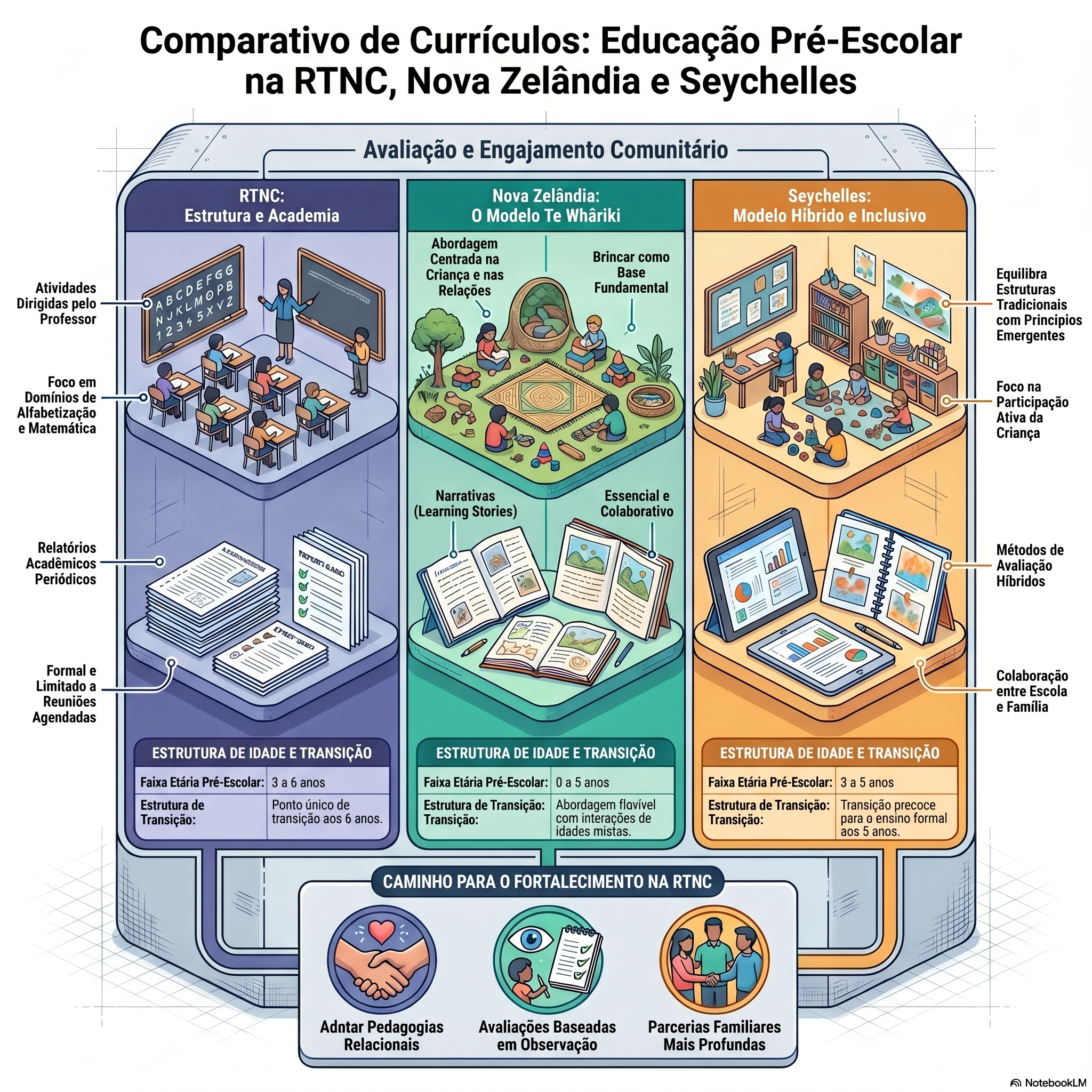
O estudo tem como objetivo comparar e contrastar os currículos de educação pré-escolar na República Turca do Norte de Chipre (RTNC), na Nova Zelândia e em Seychelles, com foco na estrutura curricular, nas filosofias pedagógicas, nas estratégias de ensino, nas práticas de avaliação, no envolvimento da família e da comunidade e nas qualificações docentes em relação ao desenvolvimento das competências sociais e interpessoais das crianças. Foi empregada uma abordagem qualitativa de análise documental, envolvendo uma revisão sistemática de documentos curriculares oficiais, regulamentações legislativas e relatórios publicados por organizações internacionais. Os resultados mostram que os três países adotam abordagens centradas na criança e baseadas no brincar, que apoiam o desenvolvimento integral das crianças; no entanto, as formas como essas abordagens são concebidas e implementadas diferem de acordo com prioridades nacionais, culturais e educacionais. De modo geral, os achados sugerem que a educação pré-escolar na RTNC pode ser fortalecida a partir da incorporação de práticas reconhecidas internacionalmente, observadas na Nova Zelândia e em Seychelles, especialmente aquelas que enfatizam pedagogias centradas nas relações, fortes parcerias com as famílias e ambientes inclusivos de aprendizagem social.
Downloads
Referências
Africa, U. N. Economic Commission for Africa. (2016). Africa human development report 2016: Accelerating gender equality and women’s empowerment in Africa. https://doi.org/10.22004/ag.econ.267638
Aksoy, Y. Ü. (2024). Teachers’ perspectives on how exposure to foreign languages affects young children’s language development. Encuentro Journal, 32, 23–36. https://doi.org/10.37536/ej.2024.32.2444
Alayande, B., Chu, K. M., Jumbam, D. T., et al. (2022). Disparities in access to trauma care in sub-Saharan Africa: A narrative review. Current Trauma Reports, 8, 66–94. https://doi.org/10.1007/s40719-022-00229-1
Anshin, S. (2006). Foreign language teaching in children. D.U. Gokalp Faculty of Education Journal, 6, 9–20. https://dergipark.org.tr/en/pub/zgefd/issue/47964/606853
Astiwi, W., Siswanto, D. H., & Suryatama, H. (2024). Description regarding the influence of teacher qualifications and competence on early childhood learning achievement. Asian Journal of Applied Education, 3(3), 347–358. https://doi.org/10.55927/ajae.v3i3.10360
Barth, R. P. (2009). Preventing child abuse and neglect with parent training: Evidence and opportunities. The Future of Children, 19(2), 95–118. https://doi.org/10.1353/foc.0.0031
Baustad, A. G., & Bjørnestad, E. (2022). Everyday interactions between staff and children aged 1–5 in Norwegian ECEC. Early Years, 42(4–5), 557–571. https://doi.org/10.1080/09575146.2020.1819207
Bécares, L., & Atatoa-Carr, P. (2016). The association between maternal and partner experienced racial discrimination and prenatal perceived stress, prenatal and postnatal depression: Findings from the Growing Up in New Zealand cohort study. International Journal for Equity in Health, 15, Article 155. https://doi.org/10.1186/s12939-016-0443-4
Beck, T. (2000). Using gender-sensitive indicators: A reference manual for governments and other stakeholders. The Commonwealth Secretariat. https://doi.org/10.14217/9781848596825-en
Bialystok, E. (2006). Second-language acquisition and bilingualism at an early age and the impact on early cognitive development. York University.
Bierman, K. L. (2004). Peer rejection: Developmental processes and intervention strategies. Guilford Press.
Blaiklock, K. (2010). Te Whāriki, the New Zealand early childhood curriculum: Is it effective? International Journal of Early Years Education, 18(3), 201–212. https://doi.org/10.1080/09669760.2010.521296
Blair, C., & Raver, C. C. (2015). School readiness and self-regulation: A developmental psychobiological approach. Annual Review of Psychology, 66, 711–731. https://doi.org/10.1146/annurev-psych-010814-015221
Bone, J., Cullen, J., & Loveridge, J. (2007). Everyday spirituality: An aspect of the holistic curriculum in action. Contemporary Issues in Early Childhood, 8(4), 344–354. https://doi.org/10.2304/ciec.2007.8.4.344
Bowen, G. A. (2009). Document analysis as a qualitative research method. Qualitative Research Journal, 9(2), 27–40. https://doi.org/10.3316/QRJ0902027
Brown, S., Power, N., Bowmar, A., & Foster, S. (2018). Student engagement in a human anatomy and physiology course: A New Zealand perspective. Advances in Physiology Education, 42(4). https://doi.org/10.1152/advan.00035.2018
Choi, J., Dutz, M., & Usman, Z. (2020). The future of work in Africa: Harnessing the potential of digital technologies for all. World Bank. https://doi.org/10.1596/978-1-4648-1444-0
Cooper, M., & Hedges, H. (2014). Beyond participation: What we learned from Hunter about collaboration with Pasifika children and families. Contemporary Issues in Early Childhood, 15(2). https://doi.org/10.2304/ciec.2014.15.2.165
Erbay, F., Amca Toklu, D., Kuset, Ş., & Sıddık, H. (2021). Comparison of pre-school education curricula of Turkish Republic of Northern Cyprus, England, Finland, Southern Cyprus and India. Participatory Educational Research, 8(3), 385–401. https://doi.org/10.17275/per.21.72.8.3
García-Carrión, R., & Villardón-Gallego, L. (2016). Dialogue and interaction in early childhood education: A systematic review. Multidisciplinary Journal of Educational Research, 6(1), 51–76. https://doi.org/10.17583/remie.2016.1919
Government of Seychelles. (2010). National curriculum framework for early childhood. Ministry of Education.
Hahn, R. A., & Barnett, W. S. (2022). Early childhood education: Health, equity, and economics. Annual Review of Public Health, 44, 75–92. https://doi.org/10.1146/annurev-publhealth-071321-032337
Halfon, N., & Hochstein, M. (2002). Life course health development: An integrated framework for developing health, policy, and research. The Milbank Quarterly, 80, 433–479. https://doi.org/10.1111/1468-0009.00019
Johansson, E., & Rosell, Y. (2021). Social sustainability through children’s expressions of belonging in peer communities. Sustainability, 13(7), Article 3839. https://doi.org/10.3390/su13073839
Khalfaoui, A., García-Carrión, R., & Villardón-Gallego, L. (2021). A systematic review of the literature on aspects affecting positive classroom climate in multicultural early childhood education. Early Childhood Education Journal, 49, 71–81. https://doi.org/10.1007/s10643-020-01054-4
Kılıç, Z. (2023). Preschool teachers' opinions on movement activities. International Journal of Education, Technology and Science, 3(3), 931–951.
Kol, S., & Tunçeli, H. (2022). Legal foundations and comparative analysis of early childhood education practices in the Turkish world. Jurnal Cita Hukum, 10(2), 239–266. https://doi.org/10.15408/jch.v10i2.26237
LaForett, D. R., & Mendez, J. L. (2010). Parent involvement, parental depression, and program satisfaction among low-income parents participating in a two-generation early childhood education program. Early Education and Development, 21(4), 517–535. https://doi.org/10.1080/10409280902927767
Lee, W., Carr, M., Soutar, B., & Mitchell, L. (2013). Understanding the Te Whāriki approach. Routledge.
Li, S., Tang, Y., & Zheng, Y. (2023). How the home learning environment contributes to children’s social–emotional competence: A moderated mediation model. Frontiers in Psychology, 14. https://doi.org/10.3389/fpsyg.2023.1065978
Liu, J. (2025). The effects of early childhood education on long-term cognitive and social outcomes. SHS Web of Conferences, 213, Article 02026. https://doi.org/10.1051/shsconf/202521302026
Loprinzi, P. D., Davis, R. E., & Fu, Y. (2015). Early motor skill competence as a mediator of child and adult physical activity. Preventive Medicine Reports, 2, 833–838. https://doi.org/10.1016/j.pmedr.2015.09.015
McLaughlin, T., Aspden, K., & Clarke, L. (2017). How do teachers support children’s social–emotional competence? Strategies for teachers. Early Childhood Folio, 21(2), 21–27. https://doi.org/10.18296/ecf.0041
Mendez, J. L., Fantuzzo, J. W., & Cicchetti, D. (2003). Profiles of social competence among low-income African American preschool children. Child Development, 73(4). https://doi.org/10.1111/1467-8624.00459
Ministry of Education. (2017). Te Whāriki: Early childhood curriculum (Rev. ed.). Learning Media.
Moorosi, P., & Bush, T. (2011). School leadership development in Commonwealth countries: Learning across the boundaries. University of Warwick. https://wrap.warwick.ac.uk/id/eprint/39460/
Neuman, S. B., & Celano, D. (2001). Access to print in low-income and middle-income communities: An ecological study of four neighborhoods. Reading Research Quarterly, 36, 8–26. https://doi.org/10.1598/RRQ.36.1.1
Organisation for Economic Co-operation and Development. (2017). Starting strong V: Transitions from early childhood education and care to primary education. OECD Publishing. https://doi.org/10.1787/9789264276253-en
Park, M. N., Moulton, E. E., & Laugeson, E. A. (2022). Parent-assisted social skills training for children with autism spectrum disorder: PEERS for preschoolers. Focus on Autism and Other Developmental Disabilities, 38(2), 80–89. https://doi.org/10.1177/10883576221110158
Patton, M. Q. (2002). Qualitative research and evaluation methods (3rd ed.). Sage Publications.
Peköz, Ç., & Gürşimşek, A. I. (2020). Multicultural attitudes and cultural intelligence of preschool teachers. Journal for Multicultural Education, 14(1), 45–60. https://doi.org/10.1108/JME-05-2019-0043
Phillips, D., & Schweisfurth, M. (2014). Comparative and international education: An introduction to theory, method and practice (2nd ed.). Bloomsbury.
Reese, E., Kokaua, J., Guiney, H., et al. (2023). Kia Tīmata Pai (Best Start): A study protocol for a cluster randomised trial with early childhood teachers to support children’s oral language and self-regulation development. BMJ Open, 13(9). https://doi.org/10.1136/bmjopen-2023-073361
Salaj, S., & Masnjak, M. (2022). Correlation of motor competence and social-emotional wellbeing in preschool children. Frontiers in Psychology. https://doi.org/10.3389/fpsyg.2022.846520
Shonkoff, J. P., & Phillips, D. A. (Eds.). (2000). From neurons to neighborhoods: The science of early childhood development. National Academy Press.
Solang, D. J., Yunus, M., Rukmini, B. S., Kurnia, K., & Umam, K. (2024). The impact of early childhood education on long-term outcomes. The Journal of Academic Science, 1(4). https://doi.org/10.59613/7pvaa271
Suchodoletz, A., Lee, D. S., Henry, J., et al. (2023). Early childhood education and care quality and associations with child outcomes: A meta-analysis. PLOS ONE, 18(10). https://doi.org/10.1371/journal.pone.0293056
TRNC Ministry of Education. (2018). Early childhood curriculum.
Ufuk, H., & Çağanağa, Ç. (2019). A general overview over Northern Cyprus education policies between 1983–2016. Open Access Library Journal, 6, 1–17. https://doi.org/10.4236/oalib.1104809
UNESCO International Bureau of Education. (2017). Seychelles early childhood care and education (ECCE) country profile. https://unesdoc.unesco.org/
Wagner, D. A. (2010). Quality of education, comparability, and assessment choice in developing countries. Compare: A Journal of Comparative and International Education, 40(6), 741–760. https://doi.org/10.1080/03057925.2010.523231
Wang, M., & Eccles, J. S. (2012). Social support matters: Longitudinal effects of social support on three dimensions of school engagement from middle to high school. Child Development, 83(3). https://doi.org/10.1111/j.1467-8624.2012.01745.x
White, L. O., Schulz, C. C., Schoett, M. J. S., Kungl, M. T., Keil, J., Borelli, J. L., & Vrtička, P. (2020). Conceptual analysis: A social neuroscience approach to interpersonal interaction in the context of disruption and disorganization of attachment (NAMDA). Frontiers in Psychiatry, 11, Article 517372. https://doi.org/10.3389/fpsyt.2020.517372
Wu, L., Kim, M., & Markauskaitė, L. (2020). Developing young children’s empathic perception through digitally mediated interpersonal experience: Principles for a hybrid design of empathy games. British Journal of Educational Technology, 51(4). https://doi.org/10.1111/bjet.12918
Publicado
Como Citar
Edição
Seção
Licença
Copyright (c) 2026 Revista on line de Política e Gestão Educacional

Este trabalho está licenciado sob uma licença Creative Commons Attribution-NonCommercial-ShareAlike 4.0 International License.
Manuscritos aceitos e publicados são de propriedade da Revista on line de Política e Gestão Educacional. É vedada a submissão integral ou parcial do manuscrito a qualquer outro periódico. A responsabilidade do conteúdo dos artigos é exclusiva dos autores. É vedada a tradução para outro idioma sem a autorização escrita do Editor ouvida a Comissão Editorial Científica.