Thoughts on education and culture in the works of Awang Had Salleh
DOI:
https://doi.org/10.22633/rpge.v30iesp1.20909Keywords:
Awang Had Salleh, Culture, Education, Identity, National developmentAbstract
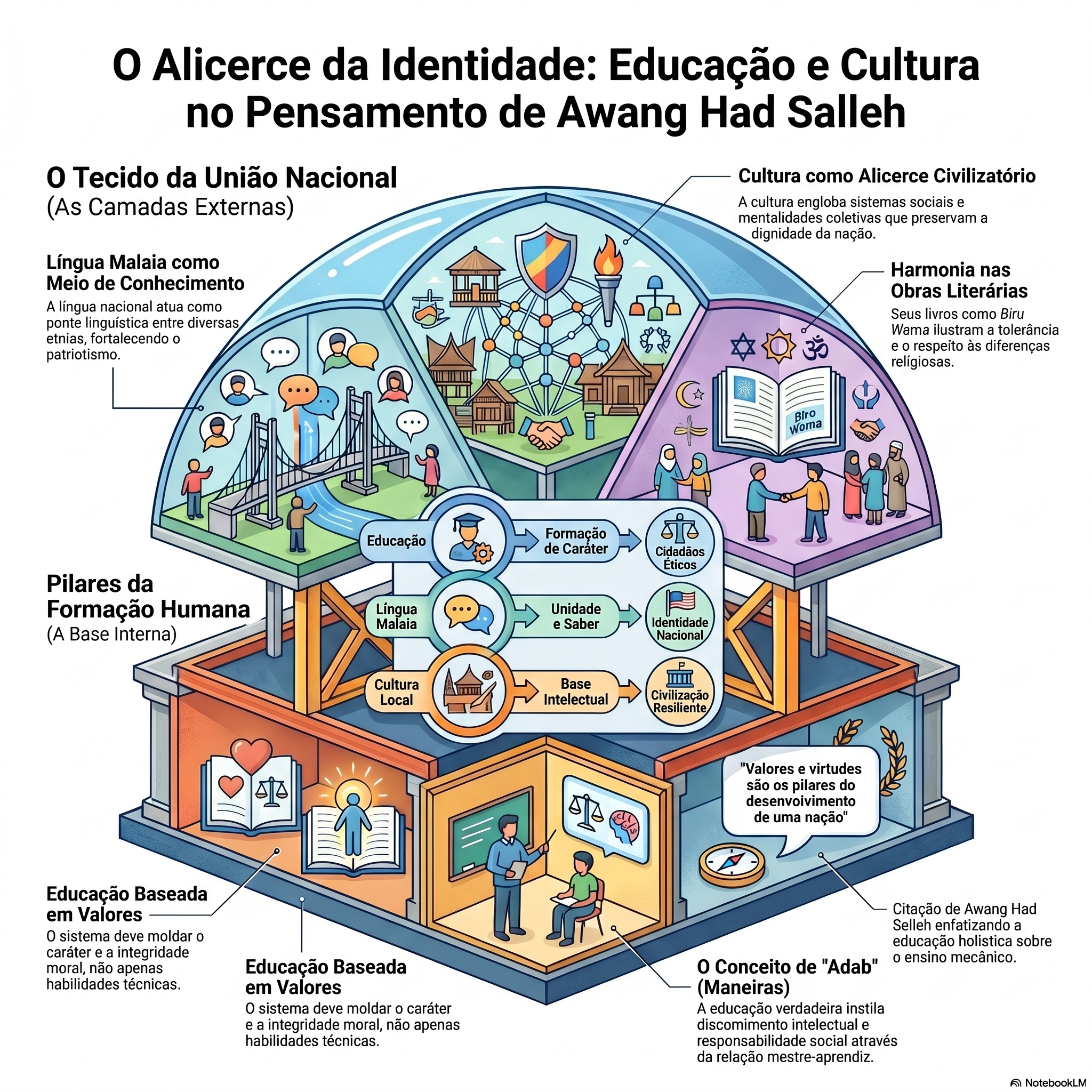
Education and culture play a significant role in shaping national identity in Malaysia. Policies such as the Razak Report (1956) and the Rahman Talib Report (1960) paved the way for the establishment of a national education system based on the principles of unity, knowledge, and human advancement. The works of Awang Had Salleh are seen as contributing to the development of educational and cultural thought in Malaysia. This study employed textual analysis to explore recurring themes in Salleh’s Biru Warna (1974) and Antara Dua Dunia (2005), such as value-based education, the importance of the Malay language and culture in shaping national identity. The findings revealed that Salleh’s thoughts remain highly relevant in modern Malaysia, which faces various challenges posed by globalization and shifting societal values. The study also highlights the importance of strengthening national identity through holistic education grounded in cultural values.
Downloads
References
Abu Bakar Hamid. (2001). Wacana pemikiran pendidikan Melayu [Discourse on Malay educational thought]. UKM Press.
Awang Had Salleh. (1980). Pendidikan dan peranan bahasa dalam pembinaan bangsa [Education and the role of language in nation building]. Jurnal Dewan Bahasa, 24(3), 45–53.
Awang Had Salleh. (1987). Biru warna. Dewan Bahasa dan Pustaka.
Awang Had Salleh. (1992). Pendidikan dan perubahan sosial [Education and social change]. Dewan Bahasa dan Pustaka.
Awang Had Salleh. (1993). Warna-warna pengalaman seorang guru [The many shades of a teacher’s experience]. Utusan Publication & Distribution Sdn. Bhd.
Awang Had Salleh. (1994). Budaya ilmu dan pembangunan tamadun [The culture of knowledge and the development of civilization] [Public lecture]. ATMA, Universiti Kebangsaan Malaysia.
Awang Had Salleh. (2005a). Antara dua dunia. Dewan Bahasa dan Pustaka.
Awang Had Salleh. (2005b). Kumpulan cerpen antara dua dunia [Collection of short stories: Between two worlds]. Dewan Bahasa dan Pustaka.
Braun, V., & Clarke, V. (2006). Using thematic analysis in psychology. Qualitative Research in Psychology, 3(2), 77–101.
Creswell, J. W. (2014). Research design: Qualitative, quantitative, and mixed methods approaches. Sage.
Miles, M. B., Huberman, A. M., & Saldaña, J. (2014). Qualitative data analysis: A methods sourcebook. Sage.
Mohd Yusof Hasan. (2018). Lagenda pendidikan global Malaysia [The legend of global education in Malaysia]. Penerbit UPSI.
Mohd Taib Osman. (1981). Traditional Malay literature in historical perspective. Dewan Bahasa dan Pustaka.
Muhammad Haji Salleh (Ed.). (2004). An anthology of contemporary Malaysian literature. Oxford Fajar.
Patton, M. Q. (2002). Qualitative research & evaluation methods. Sage.
Shahril Nizam. (2015). Jati diri dalam pemikiran Melayu kontemporari [Identity in contemporary Malay thought]. Penerbit Universiti Malaya.
Downloads
Published
How to Cite
Issue
Section
License
Copyright (c) 2026 Revista on line de Política e Gestão Educacional

This work is licensed under a Creative Commons Attribution-NonCommercial-ShareAlike 4.0 International License.
Manuscritos aceitos e publicados são de propriedade da Revista on line de Política e Gestão Educacional. É vedada a submissão integral ou parcial do manuscrito a qualquer outro periódico. A responsabilidade do conteúdo dos artigos é exclusiva dos autores. É vedada a tradução para outro idioma sem a autorização escrita do Editor ouvida a Comissão Editorial Científica.