Avanço da pedagogia da educação infantil por meio da integração de lousas eletrônicas móveis e portfólios digitais
DOI:
https://doi.org/10.22633/rpge.v30iesp1.20943Palavras-chave:
King Abdul Aziz University, Portfólio digital, Envolvimento parental, Educação infantil, STEAM-PJBLResumo
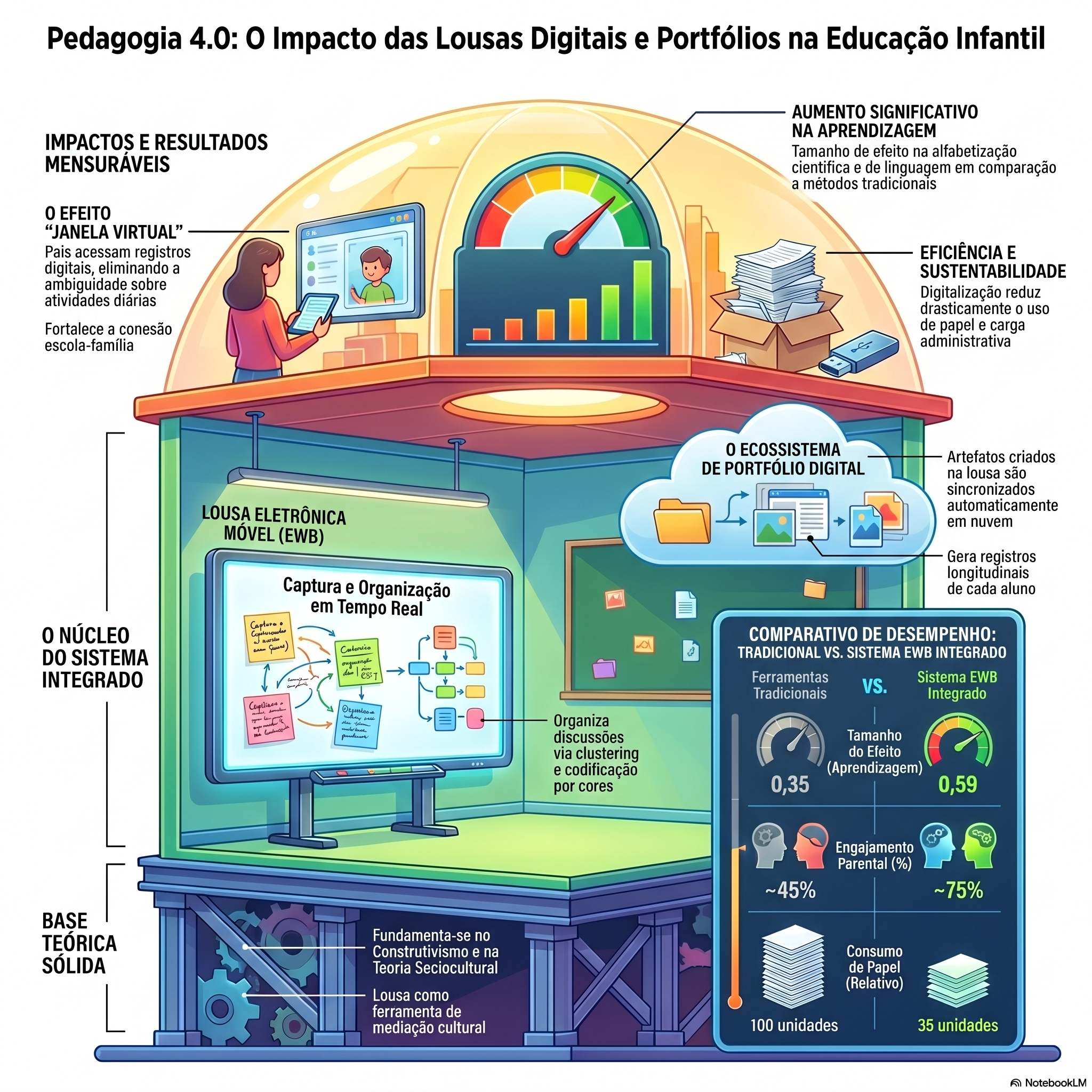
Este artigo apresenta uma análise crítica da aplicação de um sistema de Lousa Eletrônica Móvel (EWB) como ferramenta pedagógica para estruturar o discurso colaborativo em sala de aula e aprimorar o envolvimento parental no contexto da educação infantil. O delineamento metodológico adotado é de natureza mista, integrando resultados de meta-análises prévias sobre TIC com dados qualitativos obtidos por meio de entrevistas com stakeholders-chave, como professores e pais. Os resultados indicam que a EWB promove avaliações multidimensionais, superando o modelo tradicional somativo e avançando para uma abordagem formativa e baseada em evidências. Evidências empíricas demonstram que a capacidade da EWB de documentar e categorizar dados instrucionais em tempo real resulta em melhoria estatisticamente significativa na aprendizagem de conteúdos, com tamanho de efeito observado de 0,59, alinhado a estudos anteriores sobre aprendizagem mediada por TIC.
Downloads
Referências
Alaçam, N. (2025). The role of pedagogical documentation in child and parent participation: An investigation of educator and parent perspectives in a Reggio Emilia-inspired preschool. European Early Childhood Education Research Journal, 1–18.
Alghamdi, S. (2025). Mobile electronic whiteboard (No. 1795037). Japan Patent Office. https://www.j-platpat.inpit.go.jp/s0100
Ain, Q., & Butt, B. (2024). Exploring the impact of interactive whiteboards on interaction patterns between teachers and students and learning outcomes in early years education: An explanation through critical discourse analysis. Annals of Human and Social Sciences, 5(1), 646–659.
Aust, L., Schütze, B., Hochweber, J., & Souvignier, E. (2024). Effects of formative assessment on intrinsic motivation in primary school mathematics instruction. European Journal of Psychology of Education, 39(3), 2177–2200.
Handley, H. (2023). Best practices for using online interactive whiteboards. The Journal of Applied Instructional Design, 12(4), 57–73.
Maceira, T. E., & Wong, D. A. (2017). Beyond passive learning: Utilizing active learning tools for engagement, reflection, and creation.
Miller, P. J., Sperry, D. E., & Sperry, L. L. (2024). A deficit story in motion: How marginalized youngsters are defined out of the educational game before they enter school. Journal of Social Issues, 80(4), 1218–1237.
Mohamed Hashim, M. A., Tlemsani, I., & Matthews, R. (2022). Higher education strategy in digital transformation. Education and Information Technologies, 27(3), 3171–3195.
Nguyen, L. T., Kanjug, I., Lowatcharin, G., Manakul, T., Poonpon, K., Sarakorn, W., et al. (2022). How teachers manage their classroom in the digital learning environment: Experiences from the University Smart Learning Project. Heliyon, 8(10).
Okada, A., Sherborne, T., Panselinas, G., & Kolionis, G. (2025). Fostering transversal skills through open schooling supported by the CARE-KNOW-DO pedagogical model and the UNESCO AI competencies framework. International Journal of Artificial Intelligence in Education, 1–46.
Petre, G. E. (2020). Developing students’ leadership skills through cooperative learning: An action research case study. International Forum Journal, 23(2), 143–162.
Purola, K., Kuusisto, A., & Reunamo, J. (2025). Digital portfolios as a means to enhance parental participation in early childhood education and care. In Handbook on families and education (pp. 191–206). Edward Elgar Publishing.
Rehman, I. U., & Ullah, S. (2022). Gestures- and marker-based low-cost interactive writing board for primary education. Multimedia Tools and Applications, 81(1), 1337–1356.
Stacey, S. (2023). Pedagogical documentation in early childhood: Sharing children's learning and teachers' thinking. Redleaf Press.
Sultana, S., Rastogi, R., & Tabassum, S. (2022). Social constructivist approach: A panacea for EFL learners’ stress and anxiety during COVID-19. Journal of Positive School Psychology, 6(3), 1–8.
Tian, S., Wang, D., Wang, J., & Zhong, W. (2025). Empowering GenAI with a guidance-based approach in MTPE learning: Effect on student translators’ cognitive process, final translation quality and learning motivation. The Interpreter and Translator Trainer, 19(3–4), 379–404.
Washington, J. (2022). Exploring digital equity through parent perceptions of students’ use of 1:1 devices: A mixed methods approach.
Yevdokymova, N. (2024). The psychology of personalized education: Enhancing learning through individualization. SSRN. https://doi.org/10.2139/ssrn.4732923
Zhou, Y., Li, X., & Wijaya, T. T. (2022). Determinants of behavioral intention and use of interactive whiteboard by K-12 teachers in remote and rural areas. Frontiers in Psychology, 13, Article 934423.
Publicado
Como Citar
Edição
Seção
Licença
Copyright (c) 2026 Revista on line de Política e Gestão Educacional

Este trabalho está licenciado sob uma licença Creative Commons Attribution-NonCommercial-ShareAlike 4.0 International License.
Manuscritos aceitos e publicados são de propriedade da Revista on line de Política e Gestão Educacional. É vedada a submissão integral ou parcial do manuscrito a qualquer outro periódico. A responsabilidade do conteúdo dos artigos é exclusiva dos autores. É vedada a tradução para outro idioma sem a autorização escrita do Editor ouvida a Comissão Editorial Científica.