Fostering understanding of infinite geometric series through a visual area model
a didactic design based on APOS theory
DOI:
https://doi.org/10.22633/rpge.v30iesp2.21364Keywords:
Infinite geometric series, APOS theory, Area model, Didactic engineering, Visual representationAbstract
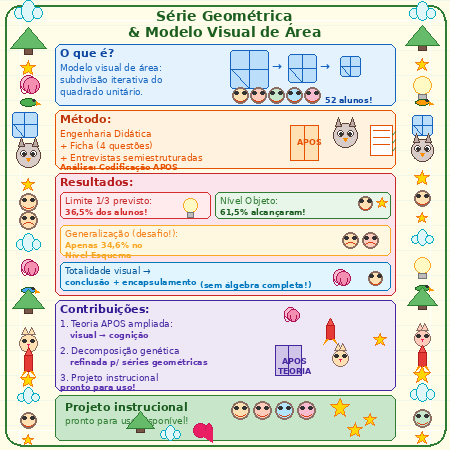
This study investigates how a visual area model (iterative unit square subdivision) influences students’ construction of the sum of an infinite geometric series, and clarifies the cognitive mechanisms involved. Following a didactic engineering approach, 52 Grade 11 students completed a four-question worksheet. Data from worksheets and semi-structured interviews were analyzed using APOS-based coding. The visual model appeared to facilitate completion (36.5% of students correctly predicted the limit 1/3 before formal instruction) and encapsulation (61.5% reached the Object level). However, generalization to arbitrary ratios remained challenging (only 34.6% achieved Schema). The study extends APOS theory by demonstrating that visual totality alone can trigger completion and encapsulation, even without full algebraic mastery. It also offers a refinement of the genetic decomposition for infinite geometric series, highlighting the need for additional scaffolding in generalization. A ready‑to‑use instructional design is provided.
Downloads
References
Arnon, I., Dubinsky, E., Cottrill, J., Oktaç, A., Roa-Fuentes, S., Trigueros, M., & Weller, K. (2014). APOS theory: A framework for research and curriculum development in mathematics education. Springer.
Artigue, M. (1998). Enseñanza y aprendizaje del análisis elemental: ¿Qué se puede aprender de las investigaciones didácticas y los cambios curriculares? Revista Latinoamericana de Investigación en Matemática Educativa, 1(1), 40–55.
Artigue, M. (2014). Didactic engineering in mathematics education. In S. Lerman (Ed.), Encyclopedia of mathematics education (pp. 159–162). Springer.
Brown, A., McDonald, M., & Weller, K. (2010). Step by step: Infinite iterative processes and actual infinity. In F. Hitt, D. Holton, & P. W. Thompson (Eds.), Research in collegiate mathematics education VII: CBMS issues in mathematics education (Vol. 16, pp. 115–141). American Mathematical Society.
Dubinsky, E., Arnon, I., & Weller, K. (2013). Preservice teachers’ understanding of the relation between a fraction or integer and its decimal expansion: The case of 0.9̄ and 1. Canadian Journal of Science, Mathematics and Technology Education, 13(3), 232–258.
Ely, R. (2011). Envisioning the infinite by projecting finite properties. Journal of Mathematical Behavior, 30(1), 1–18. https://doi.org/10.1016/j.jmathb.2010.12.001
Fischbein, E. (2001). Tacit models and infinity. Educational Studies in Mathematics, 48, 309–329. https://doi.org/10.1023/A:1016088708705
Gray, E. M., & Tall, D. O. (1994). Duality, ambiguity, and flexibility: A "proceptual" view of simple arithmetic. Journal for Research in Mathematics Education, 25(2), 116–140. https://doi.org/10.2307/749505
Miles, M. B., Huberman, A. M., & Saldaña, J. (2014). Qualitative data analysis: A methods sourcebook (3rd ed.). Sage.
Nam, P. S. (2013). Improve the effectiveness of teaching some calculus concepts for high school students specializing in mathematics based on the application of constructivist theory (Doctoral dissertation, Vinh University).
Nam, P. S., Linh, N. T., Tu, P. T. T., Lavicza, Z., & Bautista, G., Jr. (2024). PowerPoint as a tool to support the creation of dynamic models for teaching: The case of the sum of an infinite geometric sequence. International Journal for Technology in Mathematics Education, 31(3), 125–134. https://doi.org/10.1564/tme_v31.3.03
Sfard, A. (1991). On the dual nature of mathematical conceptions: Reflections on processes and objects as different sides of the same coin. Educational Studies in Mathematics, 22, 1–36. https://doi.org/10.1007/BF00302715
Sierpinska, A. (1987). Humanities students and epistemological obstacles related to limits. Educational Studies in Mathematics, 18(4), 371–397. https://doi.org/10.1007/BF00240986
Villabona, D., Oktaç, A., & Roa-Fuentes, S. (2024). Acting on totalities of infinite processes: Constructing facets of an object conception. ZDM – Mathematics Education, 56, 1375–1387. https://doi.org/10.1007/s11858-024-01631-6
Downloads
Published
How to Cite
Issue
Section
License
Copyright (c) 2026 Revista on line de Política e Gestão Educacional

This work is licensed under a Creative Commons Attribution-NonCommercial-ShareAlike 4.0 International License.
Manuscritos aceitos e publicados são de propriedade da Revista on line de Política e Gestão Educacional. É vedada a submissão integral ou parcial do manuscrito a qualquer outro periódico. A responsabilidade do conteúdo dos artigos é exclusiva dos autores. É vedada a tradução para outro idioma sem a autorização escrita do Editor ouvida a Comissão Editorial Científica.