Integrated model of digital transformation of higher military education
innovative methods and AI technologies for training a new type of officer
DOI:
https://doi.org/10.22633/rpge.v30iesp2.21385Keywords:
Digital Transformation, Military Education, Officer Training, Simulation Technologies, Digital CompetenciesAbstract
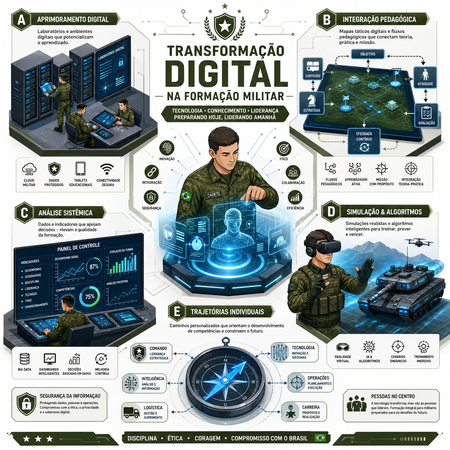
This study aims to improve the educational model of specialized professional military education/training for future officers of the Armed Forces of Ukraine in higher military educational institutions through digital technologies. The research formalizes officer training by integrating technological, pedagogical, and managerial solutions, while distinguishing this specific training context from general or civilian educational systems. Methodologically, the study is based on systems analysis of the educational process and on the construction of integral indices and functional dependencies for assessing learning effectiveness. The results indicate that digital platforms, simulation environments, analytical tools, and algorithmic systems transform the organization of curricula, learning management, competency development, and assessment practices. The proposed model supports more precise evaluation of cadets’ activities and the formation of individual learning trajectories. It also articulates professional, leadership, and digital competencies, clarifying the educational relevance of digital transformation within higher military training.
Downloads
References
Afina, Y. (2026). The global prism of military AI governance: Reflections from the 2025 regional consultations on responsible AI in the military domain. United Nations Institute for Disarmament Research.
Bestyuk, A., & Pokhnatiuk, S. (2025). Integration of artificial intelligence into higher military education as a factor in increasing the efficiency of professional training. Scientific Bulletin of Mukachevo State University. Series “Pedagogy and Psychology,” 11(2), 60–71. https://doi.org/10.52534/msu-pp2.2025.60
Biggs, A. T. (2025). Enhancing professional military education with AI: Best practices for effective implementation. Journal of Military Learning, 22–37.
Chmyr, V., Koriekhov, A., Psol, S., & Partyka, S. (2024). Fostering digital transformations in military engineering education: Introduction of a technology-enhanced learning environment. Problems of Education in the 21st Century, 82(2), 162–185. https://doi.org/10.33225/pec/24.82.162
Danilyan, O. G., Dzeban, O. P., Kalynovskyi, Y. Y., Pavlichenko, O. O., & Serhieieva, H. A. (2023). Applying information technologies at higher military education institutions of Ukraine in the current context: Pedagogical and psychological aspects. Academia y Virtualidad, 16(1), 147–162. https://doi.org/10.18359/ravi.6303
Găină, L. (2025). Perspectives of higher military education through emerging technologies: Integrating radiolocation and artificial intelligence for aerial surveillance. Land Forces Academy Review, 30(2), 260–268. https://doi.org/10.2478/raft-2025-0025
Joshi, S. (2025). Reskilling the U.S. military workforce for the agentic AI era: A framework for educational transformation. Journal of Education, Society and Behavioural Science, 38(6), 1–13. https://doi.org/10.9734/jesbs/2025/v38i61436
Kang, Y., & Lee, H. (2025). AI-driven transformation of military education and training: A comparative SWOT analysis for the Republic of Korea Armed Forces. International Journal of Military Affairs, 10, 12–24. https://doi.org/10.22471/military.2025.10.0.12
Kapoula, O., Panitsidis, K., Vezou, M., & Karapatsias, E. (2026). Systemic thinking and AI-driven innovation in higher education: The case of military academies. Education Sciences, 16(2), Article 183. https://doi.org/10.3390/educsci16020183
Kjeksrud, S., Engdal, S. A., Hokstad, L. M., Grassini, S., & Lindqvist, P. H. F. (2026). Making hybrid war teachable and learnable: Combining artificial intelligence and virtual reality in military education. Scandinavian Journal of Military Studies, 9(1), 62–81. https://doi.org/10.31374/sjms.414
Liu, D. Y. T., & Bates, S. (2025). Generative AI in higher education: Current practices and ways forward [White paper]. Association of Pacific Rim Universities.
Makedon, V., Pavlov, D., Plakhotnik, O., Nechaev, D., & Kovnir, O. (2025). Construction of a strategic change management model to enable the evolution of a high-tech enterprise. Eastern-European Journal of Enterprise Technologies, 6(13), 6–15. https://doi.org/10.15587/1729-4061.2025.347459
Mishra, P. (2025). Code, command, and conflict: Charting the future of AI in national security. Belfer Center for Science and International Affairs, Harvard Kennedy School.
NATO Defence Education Enhancement Programme (DEEP). (2025). NATO DEEP eAcademy education & training portfolio 2025.
Özbek, C., & Erdem, T. (2025). Technological trends in security policies of NATO: Artificial intelligence (AI). Mehmet Akif Ersoy Üniversitesi İktisadi ve İdari Bilimler Fakültesi Dergisi, 12(4), 1545–1563. https://doi.org/10.30798/makuiibf.1677558
Rashid, A. B., Kausik, A. K., Sunny, A. A. H., Bappy, M. H., & Hassan, M. (2023). Artificial intelligence in the military: An overview of the capabilities, applications, and challenges. International Journal of Intelligent Systems, 2023, Article 8676366. https://doi.org/10.1155/2023/8676366
Rodikov, V., Shemchuk, V., Zinevych, A., Romanyshyna, O., & Trotskyi, R. (2025). Building professional competencies of military specialists in different countries. Eduweb, 19(3), 125–138. https://doi.org/10.46502/issn.1856-7576/2025.19.03.8
Shylo, S., Borozenets, I., Osiievskyi, S., Nesmiian, O., Open’ko, P., & Uhrynovych, O. (2022). Formalized student representation in the higher military education institution online learning system. Social Development and Security, 12(3), 30–38. https://doi.org/10.33445/sds.2022.12.3.4
Storey, V. A., & Wagner, A. (2025). Integrating artificial intelligence into military education: Opportunities, challenges, and future directions. Journal of East-West Thought, 15(1), 1–15. https://doi.org/10.4018/IJAET.345921
Tran, H. T., & Tran, X. P. (2026). Factors affecting the effectiveness of information technology applications and digital transformation in education and training at military schools in the current context. Vietnam Journal of Educational Sciences, 22(2), 40–48.
Trofymenko, O., Loginova, N., Sokolov, A., Chikunov, P., & Akhmametieva, H. (2024). Artificial intelligence in the military sphere. Cybersecurity: Education, Science, Technique, 1(25), 161–176. https://doi.org/10.28925/2663-4023.2024.25.161176
Wu, Y., Gao, X., Zhu, Y., Zhong, P., & Deng, P. (2025, April 25–27). Exploring the application of artificial intelligence technology in the field of military continuing education. In B. Majoul, A. Abdullah, S. F. S. Mohammed, & F. D. Hutagalung (Eds.), Proceedings of the 2025 11th International Conference on Humanities and Social Science Research (ICHSSR 2025) (pp. 1230–1236). Atlantis. https://doi.org/10.2991/978-2-38476-440-2_138
Zhai, C., Jing, B., Fang, S., Hu, X., Tan, Y., & Dai, L. (2025, October 24–26). The evolution and prospects of US military AI-enabled military training. In Association for Computing Machinery (Ed.), Proceedings of the 2025 4th International Conference on Artificial Intelligence and Intelligent Information Processing (AIIIP 2025) (pp. 627–632). ICPS. https://doi.org/10.1145/3778534.3778632
Downloads
Published
How to Cite
Issue
Section
License
Copyright (c) 2026 Revista on line de Política e Gestão Educacional

This work is licensed under a Creative Commons Attribution-NonCommercial-ShareAlike 4.0 International License.
Manuscritos aceitos e publicados são de propriedade da Revista on line de Política e Gestão Educacional. É vedada a submissão integral ou parcial do manuscrito a qualquer outro periódico. A responsabilidade do conteúdo dos artigos é exclusiva dos autores. É vedada a tradução para outro idioma sem a autorização escrita do Editor ouvida a Comissão Editorial Científica.