Meditative practices in school
perceptions about learning and feelings in elementary school students
DOI:
https://doi.org/10.30715/doxa.v27i00.20412Keywords:
Emotional health, Learning, Affectivity, Qualitative-quantitative researchAbstract
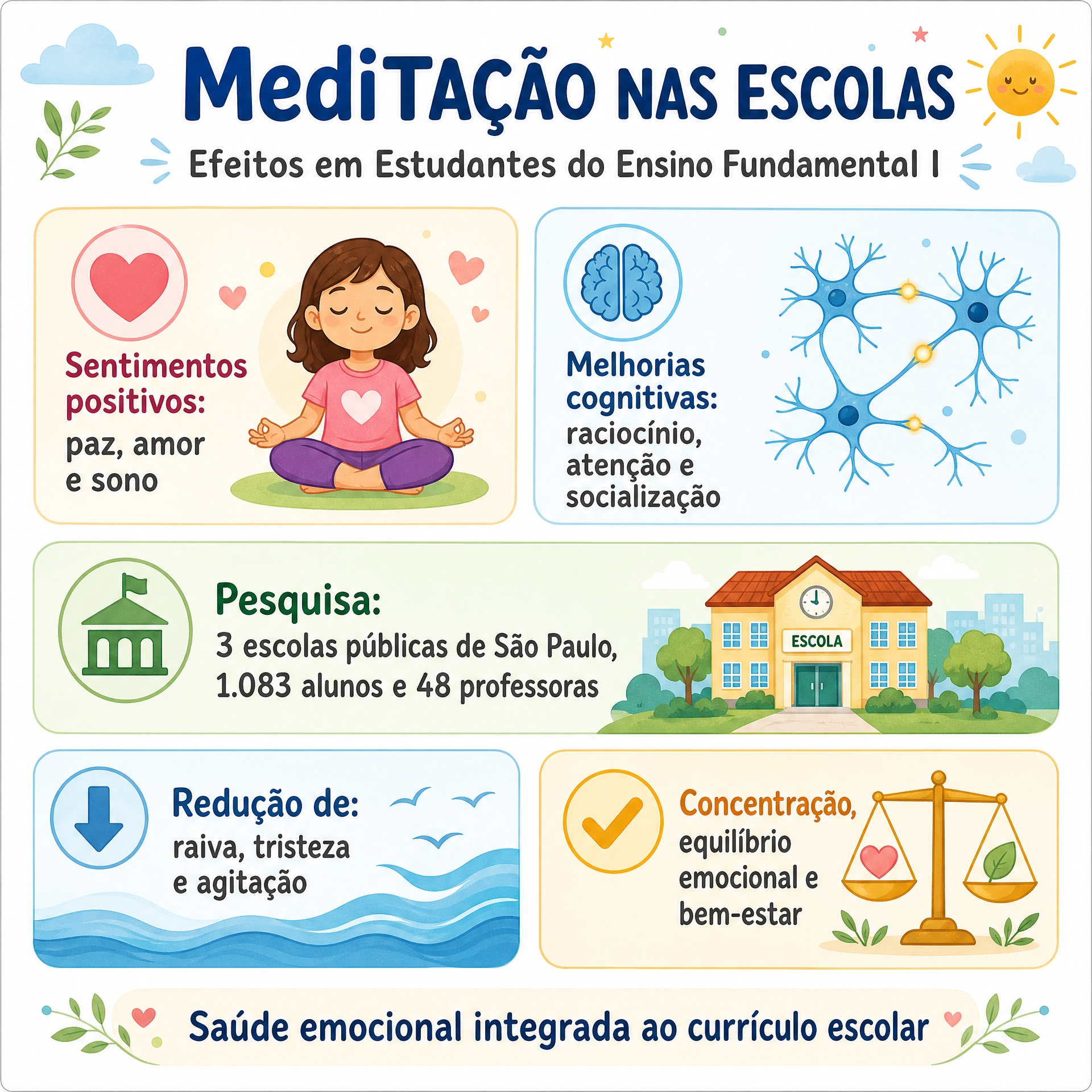
The article analyzes the effects of meditative practices on Elementary School students, focusing on emotional, behavioral, and cognitive aspects. The research was conducted in three public schools in the state of São Paulo, involving 1,083 students and 48 teachers, using questionnaires, interviews, and emoji-based scales. The results indicate an increase in feelings of peace, love, and sleepiness, and a decrease in anger, sadness, curiosity, and joy (associated with agitation). The teachers reported improvements in students' reasoning, attention, and socialization. Meditative practices contributed to students’ concentration, emotional balance, and well-being, being seen as effective tools for comprehensive education. The study highlights the importance of integrating emotional health into the school curriculum, especially in the post-pandemic context, fostering more affective and welcoming learning environments.
Downloads
References
Bauer, M. W., Gaskell, G., & Allum, N. C. (2008). Qualidade, quantidade e interesses do conhecimento: Evitando confusões. In M. W. Bauer & G. Gaskell (Orgs.), Pesquisa qualitativa com texto, imagem e som: Um manual prático (P. A. Guareschi, Trad.; 7ª ed.; pp. 17–36). Vozes.
Bothe, D. A., Grignon, J. B., & Olness, K. N. (2014). The effects of a stress management intervention in elementary school children. Journal of Developmental & Behavioral Pediatrics, 35(1), 62–67. https://doi.org/10.1097/DBP.0000000000000016
Damásio, A. R. (2012). O erro de Descartes: Emoção, razão e o cérebro humano. Companhia das Letras.
Fleer, M., & Hammer, M. (2013). Emotions in imaginative situations: The valued place of fairytales for supporting emotion regulation. Mind, Culture, and Activity, 20(3), 240–259. https://doi.org/10.1080/10749039.2013.781652
Goleman, D. (2012). Inteligência emocional (M. Santarrita, Trad.). Objetiva.
Instituto Brasileiro de Geografia e Estatística. (2022). Censo demográfico 2022. https://www.ibge.gov.br/estatisticas/sociais/saude/22827-censo-demografico-2022.html
Instituto Brasileiro de Geografia e Estatística. (2017). Pesquisa nacional de saneamento básico 2017: Abastecimento de água e esgotamento sanitário. https://agenciadenoticias.ibge.gov.br/media/com_mediaibge/arquivos/45f7422705c07ef3409d076fd95bd516.pdf
Kim, J., Kim, S., Kim, M. W. D., Park, Y.-H., Lee, K., Chung, D. S., Kim, Y. H., Kweon, Y.-S., Moon, D.-S., Lee, H.-Y., Park, J. S., Kang, Y. H., Won, S., & Kwack, Y. S. (2024). Effectiveness of the mindfulness-based social–emotional growth (MSEG) program in enhancing mental health of elementary school students in Korea. Behavioral Sciences, 15(3), 315. https://doi.org/10.3390/bs15030315
Leal, C. (2022). Afecções e afetos em Spinoza: Sua contribuição para a psicologia. Sapere Aude, 13(25), 359–369. https://doi.org/10.5752/P.2177-6342.2022v13n25p359-369
Leite, S. A. S. (2012). Afetividade nas práticas pedagógicas. Temas em Psicologia, 20(2), 355–368. https://doi.org/10.9788/TP2012.2-06
Leite, S. A. S., & Tagliaferro, A. R. (2005). A afetividade na sala de aula: Um professor inesquecível. Psicologia Escolar e Educacional, 9(2), 247–260. https://doi.org/10.1590/S1413-85572005000200007
Lines, R. (2005). The structure and function of attitudes toward organizational change. Human Resource Development Review, 4(1), 8–32. https://doi.org/10.1177/1534484304273818
Milaré, C. A. R., Lacerda, S., Barrichello, C., Tobo, P., Okuno, M. F. P., & Horta, A. L. M. (2025). Effects of a mindfulness training on self-regulation and social-emotional skills in basic education: Perceptions of teachers, family members, and students. Estudos de Psicologia, 42, e220113. https://doi.org/10.1590/1982-0275202542e220113
Minayo, M. C. S. (2012). Análise qualitativa: Teoria, passos e fidedignidade. Ciência & Saúde Coletiva, 17(3), 621–626. https://doi.org/10.1590/S1413-81232012000300007
Rumenos, N. N., Spazziani, M. L., Nogueira, L. E. M. B., Santos, M. S. G., Oliveira, G. G., & Vidotto, I. (2023). Educação em saúde ambiental, física e emocional: Formação de guias da natureza e a implementação de projetos nas escolas de São Manuel-SP. Scientific Journal ANAP, 1(6), 228–240. https://publicacoes.amigosdanatureza.org.br/index.php/anap/article/view/4252
Santos Filho, J. C. (1995). Pesquisa quantitativa versus pesquisa qualitativa: O desafio paradigmático. In J. C. Santos Filho & S. S. Gamboa (Orgs.), Pesquisa educacional: Quantidade-qualidade (pp. 13–59). Cortez.
Sarroeira, S., Pereira, B. O., Carvalho, G. S., & Fernández, E. R. (2022). Intervenções baseadas em métodos de relaxação em contexto escolar na perspetiva de promoção de saúde e bem-estar: Uma revisão sistemática. Retos, 45, 582–590. https://doi.org/10.47197/retos.v45i0.90898
Souza, D. M., Fortunato, I., & Correa, M. T. (2020). O pensamento holístico na escola: O caso do projeto meditação de Itapetininga/SP. Temas em Educação e Saúde, 16(2), 675–688. https://doi.org/10.26673/tes.v16i2.14590
Souza, K. R., & Kerbauy, M. T. M. (2017). Abordagem quanti-qualitativa: Superação da dicotomia quantitativa-qualitativa na pesquisa em educação. Educação e Filosofia, 31(61), 21–44. https://doi.org/10.14393/REVEDFIL.issn.0102-6801.v31n61a2017-p21a44
Spazziani, M. L., Gheler-Costa, C., Vieira, C. L. Z., & Toqueti, F. (2022). Educação e educação ambiental: Perspectivas críticas e a vertente sintrópica para a regeneração planetária. In M. L. Spazziani, N. N. Rumenos, E. A. T. Pinto, C. Gheler-Costa, C. L. Z. Vieira, & F. Toqueti (Orgs.), Educação ambiental sintrópica: Ensaios para o futuro (pp. 31–60). Cultura Acadêmica.
Spazziani, M. L., Stipkovic, G. C., & Rumenos, N. N. (2024). Educação ambiental sintrópica e as competências emocionais, sociais e de trabalho dos professores e suas percepções na aprendizagem dos estudantes e da comunidade. Aracê, 6(4), 11798–11816.
Spinoza, B. (2009). Ética (T. Tadeu, Trad.). Autêntica.
The Mindfulness Initiative. (2024). Mindfulness All-Party Parliamentary Group. https://www.themindfulnessinitiative.org/mindfulness-all-party-parliamentary-group
Vickery, C. E., & Dorjee, D. (2016). Mindfulness training in primary schools decreases negative affect and increases metacognition in children. Frontiers in Psychology, 6, 2025. https://doi.org/10.3389/fpsyg.2015.02025
Vieira, C. L. Z., Stipkovic, G., & Carnevalle, C. V. (2022). Educação emocional na educação ambiental sintrópica. In M. L. Spazziani, N. N. Rumenos, E. A. T. Pinto, C. Gheler-Costa, C. L. Z. Vieira, & F. Toqueti (Orgs.), Educação ambiental sintrópica: Ensaios para o futuro (pp. 193–210). Cultura Acadêmica.
Vygotsky, L. S. (2001). A construção do pensamento e da linguagem (P. Bezerra, Trad.). Martins Fontes.
Wallon, H. (2007). A evolução psicológica da criança (C. Berliner, Trad.). Martins Fontes.
World Health Organization. (2024, October 5). Mental health. https://www.who.int/en/news-room/fact-sheets/detail/mental-health-strengthening-our-response
Wortmeyer, D. S., Silva, D. N. H., & Branco, A. U. (2014). Explorando o território dos afetos a partir de Lev Semenovich Vigotski. Psicologia em Estudo, 19(2), 285–296. https://doi.org/10.1590/1413-737223446011
Zabala, A. (2014). A prática educativa: Como ensinar (E. F. F. Rosa, Trad.). Penso.
Zenner, C., Herrnleben-Kurz, S., & Walach, H. (2014). Mindfulness-based interventions in schools: A systematic review and meta-analysis. Frontiers in Psychology, 5, 603. https://doi.org/10.3389/fpsyg.2014.00603
Downloads
Published
How to Cite
Issue
Section
License
Copyright (c) 2026 DOXA: Revista Brasileira de Psicologia e Educação

This work is licensed under a Creative Commons Attribution-NonCommercial-ShareAlike 4.0 International License.
Manuscritos aceitos e publicados são de propriedade da Doxa. É vedada a submissão integral ou parcial do manuscrito a qualquer outro periódico. A responsabilidade do conteúdo dos artigos é exclusiva dos autores. É vedada a tradução para outro idioma sem a autorização escrita do Editor ouvida a Comissão Editorial.