De la curiosidad a la ciencia. Fomentando el pensamiento científico en preescolar
Palavras-chave:
educación preescolar, pensamiento, aprendizaje activo, transformaciones de alimentos, curiosidadResumo
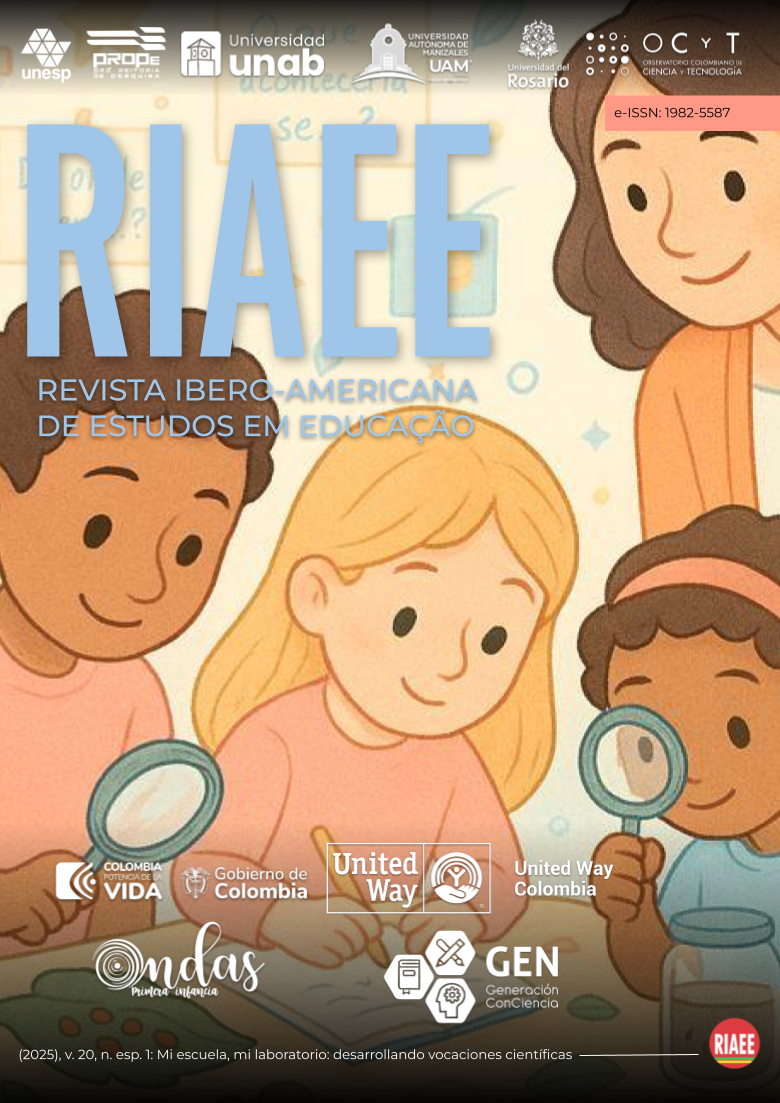
El presente artículo da cuenta de una investigación que analizó el desarrollo del pensamiento científico en niños de preescolar de la Institución Educativa Luis Eduardo Mora Osejo, en Pasto, Colombia; a través de actividades enfocadas en las transformaciones de la materia. El estudio se centró en motivar la curiosidad y el razonamiento científico mediante experimentos prácticos y accesibles, adaptados a la edad de los niños. La metodología cualitativa empleada incluyó observación directa y el uso de diarios de campo para registrar el aprendizaje. Los resultados muestran un incremento en la participación activa de los estudiantes, quienes lograron una comprensión más profunda sobre los cambios en los materiales. Asimismo, el trabajo colaborativo y la experimentación contribuyeron al desarrollo de habilidades como la observación, formulación de hipótesis y resolución de problemas, evidenciando la efectividad de esta estrategia pedagógica en la educación infantil.
https://doi.org/10.21723/riaee.v20iesp.1.2022801
Downloads
Referências
ALLEN, M. Misconceptions in primary science. 2. ed. New York: McGraw-Hill Education, 2014.
AMERICAN PSYCHOLOGICAL ASSOCIATION. Ethical principles of psychologists and code of conduct. Washington, D.C.: APA, 2017.
BARTON, A. C.; TAN, E. We Be Burnin’! Agency, Identity, and Science Learning. Journal of the Learning Sciences, Milton Park, v. 19, n. 2, p. 187-229, 2010. DOI: https://doi.org/10.1080/10508400903530044.
BERK, L. E. Child development. 8. ed. Boston: Pearson, 2008.
BRUNER, J. S. The act of discovery. Harvard Educational Review, Cambridge, v. 31, n. 1, p. 21-32, 1961.
CHI, M. T. H.; WYLIE, R. The ICAP framework: linking cognitive engagement to active learning outcomes. Educational Psychologist, Milton Park, v. 49, n. 4, p. 219-243, 2014. DOI: https://doi.org/10.1080/00461520.2014.965823.
COLOMBIA. Ministério de Educación Nacional de Colombia. Lineamientos pedagógicos para la educación inicial en el marco de la atención integral. Bogotá: MEN, 2019.
CRESWELL, J. W. Research design: Qualitative, quantitative, and mixed methods approaches. 4. ed. Thousand Oaks: SAGE, 2013.
CRESWELL, J. W.; POTH, C. N. Qualitative inquiry and research design: Choosing among five approaches. 4. ed. Thousand Oaks: SAGE, 2017.
CROWLEY, K. et al. Shared scientific thinking in everyday parent–child activity. Science Education, Hoboken, v. 85, n. 6, p. 712-732, 2001. DOI: https://doi.org/10.1002/sce.1035.
DRIVER, R. et al. Making sense of secondary science: research into children’s ideas. London: Routledge, 2014. DOI: https://doi.org/10.4324/9781315747415.
ESHACH, H.; FRIED, M. N. Should science be taught in early childhood? Journal of Science Education and Technology, Berlin, v. 14, n. 3, p. 315-336, 2005. https://doi.org/10.1007/s10956-005-7198-9.
FLEER, M. Supporting scientific conceptual consciousness or learning in ‘a roundabout way’ in play‐based contexts. International Journal of Science Education, Milton Park, v. 31, n. 8, p. 1069-1089, 2009. https://doi.org/10.1080/09500690801953161.
FLEER, M. The demands and motives afforded through digital play in early childhood activity settings. Learning, Media and Technology, Milton Park, v. 39, n. 3, p. 327-341, 2014.
FLICK, U. An introduction to qualitative research. 6. ed. Thousand Oaks: SAGE, 2018.
GELMAN, R.; BRENNEMAN, K. Science learning pathways for young children. Early Childhood Research Quarterly, Columbus, v. 19, n. 1, p. 150-158, 2004. https://doi.org/10.1016/j.ecresq.2004.01.009.
GILLIES, R. M. Cooperative learning: Review of research and practice. The Australian Journal of Teacher Education, Joondalup, v. 41, n. 3, p. 39-54, 2016. https://doi.org/10.14221/ajte.2016v41n3.3.
GOPNIK, A.; MELTZOFF, A. N.; KUHL, P. K. The scientist in the crib: What early learning tells us about the mind. New York: William Morrow & Co, 2001.
HERNÁNDEZ, R.; FERNÁNDEZ, C.; BAPTISTA, P. Metodología de la investigación. 6. ed. Ciudad de México: McGraw-Hill, 2014.
HOWE, C.; ABEDIN, M. Classroom dialogue: A systematic review across four decades of research. Cambridge Journal of Education, Cambridge, v. 43, n. 3, p. 325-356, 2013. https://doi.org/10.1080/0305764X.2013.786024.
JOHNSON, D. W.; JOHNSON, R. T. An educational psychology success story: social interdependence theory and cooperative learning. Educational Researcher, Thousand Oaks, v. 38, n. 5, p. 365-379, 2009. https://doi.org/10.3102/0013189X09339057.
NIELSEN, J. A. Co-constructing arguments in classroom talk: How ‘doing science’ involves particular argumentative roles. International Journal of Science Education, Milton Park, v. 41, n. 11, p. 1465-1483, 2019.
OSBORNE, J.; DILLON, J. Good practice in science teaching: what research has to say. Maidenhead: Open University Press, 2010.
PATTON, M. Q. Qualitative research and evaluation methods. 4. ed. Thousand Oaks: SAGE, 2015.
PIAGET, J. The principles of genetic epistemology. New York: Basic Books, 1972.
SHEPHERD, J. Childhood curiosity and scientific inquiry. Journal of Early Childhood Research, Thousand Oaks, v. 4, n. 1, p. 12-21, 2006.
SHONKOFF, J. P.; PHILLIPS, D. A. From neurons to neighborhoods: The science of early childhood development. Washington, D.C.: National Academies Press, 2000.
SLAVIN, R. E. Educational psychology: Theory and practice. 11. ed. Boston: Pearson, 2014.
SPRADLEY, J. P. Participant observation. Long Grove: Waveland Press, 2016.
THARP, R. G.; GALLIMORE, R. Rousing minds to life: Teaching, learning, and schooling in social context. Cambridge: Cambridge University Press, 1998.
TRUNDLE, K. C.; SACKES, M. The early childhood science education research. Journal of Science Education and Technology, Berlin, v. 24, n. 2-3, p. 165-186, 2015.
VYGOTSKY, L. S. Mind in society: The development of higher psychological processes. Cambridge: Harvard University Press, 1978.
WORTH, K.; GROLLMAN, S. Science in early childhood classrooms: Content and process. Early Childhood Research Quarterly, Columbus, v. 18, n. 1, p. 131-150, 2003.
Downloads
Publicado
Como Citar
Edição
Seção
Licença
Copyright (c) 2026 Alba Nubia Muñoz Rosero, Lina Maria Osorio Valdés

Este trabalho está licenciado sob uma licença Creative Commons Attribution 4.0 International License.
Manuscritos aceitos e publicados são de propriedade dos autores com gestão da Ibero-American Journal of Studies in Education. É proibida a submissão total ou parcial do manuscrito a qualquer outro periódico. A responsabilidade pelo conteúdo dos artigos é exclusiva dos autores. A tradução para outro idioma é proibida sem a permissão por escrito do Editor ouvido pelo Comitê Editorial Científico.