Abordagens inovadoras para a formação profissional de futuros especialistas no ensino superior
DOI:
https://doi.org/10.22633/rpge.v30i00.20845Palavras-chave:
Instituições de ensino superior, Realidade virtual, Realidade aumentada, Blockchain, Informatização do processo educacionalResumo
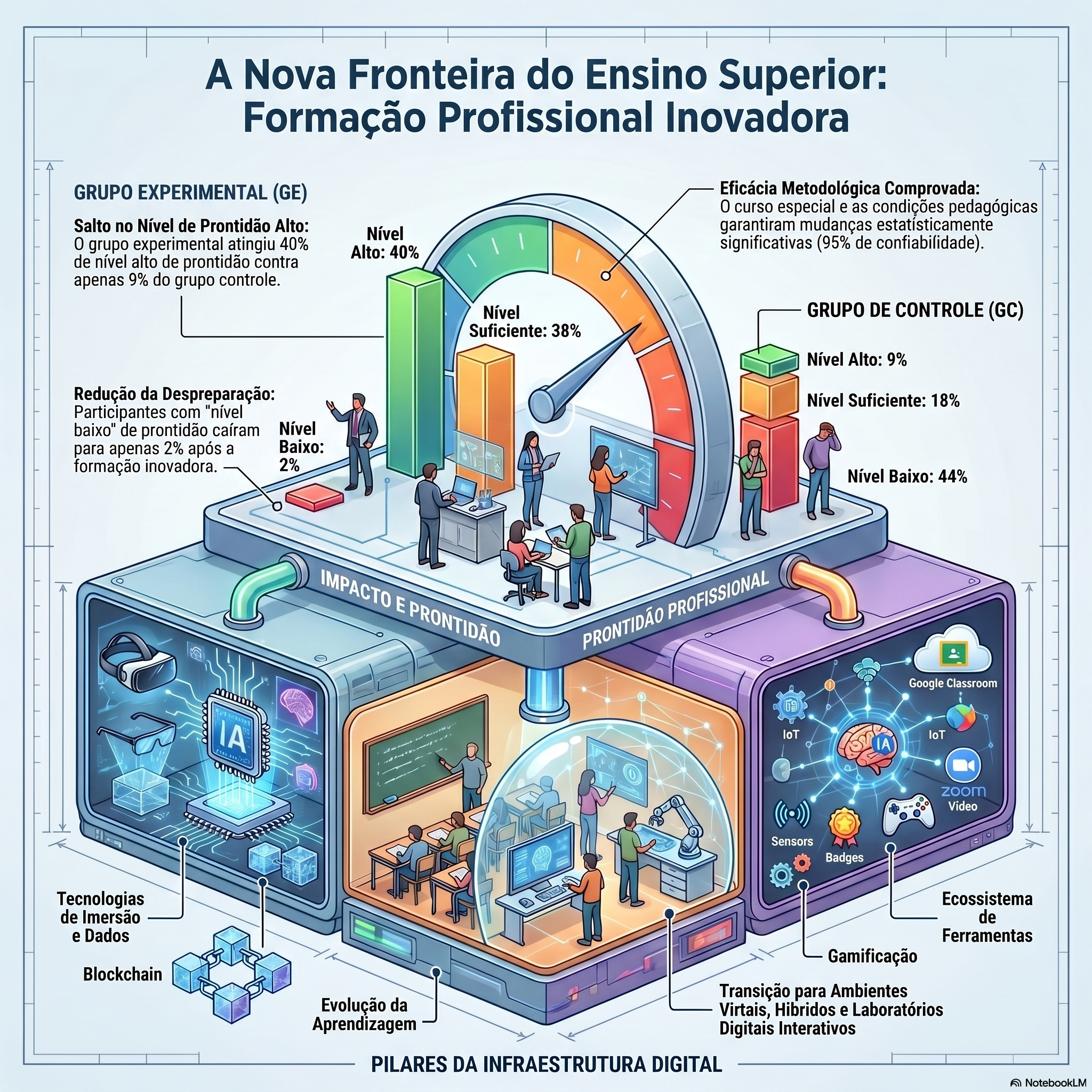
O artigo examina o conteúdo dos conceitos de pesquisa e os principais requisitos inovadores para os especialistas modernos. Destaca os métodos de ensino inovadores necessários para os estudantes durante sua formação profissional no ensino superior. Os períodos em que as tecnologias de ensino inovadoras são utilizadas nas instituições de ensino superior são caracterizados. A essência do experimento foi exercer influência direcionada sobre os participantes para aprimorar a formação profissional de futuros especialistas por meio de tecnologias de ensino inovadoras. A análise do estado inicial de prontidão para o uso de tecnologias de ensino inovadoras, seus baixos indicadores e a modelagem do processo de preparação para a atividade delineada permitiram a transição da fase de verificação para a fase formativa do experimento. Os resultados da fase de controle do estudo indicam a eficácia de todos os materiais de apoio metodológico, cursos específicos e condições pedagógicas utilizadas no grupo experimental.
Downloads
Referências
Alexander, B., Ashford-Rowe, K., Barajas-Murph, N., Dobbin, G., Knott, J., McCormack, M., Pomerantz, J., Seilhamer, R., & Weber, N. (2019). Horizon report 2019 higher education edition. EDUCAUSE. https://www.learntechlib.org/p/208644/
Aljawarneh, S. A. (2019). Reviewing and exploring innovative ubiquitous learning tools in higher education. Journal of Computing in Higher Education, 32(1), 57–73. https://doi.org/10.1007/s12528-019-09207-0
Almeida, F., & Simões, J. (2019). The role of serious games, gamification and Industry 4.0 tools in the Education 4.0 paradigm. Contemporary Educational Technology, 10(2), 120–136. https://doi.org/10.30935/cet.554469
Buinytska, O. P. (2021). System of pedagogical design of information and educational environment for training future social educators [Monograph, Borys Grinchenko Kyiv University]. Digital Library NAES of Ukraine. https://lib.iitta.gov.ua/id/eprint/729269/
Castro, R. (2019). Blended learning in higher education: Trends and capabilities. Education and Information Technologies, 24(4), 2523–2546. https://doi.org/10.1007/s10639-019-09886-3
Geng, S., Law, K. M. Y., & Niu, B. (2019). Investigating self-directed learning and technology readiness in blended learning environment. International Journal of Educational Technology in Higher Education, 16(1), 17. https://doi.org/10.1186/s41239-019-0147-0
Haidabrus, B. (2022). Information technology and management in higher education and science. Futurity Education, 2(4), 29–41. https://doi.org/10.57125/fed.2022.25.12.03
Kim, H. J., Hong, A. J., & Song, H.-D. (2019). The roles of academic engagement and digital readiness in students’ achievements in university e-learning environments. International Journal of Educational Technology in Higher Education, 16(1), 21. https://doi.org/10.1186/s41239-019-0152-3
Knysh, I., Chovriy, S., Vaculenko, S., Koycheva, T., Lytvynov, A., & Kuchai, O. (2026). Artificial intelligence: A tool for quality training of future specialists in socio-economic specialties. Revista Conrado, 22(108), e4682. https://conrado.ucf.edu.cu/index.php/conrado/article/view/4682
Knysh, I., Drobin, A., Filimonova, T., Koycheva, T., Kushnir, A., & Kuchai, O. (2024). The use of information technologies in the educational space of Ukraine (on the example of STEAM technologies). Revista Conrado, 20(100), 437–448.
Kuchai, T., Kuchai, O., & Pyrzyk, I. (2017). Studying the peculiarities of education development in Japan (in terms of primary education). Science and Education, (5), 33–39. https://doi.org/10.24195/2414-4665-2017-5-7
Lai, J. W. M., & Bower, M. (2019). How is the use of technology in education evaluated? A systematic review. Computers & Education, 133, 27–42. https://doi.org/10.1016/j.compedu.2019.01.010
Mytnyk, A., Uninets, I., Ivashkevych, E., Rashkovska, I., Ivashkevych, E., & Kuchai, O. (2024). Formation of professional competence in future psychologists using innovative technologies. Revista Conrado, 20(100), 293–304.
Naciri, A., Baba, M. A., Achbani, A., & Kharbach, A. (2020). Mobile learning in higher education: Unavoidable alternative during COVID-19. Aquademia, 4(1), ep20016. https://doi.org/10.29333/aquademia/8227
Okolie, U. C., Nwosu, H. E., & Mlanga, S. (2019). Graduate employability: How higher education institutions can meet the demand of the labour market. Higher Education, Skills and Work-Based Learning, 9(4), 620–636. https://doi.org/10.1108/HESWBL-09-2018-0089
Rakhimov, T., & Mukhamediev, M. (2022). Peculiarities of the implementation of the principles of the education of the future: Analysis of the main dilemmas. Futurity Education, 2(3), 4–14. https://doi.org/10.57125/fed.2022.10.11.29
Smith, K., & Hill, J. (2019). Defining the nature of blended learning through its depiction in current research. Higher Education Research & Development, 38(2), 383–397. https://doi.org/10.1080/07294360.2018.1517732
Tereshchuk, V. I., Ilchenko, A. M., & Semenyshyna, I. V. (2023). Innovative learning technologies in higher education institutions. Academic Visions, (16), 1–9. https://doi.org/10.5281/zenodo.7639008
Verbivskyi, D. S. (2023). Innovative technologies in a higher education institution. Scientific Bulletin of Uzhhorod University. Series: Pedagogy. Social Work, 2(53), 30–33. https://doi.org/10.24144/2524-0609.2023.53.30-33
Zasiekina, T., Desiatnyk, K., Makaruk, O., Dvorska, A., Kostolovych, M., & Kuchai, O. (2025). Formation of leadership qualities for successful professional activity of specialists. Revista Conrado, 21(S1), e4355.
Zawacki-Richter, O., Marín, V. I., Bond, M., & Gouverneur, F. (2019). Systematic review of research on artificial intelligence applications in higher education: Where are the educators? International Journal of Educational Technology in Higher Education, 16(1). https://doi.org/10.1186/s41239-019-0171-0
Publicado
Como Citar
Edição
Seção
Licença
Copyright (c) 2026 Revista on line de Política e Gestão Educacional

Este trabalho está licenciado sob uma licença Creative Commons Attribution-NonCommercial-ShareAlike 4.0 International License.
Manuscritos aceitos e publicados são de propriedade da Revista on line de Política e Gestão Educacional. É vedada a submissão integral ou parcial do manuscrito a qualquer outro periódico. A responsabilidade do conteúdo dos artigos é exclusiva dos autores. É vedada a tradução para outro idioma sem a autorização escrita do Editor ouvida a Comissão Editorial Científica.