Innovation-driven approaches to the professional training of future specialists in higher education
DOI:
https://doi.org/10.22633/rpge.v30i00.20845Keywords:
Higher education institutions, Virtual reality, Augmented reality, Blockchain, Informatization of the educational processAbstract
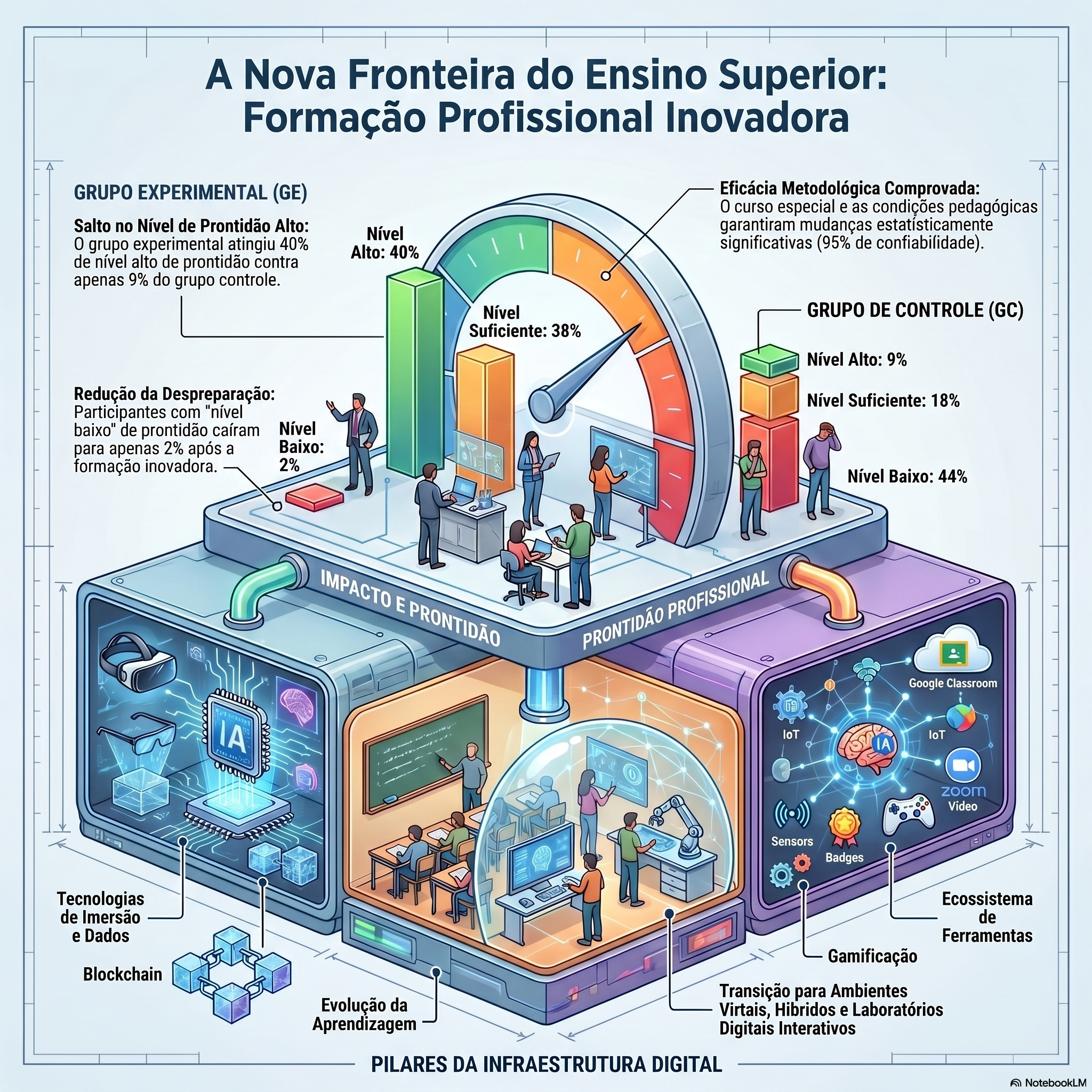
The article examines the content of research concepts and the key innovative requirements for modern specialists. It highlights the necessary innovative teaching methods for students during their professional training in higher education. The periods when innovative teaching technologies are used in higher education institutions are characterized. The essence of the experiment was to exert targeted influence on participants to enhance the professional training of future specialists through innovative teaching technologies. The analysis of the initial state of readiness for the use of innovative teaching technologies, its low indicators, and the modeling of the preparation process for the outlined activity enabled a transition from the ascertaining stage to the formative stage of the experiment. The results of the control stage of the study indicate the effectiveness of all methodological support materials, special courses, and pedagogical conditions used in the experimental group.
Downloads
References
Alexander, B., Ashford-Rowe, K., Barajas-Murph, N., Dobbin, G., Knott, J., McCormack, M., Pomerantz, J., Seilhamer, R., & Weber, N. (2019). Horizon report 2019 higher education edition. EDUCAUSE. https://www.learntechlib.org/p/208644/
Aljawarneh, S. A. (2019). Reviewing and exploring innovative ubiquitous learning tools in higher education. Journal of Computing in Higher Education, 32(1), 57–73. https://doi.org/10.1007/s12528-019-09207-0
Almeida, F., & Simões, J. (2019). The role of serious games, gamification and Industry 4.0 tools in the Education 4.0 paradigm. Contemporary Educational Technology, 10(2), 120–136. https://doi.org/10.30935/cet.554469
Buinytska, O. P. (2021). System of pedagogical design of information and educational environment for training future social educators [Monograph, Borys Grinchenko Kyiv University]. Digital Library NAES of Ukraine. https://lib.iitta.gov.ua/id/eprint/729269/
Castro, R. (2019). Blended learning in higher education: Trends and capabilities. Education and Information Technologies, 24(4), 2523–2546. https://doi.org/10.1007/s10639-019-09886-3
Geng, S., Law, K. M. Y., & Niu, B. (2019). Investigating self-directed learning and technology readiness in blended learning environment. International Journal of Educational Technology in Higher Education, 16(1), 17. https://doi.org/10.1186/s41239-019-0147-0
Haidabrus, B. (2022). Information technology and management in higher education and science. Futurity Education, 2(4), 29–41. https://doi.org/10.57125/fed.2022.25.12.03
Kim, H. J., Hong, A. J., & Song, H.-D. (2019). The roles of academic engagement and digital readiness in students’ achievements in university e-learning environments. International Journal of Educational Technology in Higher Education, 16(1), 21. https://doi.org/10.1186/s41239-019-0152-3
Knysh, I., Chovriy, S., Vaculenko, S., Koycheva, T., Lytvynov, A., & Kuchai, O. (2026). Artificial intelligence: A tool for quality training of future specialists in socio-economic specialties. Revista Conrado, 22(108), e4682. https://conrado.ucf.edu.cu/index.php/conrado/article/view/4682
Knysh, I., Drobin, A., Filimonova, T., Koycheva, T., Kushnir, A., & Kuchai, O. (2024). The use of information technologies in the educational space of Ukraine (on the example of STEAM technologies). Revista Conrado, 20(100), 437–448.
Kuchai, T., Kuchai, O., & Pyrzyk, I. (2017). Studying the peculiarities of education development in Japan (in terms of primary education). Science and Education, (5), 33–39. https://doi.org/10.24195/2414-4665-2017-5-7
Lai, J. W. M., & Bower, M. (2019). How is the use of technology in education evaluated? A systematic review. Computers & Education, 133, 27–42. https://doi.org/10.1016/j.compedu.2019.01.010
Mytnyk, A., Uninets, I., Ivashkevych, E., Rashkovska, I., Ivashkevych, E., & Kuchai, O. (2024). Formation of professional competence in future psychologists using innovative technologies. Revista Conrado, 20(100), 293–304.
Naciri, A., Baba, M. A., Achbani, A., & Kharbach, A. (2020). Mobile learning in higher education: Unavoidable alternative during COVID-19. Aquademia, 4(1), ep20016. https://doi.org/10.29333/aquademia/8227
Okolie, U. C., Nwosu, H. E., & Mlanga, S. (2019). Graduate employability: How higher education institutions can meet the demand of the labour market. Higher Education, Skills and Work-Based Learning, 9(4), 620–636. https://doi.org/10.1108/HESWBL-09-2018-0089
Rakhimov, T., & Mukhamediev, M. (2022). Peculiarities of the implementation of the principles of the education of the future: Analysis of the main dilemmas. Futurity Education, 2(3), 4–14. https://doi.org/10.57125/fed.2022.10.11.29
Smith, K., & Hill, J. (2019). Defining the nature of blended learning through its depiction in current research. Higher Education Research & Development, 38(2), 383–397. https://doi.org/10.1080/07294360.2018.1517732
Tereshchuk, V. I., Ilchenko, A. M., & Semenyshyna, I. V. (2023). Innovative learning technologies in higher education institutions. Academic Visions, (16), 1–9. https://doi.org/10.5281/zenodo.7639008
Verbivskyi, D. S. (2023). Innovative technologies in a higher education institution. Scientific Bulletin of Uzhhorod University. Series: Pedagogy. Social Work, 2(53), 30–33. https://doi.org/10.24144/2524-0609.2023.53.30-33
Zasiekina, T., Desiatnyk, K., Makaruk, O., Dvorska, A., Kostolovych, M., & Kuchai, O. (2025). Formation of leadership qualities for successful professional activity of specialists. Revista Conrado, 21(S1), e4355.
Zawacki-Richter, O., Marín, V. I., Bond, M., & Gouverneur, F. (2019). Systematic review of research on artificial intelligence applications in higher education: Where are the educators? International Journal of Educational Technology in Higher Education, 16(1). https://doi.org/10.1186/s41239-019-0171-0
Downloads
Published
How to Cite
Issue
Section
License
Copyright (c) 2026 Revista on line de Política e Gestão Educacional

This work is licensed under a Creative Commons Attribution-NonCommercial-ShareAlike 4.0 International License.
Manuscritos aceitos e publicados são de propriedade da Revista on line de Política e Gestão Educacional. É vedada a submissão integral ou parcial do manuscrito a qualquer outro periódico. A responsabilidade do conteúdo dos artigos é exclusiva dos autores. É vedada a tradução para outro idioma sem a autorização escrita do Editor ouvida a Comissão Editorial Científica.