A phenomenological study on thinking about citizenship in the digital age beyond anthropocentrism
DOI:
https://doi.org/10.22633/rpge.v30iesp2.21346Keywords:
Citizenship education, Post-humanism, Pre-service social studies teachers, Critique of Anthropocentricism, Qualitative PhenomenologyAbstract
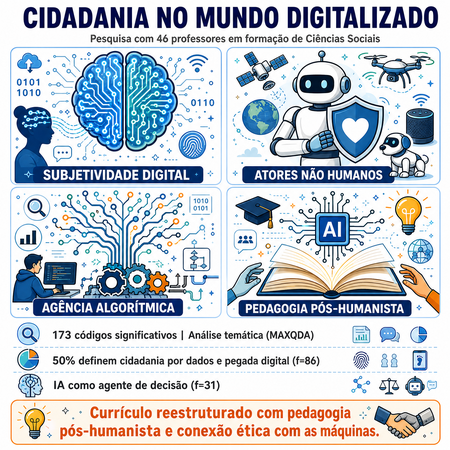
This research examines how citizenship concept in digitized world transcends anthropocentric limits based on the opinions of 46 pre-service social studies teachers. Constructed with phenomenological design, the data of the study was subjected to thematic analysis using MAXQDA software. As a result of the analysis 173 significant codes (f) were obtained, which were structured under four main themes, namely digital subjectivity, non-human stakeholders, algorithmic agency, and post-humanist pedagogy. The findings prove that participants define citizenship through data production and digital footprint to a large extent (f 86 with 50% intensity) whereas they began to see artificial intelligence as a decision-making agent (f 31). This conceptual branching visualized through Word Tree analytic shows that pre-service teachers stand at a mental threshold. In conclusion, it is recommended that social studies curriculum should not be limited to training technical skills but be restructured with a post-humanist pedagogy which encompasses the ethical connection established with machines.
Downloads
References
Achella, S. (2026). Networked humanity: An enactivist paradigm for aligning humans, nonhumans, and machines. Topoi, 1–11.
Banks, J. A. (Ed.). (2004). Diversity and citizenship education: Global perspectives. Jossey-Bass.
Biesta, G. (2011). Learning democracy in school and society: Education, lifelong learning, and the politics of citizenship. Sense Publishers.
Braidotti, R. (2013). The posthuman. Polity Press.
Budić, M. (2025). Beyond anthropocentrism? AI, moral responsibility, and the shifting boundaries of the moral community. In International Scientific Conference: Social Aspects of the Application of Artificial Intelligence and Transhumanism (pp. 62–63). Institute of Social Sciences and Research and Development Institute for Artificial Intelligence of Serbia.
Cook, D. A., Ginsburg, S., Sawatsky, A. P., Kuper, A., & D'Angelo, J. D. (2025). Artificial intelligence to support qualitative data analysis: Promises, approaches, pitfalls. Academic Medicine, 100(10), 1134–1149. https://doi.org/10.1097/ACM.0000000000006134
Falcke, S., & Peters, F. (2025). Rescaling citizenship: Revisiting debates on territory, rights, and membership. Journal of Ethnic and Migration Studies, 51(20), 5213–5240. https://doi.org/10.1080/1369183X.2025.2550109
Ferrari, R. (2026). The postsocialist posthuman: Gregor Samsa's Chinese futures in Li Jianjun's The Metamorphosis. Theatre Survey, 67(1), 59–88. https://doi.org/10.1353/tsu.2026.a980367
Friese, S., & Unterpertinger, E. (2026). CAQDAS and the grounded theory method. In G. Hadley & A. Bryant (Eds.), Grounded theory in action (pp. 23–35). Edward Elgar Publishing. https://doi.org/10.4337/9781035321919.00008
Gordon, J. S. (2026). The robot rights manifesto. Palgrave Macmillan.
Haq, M., & Yasin, N. (2025). Qualitative, quantitative, and mixed methodology paradigms. Journal of Practical Studies in Education, 6(6), 1–15. https://doi.org/10.46809/jpse.v6i6.144
Haraway, D. J. (1991). Simians, cyborgs, and women: The reinvention of nature. Routledge.
Hayles, N. K. (1999). How we became posthuman: Virtual bodies in cybernetics, literature, and informatics. University of Chicago Press.
Kumar, S., Verma, A. K., & Mirza, A. (2024). Digital transformation, artificial intelligence and society: Opportunities and challenges. Springer.
Latour, B. (2005). Reassembling the social: An introduction to actor-network-theory. Oxford University Press. https://doi.org/10.1093/oso/9780199256044.001.0001
Lin, J. C. (2026). Negotiating global citizenship and nationalism: Shifting paradigms in Hong Kong's global citizenship education. European Journal of Education, 61(2), e70553. https://doi.org/10.1111/ejed.70553
Liu, J., Shadiev, R., & Cao, M. (2025). Effects of digital citizenship educational game on teenagers' learning achievement, motivation, cognitive load, and behavioral patterns. Education and Information Technologies, 30(11), 15817–15870. https://doi.org/10.1007/s10639-025-13399-7
Osler, A., & Starkey, H. (2005). Changing citizenship: Democracy and inclusion in education. Open University Press.
Schulz, W., Ainley, J., Fraillon, J., Losito, B., Agrusti, G., Damiani, V., & Friedman, T. (2025). Education for citizenship in times of global challenge: IEA International Civic and Citizenship Education Study 2022 international report. Springer.
Shibuya, K. (2020). Digital transformation of identity in the age of artificial intelligence. Springer.
Suzuki, S. (2025). Human transformation and generative universality: Rethinking citizenship in the posthuman age. Paragrana, 34(2), 281–291.
Tan, K. H. (2025). Reconceptualizing moral agency and stakeholder rights in socio-economic systems: A framework for including non-human entities while preserving human dignity and democratic accountability. PhilPapers. https://zenodo.org/records/17667742
Westheimer, J., & Kahne, J. (2004). What kind of citizen? The politics of educating for democracy. American Educational Research Journal, 41(2), 237–269. https://doi.org/10.3102/00028312041002237
Downloads
Published
How to Cite
Issue
Section
License
Copyright (c) 2026 Revista on line de Política e Gestão Educacional

This work is licensed under a Creative Commons Attribution-NonCommercial-ShareAlike 4.0 International License.
Manuscritos aceitos e publicados são de propriedade da Revista on line de Política e Gestão Educacional. É vedada a submissão integral ou parcial do manuscrito a qualquer outro periódico. A responsabilidade do conteúdo dos artigos é exclusiva dos autores. É vedada a tradução para outro idioma sem a autorização escrita do Editor ouvida a Comissão Editorial Científica.