El papel de la educación en la rehabilitación de los niños que han vivido experiencias traumáticas durante el periodo de guerra
DOI:
https://doi.org/10.22633/rpge.v30iesp2.21376Palabras clave:
Rehabilitación educativa, Pedagogía sensible al trauma, Trastorno por estrés postraumático (TEPT), CRIES-13, Escuela de entorno seguroResumen
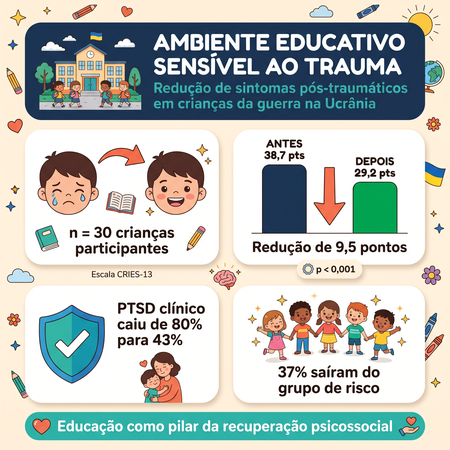
La guerra a gran escala en Ucrania ha causado un trauma sin precedentes en los niños, lo que convierte la búsqueda de recursos de recuperación escalables en una cuestión urgente. El objetivo del estudio es fundamentar teóricamente y confirmar empíricamente el potencial rehabilitador del entorno educativo como componente del apoyo psicosocial para los niños con trauma de guerra. La metodología combina una revisión sistemática de la bibliografía y un experimento psicológico y pedagógico (n = 30; escala CRIES-13). Una disminución estadísticamente significativa de la puntuación total de 38,7 a 29,2 (Δ = –9,5; p < 0,001) confirmó la eficacia del programa: la proporción de niños con TEPT clínico disminuyó del 80 % al 43 %, y el 37 % de los participantes salió del grupo de riesgo. Se ha demostrado que un entorno educativo sensible al trauma es un factor eficaz para reducir los síntomas postraumáticos. Los resultados justifican la necesidad de ampliar las prácticas educativas sensibles al trauma como prioridad de la política estatal en el contexto de la recuperación de Ucrania durante la guerra y la posguerra.
Descargas
Citas
Alzaghoul, A. F., McKinlay, A. R., & Archer, M. (2022). Post-traumatic stress disorder interventions for children and adolescents affected by war in low- and middle-income countries in the Middle East: Systematic review. BJPsych Open, 8(5), e153. https://doi.org/10.1192/bjo.2022.552
American Psychological Association. (2017). Clinical practice guideline for the treatment of posttraumatic stress disorder (PTSD) in adults. https://www.apa.org/ptsd-guideline
Balji, Ye., Vlasova, I., Kalashnikova, S., Kovtunets, V., Litovchenko, O., Orzhel, O., Ryabchenko, V., Trima, K., Chervona, L., & Shofolova, N. (2022). Analysis of leading domestic and foreign experience in implementing social responsibility of universities during conflicts, military actions, and post-war recovery (Preprint). Institute of Higher Education of the National Academy of Pedagogical Sciences of Ukraine.
Birkeland, M. S., Holt, T., Ormhaug, S. M., & Jensen, T. K. (2020). Perceived social support and posttraumatic stress symptoms in children and youth in therapy: A parallel process latent growth curve model. Behaviour Research and Therapy, 132, Article 103655. https://doi.org/10.1016/j.brat.2020.103655
Bondaruk, Y. P., Hopkalo, T. B., Hnida, I. O., Kornienko, N. V., & Lunchenko, N. V. (2020). Group forms of work in the system of psychosocial assistance to children and families who find themselves in difficult life circumstances as a result of military actions (Implementation experience). Nika-Center. https://lib.iitta.gov.ua/id/eprint/723324/
Chudzicka-Czupała, A., Hapon, N., Chiang, S. K., Żywiołek-Szeja, M., Karamushka, L., Lee, C. T., Grabowski, D., Paliga, M., Rosenblat, J. D., Ho, R., McIntyre, R. S., & Chen, Y. L. (2023). Depression, anxiety and post-traumatic stress during the 2022 Russo-Ukrainian war. Scientific Reports, 13(1), Article 3602. https://doi.org/10.1038/s41598-023-28729-3
Davydenko, A. (2022). Children and war: Methods of psychological assistance to children with traumatic experiences. In V. M. Zhdan & I. A. Holovanova (Eds.), Organizational, regulatory, and clinical issues of rehabilitation in Ukraine in peacetime and during war (pp. 31–40). Poltava State Medical University. https://repository.pdmu.edu.ua/handle/123456789/19368
Denov, M., Mitchell, C., & Rabiau, M. (2023). Global child: Children and families affected by war, displacement, and migration. Rutgers University Press.
Fabro, I. M. (2010). Rehabilitation pedagogics: Etymology of concept and genesis of scientific-pedagogical direction. Pedagogy, Psychology, and Medical-Biological Problems of Physical Education and Sports, 9, 105–107.
Inter-Agency Standing Committee. (2007). IASC guidelines on mental health and psychosocial support in emergency settings. https://www.who.int/publications/i/item/iasc-guidelines-for-mental-health-and-psychosocial-support-in-emergency-settings
Kalmykova, L., Kharchenko, N., & Misan, I. (2024). Overcoming psychotraumatic conditions in children. Pedagogical Innovations, 1(32), 90–99. https://doi.org/10.32405/2413-4139-2024-1(32)-90-99
Karpenko, O., Voroshchuk, O., & Kovalska, K. (2025). Innovative pedagogical approaches to adapting displaced Ukrainian children. Academic Visions, 42, 1–12. https://doi.org/10.5281/zenodo.15127452
Lviv State University of Life Safety. (2025). Personality in extreme conditions: Materials of the XII All-Ukrainian scientific and practical conference with international participation.
Matvienko, O. (2023, September 14). Education under fire: How schools become places of safety. Osvita. https://osvita.ua/blogs/95124/
Ministry of National Education. (2023, July 4). Accessible school for all. https://www.gov.pl/web/edukacja/projekt-accessible-school-for-all--szkola-dostepna-dla-wszystkich
Naichuk, V. V., & Skrypkina, O. M. (2024). Soft toy therapy as a means of building resilience. Scientific Notes of Lviv State University of Life Safety, 2(4), 133–137. https://doi.org/10.32782/3041-1297/2024-2-22
Norwegian Refugee Council. (2023). NRC global education strategy 2022–2025. https://www.nrc.no/resources/policy-doc/global-education-strategy-2022-2025/
Oliinyk, I. V. (2021). Social rehabilitation as an area of social work activity. Bulletin of Alfred Nobel University, 2(22), 59–66. https://doi.org/10.32342/2522-4115-2021-2-22-7
Radstaak, M., Hüning, L., & Bohlmeijer, E. T. (2020). Well-being therapy as rehabilitation therapy for posttraumatic stress disorder symptoms: A randomized controlled trial. Journal of Traumatic Stress, 33(5), 813–823. https://doi.org/10.1002/jts.22500
Romancha, A. V. (2021). Features of the relationship between depression and posttraumatic stress disorder in adolescents. In National Academy of Sciences of Ukraine et al. (Ed.), Psychology of crisis states: Science and practice (p. 144). NAES.
Schultz, J.-H., & Norheim, S. H. (2015). School-based intervention in ongoing crisis: Lessons from a psychosocial and trauma-focused approach in Gaza schools. Journal on Education in Emergencies, 1(1), 62–83. https://doi.org/10.58078/f5gx-zk56
Su, Z., McDonnell, D., Cheshmehzangi, A., Bentley, B. L., Ahmad, J., Šegalo, S., da Veiga, C. P., & Xiang, Y.-T. (2023). Media-induced war trauma amid conflicts in Ukraine. Perspectives on Psychological Science, 18(4), 908–911. https://doi.org/10.1177/17456916221109609
Subota, S. O. (2021). Psychosocial rehabilitation of posttraumatic stress disorders. Psychological Journal, 7(7), 78–86. https://doi.org/10.31108/1.2021.7.7
Terre des Hommes Hellas. (n.d.). INTACT: Inclusive trauma informed care adventure therapy activities for refugee children and youth in Greece. https://tdh-greece.org/en/child-protection-and-safeguarding
UpToDate. (2026). Posttraumatic stress disorder in children and adolescents: Trauma-focused psychotherapy. https://www.uptodate.com/contents/posttraumatic-stress-disorder-in-children-and-adolescents-trauma-focused-psychotherapy
Vaaranen-Valkonen, N., & Zavarova, N. (Eds.). (2022). Psychological support and assistance to children who have experienced traumatic events. Council of Europe.
Voznesenska, O. L., & Sydorkina, M. Yu. (2016). Art therapy in overcoming psychological trauma: A practical guide. Zoloti Vorota.
Winthrop, R., & Kirk, J. (2008). Learning for a bright future: Schooling, armed conflict, and children’s well-being. Comparative Education Review, 52(4), 639–661. https://doi.org/10.1086/591301
Zasiekina, L., Duchyminska, T., Bifulco, A., & Bignardi, G. (2024). War trauma impacts in Ukrainian combat and civilian populations: Moral injury and associated mental health symptoms. Military Psychology, 36(5), 555–566. https://doi.org/10.1080/08995605.2023.2235256
Zlivkov, V., Lukomska, S., Yevdokimova, N., & Lipinska, S. (2023). Children and war. PP Lysenko M. M.
Descargas
Publicado
Cómo citar
Número
Sección
Licencia
Derechos de autor 2026 Revista on line de Política e Gestão Educacional

Esta obra está bajo una licencia internacional Creative Commons Atribución-NoComercial-CompartirIgual 4.0.
Manuscritos aceitos e publicados são de propriedade da Revista on line de Política e Gestão Educacional. É vedada a submissão integral ou parcial do manuscrito a qualquer outro periódico. A responsabilidade do conteúdo dos artigos é exclusiva dos autores. É vedada a tradução para outro idioma sem a autorização escrita do Editor ouvida a Comissão Editorial Científica.