Estética corporal na arte e na educação
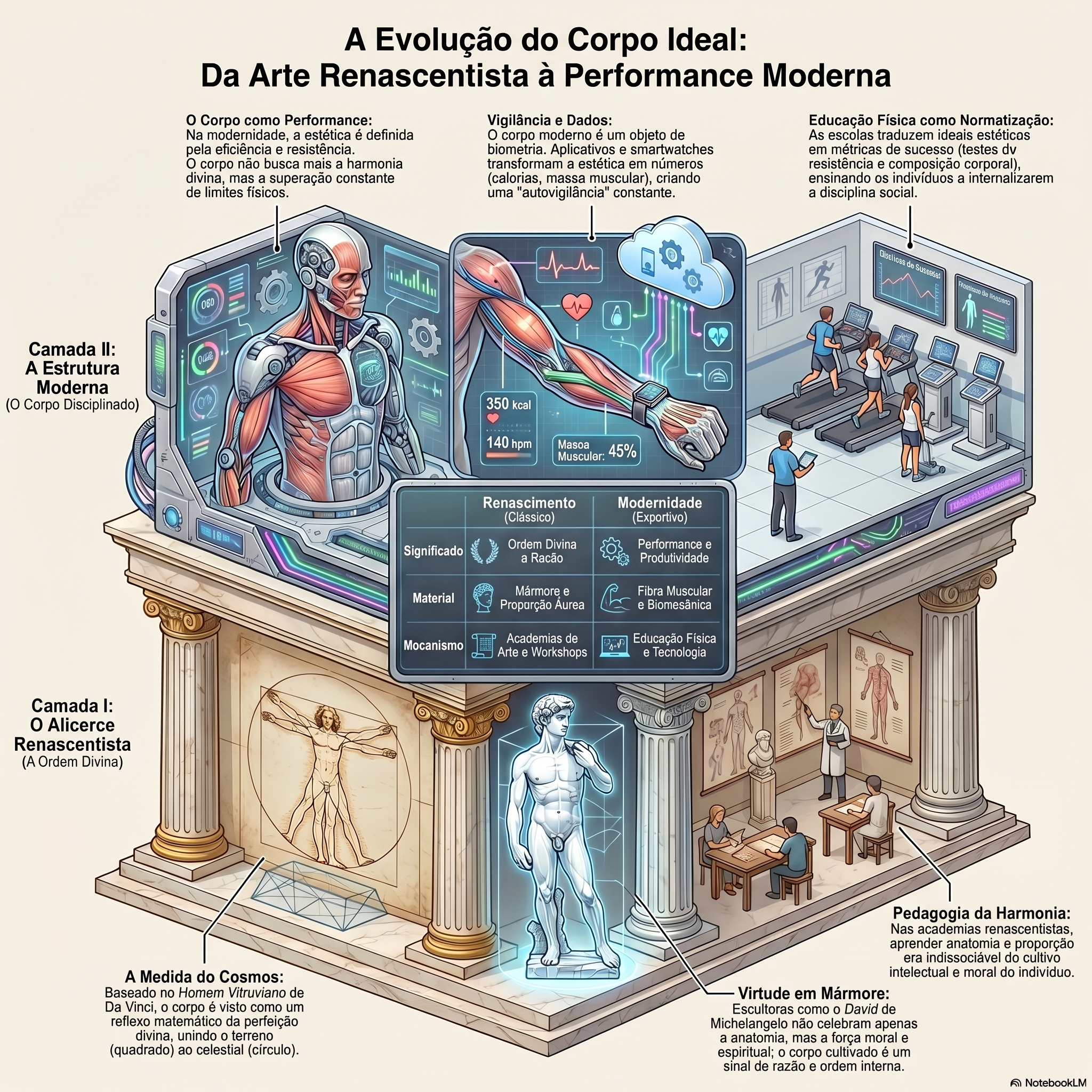
o conceito de corpo ideal da pintura renascentista aos esportes modernos e à educação física
DOI:
https://doi.org/10.22633/rpge.v30iesp1.20939Palavras-chave:
Estética corporal, Arte, Educação, Educação físicaResumo
Este artigo investiga como a estética corporal evoluiu de um ideal artístico para um constructo ideológico e educacional, interpretando essa transformação por meio de uma abordagem integrada entre história da arte, ciências do esporte e educação física. O referencial teórico articula a abordagem iconológica de Panofsky, a noção de “corpo disciplinado” de Foucault e a crítica feminista da corporeidade de Bordo, a fim de analisar como os ideais estéticos são produzidos, transmitidos e internalizados. Ao articular a análise da história da arte com a sociologia do esporte, da performance e da pedagogia, o estudo propõe uma leitura interdisciplinar da representação corporal como um espaço de poder cultural e educacional. Destaca-se o papel da educação física como mecanismo central de ensino, avaliação e normalização dos ideais corporais ao longo da história. Conclui-se que o “corpo ideal” é um constructo histórico, moldado por tradições artísticas, culturas performáticas e sistemas pedagógicos.
Downloads
Referências
Aartun, I., Walseth, K., Standal, Ø., & Kirk, D. (2020). Pedagogies of embodiment in physical education: A literature review. Sport, Education and Society, 27, 1–13. https://doi.org/10.1080/13573322.2020.1821182
Aasland, E., & Engelsrud, G. (2021). Structural discrimination in physical education: The “encounter” between the (White) Norwegian teaching content in physical education lessons and female students of color’s movements and expressions. Frontiers in Sports and Active Living, 3, Article 769756. https://doi.org/10.3389/fspor.2021.769756
Alp, K. (2014). Feminist sanatta beden ve yabancılaşma. Art-e Sanat Dergisi, 7(14), 338–365.
Andrews, D. L. (2008). Sport and neoliberalism: Politics, consumption, and culture. Temple University Press.
Aygün, N. (2022). 20. yy Batı resim sanatında beden imgesi ve temsili (Yayımlanmamış yüksek lisans tezi). Çanakkale Onsekiz Mart Üniversitesi, Lisansüstü Eğitim Enstitüsü.
Barker, D., Varea, V., Bergentoft, H., & Schubring, A. (2022). Body image in physical education: A narrative review. Sport, Education and Society, 28, 824–841. https://doi.org/10.1080/13573322.2022.2076665
Berger, J. (1972). Ways of seeing. Penguin Books.
Bordo, S. (1993). Unbearable weight: Feminism, Western culture, and the body. University of California Press.
Bourdieu, P. (1984). Distinction: A social critique of the judgement of taste. Harvard University Press.
Burke, P. (1998). The Renaissance sense of the past. Oxford University Press.
Camacho-Miñano, M., MacIsaac, S., & Rich, E. (2019). Postfeminist biopedagogies of Instagram: Young women learning about bodies, health and fitness. Sport, Education and Society, 24, 651–664. https://doi.org/10.1080/13573322.2019.1613975
Cereda, F. (2023). Sporting bodies, societal norms in history. Scientific Journal of Sport and Performance. https://doi.org/10.55860/avzs3084
Çeviker, A., Taşdemir, D. Ş., & Güler, Y. E. (2023). Boycotts in the history of the modern Olympic Games. International Journal of Eurasian Education and Culture, 22, 1943–1964.
Clark, K. (1956). The nude: A study in ideal form. Oxford University Press.
Da Rocha, R., Da Silva Ribeiro, F., Romig, I., De Oliveira Arrieira, H., Da Cunha, G., Gaya, A., Pinheiro, E., & Bergmann, G. (2025). Effects of implementing 15-minute physical exercise sessions during physical education classes on physical fitness and anthropometric indicators in rural adolescents. Journal of Physical Activity & Health, 1–11. https://doi.org/10.1123/jpah.2024-0720
Derelioğlu, M., Vural, M., Çimen, E., Saki, Ü., Yağız Saraçoğlu, Y., Karataş, B., Saç, A., Yamaner, E., Halmatov, M., Yılmaz, C., Öztaş, M., Arıkan, G., & Ceylan, L. (2025). Exploring how cognitive-behavioral physical activity links ruminative thinking and mental wellbeing in sports high school adolescents. Frontiers in Psychology, 16, Article 1665882. https://doi.org/10.3389/fpsyg.2025.1665882
Eco, U. (2004). History of beauty. Rizzoli International Publications.
Foucault, M. (1977). Discipline and punish: The birth of the prison. Vintage Books.
Gombrich, E. H. (2007). Sanatın öyküsü (Ö. Erduran & E. Erduran, Trad.). Remzi Kitabevi. (Trabalho original publicado em 1950)
González‐Calvo, G., & Gerdin, G. (2023). ‘The good, the bad and the ugly’: Primary school children’s visual representations and interpretations of PE teacher embodiments. Sport, Education and Society. https://doi.org/10.1080/13573322.2023.2177985
González‐Calvo, G., Gallego-Lema, V., Gerdin, G., & Bores-García, D. (2021). Body image(s): Problematizing future physical education teachers’ beliefs about the body and physical activity through visual imagery. European Physical Education Review, 28, 552–572. https://doi.org/10.1177/1356336x211056214
Gray, S., Hooper, O., Hardley, S., Sandford, R., Aldous, D., Stirrup, J., Carse, N., & Bryant, A. (2022). A health(y) subject? Examining discourses of health in physical education curricula across the UK. British Educational Research Journal. https://doi.org/10.1002/berj.3820
Gray, S., Sandford, R., Stirrup, J., Aldous, D., Hardley, S., Carse, N., Hooper, O., & Bryant, A. (2021). A comparative analysis of discourses shaping physical education provision within and across the UK. European Physical Education Review, 28, 575–593. https://doi.org/10.1177/1356336x211059440
Gross, M., Gear, J., & Sepponen, W. (2023). Using represented bodies in Renaissance artworks to teach musculoskeletal and surface anatomy. Anatomical Sciences Education, 17, 24–38. https://doi.org/10.1002/ase.2326
Hoberman, J. (1992). Mortal engines: The science of performance and the dehumanization of sport. Free Press.
Kapar, S. (2025). Otokonografik yaklaşım üzerinden çağdaş sanatta beden, bellek ve onarımın estetik ifadesi. Journal of Arts, 8(1), E2953.
Karampetsos, A., Efthymiou, D., Griva, E., Mesiari, C., Severin, A., & Vassilopoulou, E. (2021). Eating habits and body ideals from the Renaissance period to the present: Perspectives from paintings on nutrition and body image. Public Health Toxicology. https://doi.org/10.18332/pht/139905
Li, P., Li, P., & Mei, Y. (2017). The aesthetic thought of competitive sports and the value study of aesthetic education in health education. Eurasia Journal of Mathematics, Science and Technology Education, 13, 5115–5121. https://doi.org/10.12973/eurasia.2017.00986a
Liu, C., Cao, Y., Zhang, Z., Gao, R., & Qu, G. (2023). Correlation of fundamental movement skills with health-related fitness elements in children and adolescents: A systematic review. Frontiers in Public Health, 11. https://doi.org/10.3389/fpubh.2023.1129258
Mamedova, N. M., Gavrish, V. D., Skatershchikova, A. V., & Fomina, A. S. (2018). Modern medeniyetin sosyal pratik evreninde spor. Fiziksel Kültürün Teorisi ve Uygulaması, (1), 5.
McMenamin, P. (2021). Art and anatomy in the Renaissance: Are the lessons still relevant today. ANZ Journal of Surgery, 92. https://doi.org/10.1111/ans.17268
Metcalfe, S. (2018). Adolescent constructions of gendered identities: The role of sport and (physical) education. Sport, Education and Society, 23, 681–693. https://doi.org/10.1080/13573322.2018.1493574
Mironova, T. A., Arseenko, E. A., Sobyankin, F. I., & Samolyuk, O. I. (2017). Yeni spor görünüm türlerinin özellikleri. Tambov Üniversitesi İncelemesi. Seriler: Beşeri Bilimler, 22(4), 74–80.
Modell, N., & Gerdin, G. (2021). ‘But in PEH it still feels extra unfair’: Students’ experiences of equitable assessment and grading practices in physical education and health (PEH). Sport, Education and Society, 27, 1047–1060. https://doi.org/10.1080/13573322.2021.1965565
Moya-Mata, I., Stieg, R., Loro, A., Soares, D., & Santos, W. (2023). Physical activity according to gender in Brazilian physical education textbooks. Retos. https://doi.org/10.47197/retos.v48.96872
Özalp, K. (2016). Güzelliğin bilinçli algısı ve estetik eğitimi. İdil Sanat ve Dil Dergisi, 5(21), 491–504.
Pačesová, P., & Oborný, J. (2012). Esthetics of sport and different aspects of its meaning. Electronic Proceedings Book, 28.
Panofsky, E. (1953). Meaning in the visual arts. Doubleday Anchor.
Paterna, A., Alcaraz-Ibáñez, M., Fuller‐Tyszkiewicz, M., & Sicilia, Á. (2021). Internalization of body shape ideals and body dissatisfaction: A systematic review and meta-analysis. International Journal of Eating Disorders. https://doi.org/10.1002/eat.23568
Pérez-Ramírez, J., González-Fernández, F., & Villa-González, E. (2024). Effect of school-based endurance and strength exercise interventions in improving body composition, physical fitness and cognitive functions in adolescents. Applied Sciences. https://doi.org/10.3390/app14209200
Quennerstedt, M., Barker, D., Johansson, A., & Korp, P. (2024). Teaching with the test: Using fitness tests to teach paradoxically in physical education. European Physical Education Review, 31, 462–481. https://doi.org/10.1177/1356336x241283796
Samadov, A. R. (2019). Sport as the device of forming aesthetic ideal of person. Theoretical & Applied Science, (4), 165–167.
Schubring, A., Bergentoft, H., & Barker, D. (2021). Teaching on body ideals in physical education: A lesson study in Swedish upper secondary school. Curriculum Studies in Health and Physical Education, 12, 232–250. https://doi.org/10.1080/25742981.2020.1869048
Sealy, U., & Lee, T. (2019). Anatomy and academies of art I: Founding academies of art. Journal of Anatomy, 236. https://doi.org/10.1111/joa.13131
Shilling, C. (2017). Body pedagogics: Embodiment, cognition and cultural transmission. Sociology, 51, 1205–1221. https://doi.org/10.1177/0038038516641868
Shilling, C. (2021). Body pedagogics, culture and the transactional case of Vélo worlds. European Journal of Social Theory, 25, 312–329. https://doi.org/10.1177/1368431021996642
Stirrup, J., Aldous, D., Gray, S., Sandford, R., Hooper, O., Hardley, S., Bryant, A., & Carse, N. (2023). Exploring the re-legitimisation of messages for health and physical education within contemporary English and Welsh curricula reform. Sport, Education and Society, 29, 939–951. https://doi.org/10.1080/13573322.2023.2240822
Tekin, G. (2023). The relationship between sports, politics, and nationalism in the historical process. Journal of ROL Sport Sciences, 4(3), 1182–1201. https://doi.org/10.5281/zenodo.8353220
Temizer, M. (2024). Bir güzellik bilimi olarak estetiğin toplumsal koşullar karşısındaki evrimi. Balıkesir Üniversitesi Sosyal Bilimler Enstitüsü Dergisi, 27(52), 525–547.
Todd, S., Hoveid, M., & Langmann, E. (2021). Educating the senses: Explorations in aesthetics, embodiment and sensory pedagogy. Studies in Philosophy and Education, 40, 243–248. https://doi.org/10.1007/s11217-021-09776-7
Tudor, V., & Pîslaru, V. (2021). Performance standards for physical education: A necessity of the curricular reform. Discobolul – Physical Education, Sport and Kinetotherapy Journal. https://doi.org/10.35189/dpeskj.2021.60.2.5
Uçar, M. (2023). Modernden postmoderne, sanatta estetik deneyimin dönüşümü. Akademik Sanat, (20), 141–153.
Vidal-Albelda, B., & Martínez-Bello, V. (2017). Representation of bodies with and without disabilities in secondary school physical education textbooks. Sport in Society, 20, 957–968. https://doi.org/10.1080/17430437.2016.1221937
Voelker, D., Visek, A., Fairhurst, K., & Learner, J. (2024). Conforming to reforming: A systems understanding of aesthetic sport coaches’ behaviors and practices toward female athletes’ bodies. Body Image, 51, Article 101784. https://doi.org/10.1016/j.bodyim.2024.101784
Walseth, K., Aartun, I., & Engelsrud, G. (2017). Girls’ bodily activities in physical education: How current fitness and sport discourses influence girls’ identity construction. Sport, Education and Society, 22, 442–459. https://doi.org/10.1080/13573322.2015.1050370
Xue, S. (2024). The loss and return of body aesthetics in physical education. Journal of Human Movement Science. https://doi.org/10.23977/jhms.2024.050108
Publicado
Como Citar
Edição
Seção
Licença
Copyright (c) 2026 Revista on line de Política e Gestão Educacional

Este trabalho está licenciado sob uma licença Creative Commons Attribution-NonCommercial-ShareAlike 4.0 International License.
Manuscritos aceitos e publicados são de propriedade da Revista on line de Política e Gestão Educacional. É vedada a submissão integral ou parcial do manuscrito a qualquer outro periódico. A responsabilidade do conteúdo dos artigos é exclusiva dos autores. É vedada a tradução para outro idioma sem a autorização escrita do Editor ouvida a Comissão Editorial Científica.