Examining Turkish EFL teachers’ received training and professional development needs in language assessment
DOI:
https://doi.org/10.22633/rpge.v30iesp2.21397Keywords:
Language assessment literacy, Language testing and assessment, EFL teachers, Professional development, Teacher educationAbstract
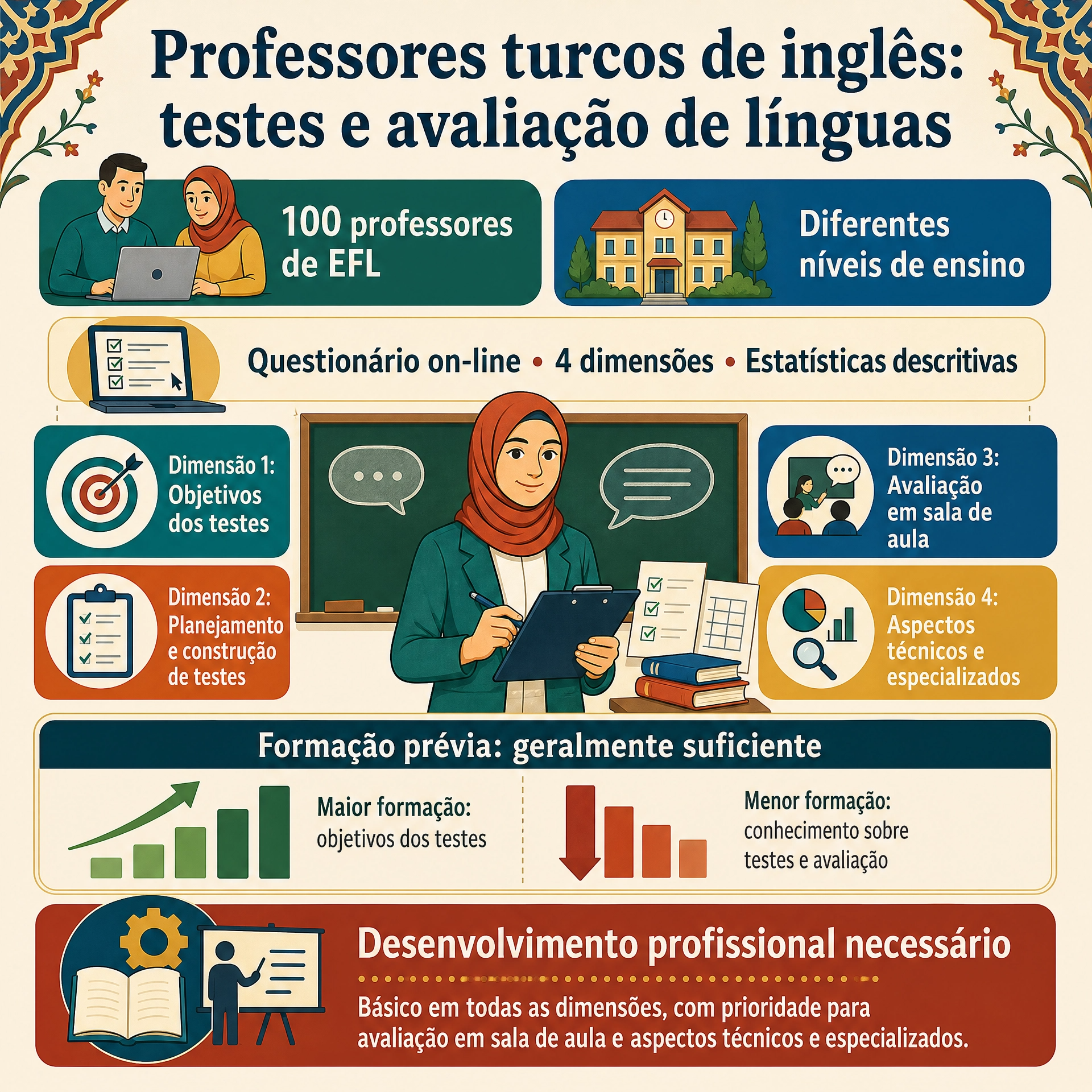
This study examines the training and professional development needs of Turkish teachers of English as a foreign language (EFL) in the field of language testing and assessment (LTA). The participants were 100 practicing EFL teachers from different educational levels who completed an online questionnaire on Language Testing and Assessment. The instrument assessed both the training received and professional development needs across four dimensions of language assessment. The data were analyzed quantitatively using descriptive statistics. The results indicate that, overall, the teachers considered their prior training sufficient across the different dimensions of LTA, although variations were observed among the domains. The highest levels of training were reported in relation to test purposes, whereas the lowest levels concerned knowledge of testing and assessment. Despite considering their preparation sufficient, the participants reported basic professional development needs across all assessment dimensions, particularly regarding classroom-based assessment and the more technical and specialized aspects of language assessment.
Downloads
References
Arıcı, M. (2022). Exploring the relationship between EFL teachers’ language assessment literacy and their reflective teaching [Unpublished master’s thesis, Başkent University].
Bağışlayıcı, A. (2023). Designing an online language assessment training course for improving language assessment literacy of secondary school EFL in-service teachers in Mersin [Unpublished doctoral dissertation, Yeditepe University].
Bailey, K. M., & Brown, J. D. (1996). Language testing courses: What are they? In A. Cumming & R. Berwick (Eds.), Validation in language testing (pp. 236–256). Multilingual Matters.
Ballıdağ, S., & İnan-Karagül, B. (2021). Exploring the language assessment literacy of Turkish in-service EFL teachers. Balıkesir Üniversitesi Sosyal Bilimler Enstitüsü Dergisi, 24(45), 73–92. https://doi.org/10.31795/baunsobed.909953
Bayram, M. (2026). An investigation of language assessment literacy levels and training needs of Turkish EFL in-service teachers [Unpublished doctoral dissertation, Hacettepe University].
Borg, S. (2015). Teacher cognition and language education: Research and practice. Bloomsbury Academic.
Brindley, G. (2001). Language assessment and professional development. In C. Elder, A. Brown, K. Hill, N. Iwashita, T. Lumley, T. McNamara, & K. O’Loughlin (Eds.), Experimenting with uncertainty: Essays in honour of Alan Davies (pp. 126–136). Cambridge University Press.
Brookhart, S. M. (2001). The standards and classroom assessment research [Conference presentation]. Annual Meeting of the American Association of Colleges for Teacher Education, Dallas, TX, United States.
Brown, J. D., & Bailey, K. M. (2008). Language testing courses: What are they in 2007? Language Testing, 25(3), 349–383. https://doi.org/10.1177/0265532208090157
Bulut, N. (2024). Different stakeholders’ localized conceptualization of technology-enhanced language assessment literacy in higher educational context in Türkiye [Unpublished master’s thesis, Başkent University].
Cheng, L. (1997). How does washback influence teaching? Implications for Hong Kong. Language and Education, 11(1), 38–54. https://doi.org/10.1080/09500789708666717
Clapham, C. (2000). Assessment and testing. Annual Review of Applied Linguistics, 20, 147–161. https://doi.org/10.1017/S0267190500200093
Crusan, D., Plakans, L., & Gebril, A. (2016). Writing assessment literacy: Surveying second language teachers’ knowledge, beliefs, and practices. Assessing Writing, 28, 43–56. https://doi.org/10.1016/j.asw.2016.03.001
Çağlayan, C. (2022). An investigation into the relationship between language assessment literacy and self-efficacy beliefs of EFL instructors: An example of Ankara [Unpublished master’s thesis, Ufuk University].
Davies, A. (2008). Textbook trends in teaching language testing. Language Testing, 25(3), 327–347. https://doi.org/10.1177/0265532208090156
Dörnyei, Z., & Csizér, K. (2012). How to design and analyze surveys in second language acquisition research. In A. Mackey & S. M. Gass (Eds.), Research methods in second language acquisition: A practical guide (pp. 74–94). Wiley-Blackwell.
Fulcher, G. (2012). Assessment literacy for the language classroom. Language Assessment Quarterly, 9(2), 113–132. https://doi.org/10.1080/15434303.2011.642041
Giraldo, F. (2018). Language assessment literacy: Implications for language teachers. Profile: Issues in Teachers’ Professional Development, 20(1), 179–195. https://doi.org/10.15446/profile.v20n1.62089
Han, T., & Kaya, H. İ. (2014). Turkish EFL teachers’ assessment preferences and practices in the context of constructivist instruction. Journal of Studies in Education, 4(1), 77–93. https://doi.org/10.5296/jse.v4i1.4873
Hasselgreen, A., Carlsen, C., & Helness, H. (2004). European survey of language and assessment needs report: Part one – General findings. EALTA.
Hatipoğlu, C. (2010). Summative evaluation of an English language testing and evaluation course for future English language teachers in Turkey. English Language Teacher Education and Development Journal, 13, 40–51.
Inbar-Lourie, O. (2008). Constructing a language assessment knowledge base: A focus on language assessment courses. Language Testing, 25(3), 385–402. https://doi.org/10.1177/0265532208090158
Inbar-Lourie, O. (2017). Language assessment literacy. In E. Shohamy, I. G. Or, & S. May (Eds.), Language testing and assessment (pp. 1–14). Springer.
Jeong, H. (2013). Defining assessment literacy: Is it different for language testers and non-language testers? Language Testing, 30(3), 345–362. https://doi.org/10.1177/0265532213480334
Kaya, T. (2020). Exploring language assessment literacy of EFL instructors in language preparatory programs [Unpublished master’s thesis, Bahçeşehir University].
Kremmel, B., & Harding, L. (2020). Towards a comprehensive, empirical model of language assessment literacy across stakeholder groups: Developing the Language Assessment Literacy Survey. Language Assessment Quarterly, 17(1), 100–120. https://doi.org/10.1080/15434303.2019.1674855
Kvasova, O., & Kavytska, T. (2014). The assessment competence of university foreign language teachers: A Ukrainian perspective. Language Learning in Higher Education, 4(1), 159–177. https://doi.org/10.1515/cercles-2014-0010
Levi, T., & Inbar-Lourie, O. (2020). Assessment literacy or language assessment literacy: Learning from the teachers. Language Assessment Quarterly, 17(2), 168–182. https://doi.org/10.1080/15434303.2019.1692347
Mede, E., & Atay, D. (2017). English language teachers’ assessment literacy: The Turkish context. Ankara Üniversitesi TÖMER Dil Dergisi, 168(1), 43–60.
Mertler, C. A., & Campbell, C. (2005, April 11–15). Measuring teachers’ knowledge and application of classroom assessment concepts: Development of the Assessment Literacy Inventory [Conference presentation]. Annual Meeting of the American Educational Research Association, Montreal, Canada.
Ölmezer-Öztürk, E., & Aydın, B. (2019). Investigating language assessment knowledge of EFL teachers. Hacettepe Üniversitesi Eğitim Fakültesi Dergisi, 34(3), 602–620. https://doi.org/10.16986/HUJE.2018043465
Öz, S., & Atay, D. (2017). Turkish EFL instructors’ in-class language assessment literacy: Perceptions and practices. ELT Research Journal, 6(1), 25–44.
Pill, J., & Harding, L. (2013). Defining the language assessment literacy gap: Evidence from a parliamentary inquiry. Language Testing, 30(3), 381–402. https://doi.org/10.1177/0265532213480337
Popham, W. J. (2009). Assessment literacy for teachers: Faddish or fundamental? Theory Into Practice, 48(1), 4–11. https://doi.org/10.1080/00405840802577536
Rogers, W. T., Cheng, L., & Hu, H. (2007). ESL/EFL instructors’ beliefs about assessment and evaluation. Canadian and International Education, 36(1), 39–61. https://doi.org/10.5206/cie-eci.v36i1.9088
Sarıyıldız, G. (2018). A study into language assessment literacy of preservice English as a foreign language teachers in Turkish context [Unpublished master’s thesis, Hacettepe University].
Sarıyıldız-Canlı, G. (2023). Language assessment literacy level and needs of in-service EFL teachers in Turkey [Unpublished doctoral dissertation, Hacettepe University].
Scarino, A. (2013). Language assessment literacy as self-awareness: Understanding the role of interpretation in assessment and in teacher learning. Language Testing, 30(3), 309–327. https://doi.org/10.1177/0265532213480128
Shim, K. N. (2009). An investigation into teachers’ perceptions of classroom-based assessment of English as a foreign language in Korean primary education [Unpublished doctoral dissertation, University of Exeter].
Siegel, M. A., & Wissehr, C. (2011). Preparing for the plunge: Pre-service teachers’ assessment literacy. Journal of Science Teacher Education, 22(4), 371–391. https://doi.org/10.1007/s10972-011-9231-6
Spolsky, B. (1995). Measured words: The development of objective language testing. Oxford University Press.
Stabler-Havener, M. L. (2018). Defining, conceptualizing, problematizing, and assessing language teacher assessment literacy. Studies in Applied Linguistics & TESOL, 18(1), 1–22. https://doi.org/10.7916/salt.v18i1.1195
Stiggins, R. J. (1991). Relevant classroom assessment training for teachers. Educational Measurement: Issues and Practice, 10(1), 7–12. https://doi.org/10.1111/j.1745-3992.1991.tb00171.x
Stiggins, R. (1995). Assessment literacy for the 21st century. Phi Delta Kappan, 77, 238–249.
Stiggins, R. J. (2008). Assessment manifesto: A call for the development of balance assessment systems. The ETS Assessment Training Institute.
Stiggins, R. (2014). Revolutionize assessment: Empower students, inspire learning. Corwin Press.
Sultana, N. (2019). Language assessment literacy: An uncharted area for the English language teachers in Bangladesh. Language Testing in Asia, 9(1), 1. https://doi.org/10.1186/s40468-019-0077-8
Şahin, S. (2019). An analysis of English language testing and evaluation course in English language teacher education programs in Turkey: Developing language assessment literacy of pre-service EFL teachers [Unpublished doctoral dissertation, Middle East Technical University].
Şükür, M. (2023). The description of pre-service EFL teachers’ language assessment literacy development process [Unpublished doctoral dissertation, Gazi University].
Taylor, L. (2013). Communicating the theory, practice and principles of language testing to test stakeholders: Some reflections. Language Testing, 30(3), 403–412. https://doi.org/10.1177/0265532213480338
Tian, W., Louw, S., & Khan, M. K. (2021). Covid-19 as a critical incident: Reflection on language assessment literacy and the need for radical changes. System, 103, 102682. https://doi.org/10.1016/j.system.2021.102682
Tsagari, D., & Vogt, K. (2017). Assessment literacy of foreign language teachers around Europe: Research, challenges, and future prospects. Papers in Language Testing and Assessment, 6(1), 41–64. https://doi.org/10.58379/UHIX9883
Vogt, K., & Tsagari, D. (2014). Assessment literacy of foreign language teachers: Findings of European study. Language Assessment Quarterly, 11(4), 374–392. https://doi.org/10.1080/15434303.2014.960046
Xie, Q., & Tan, S. (2019). Preparing primary English teachers in Hong Kong: Focusing on language assessment literacy. Journal of Asia TEFL, 16(2), 653–673. https://doi.org/10.18823/asiatefl.2019.16.2.14.653
Xu, Y., & Brown, G. T. (2017). University English teacher assessment literacy: A survey-test report from China. Papers in Language Testing and Assessment, 6(1), 133–158. https://doi.org/10.58379/UZON5145
Yan, X., & Fan, J. (2021). “Am I qualified to be a language tester?” Understanding the development of language assessment literacy across three stakeholder groups. Language Testing, 38(2), 219–246. https://doi.org/10.1177/0265532220929924
Yastıbaş, A. E., & Takkaç, M. (2018). Understanding language assessment literacy: Developing language assessments. Journal of Language and Linguistic Studies, 14(1), 178–193.
Yılmaz, F. (2021). An investigation of the psychometric properties of a language assessment literacy measure [Unpublished master’s thesis, Middle East Technical University].
Zhang, L., Zheng, Y., & Yang, D. (2026). Exploring Chinese university English teachers’ language assessment literacy: A mixed-method study. Asia Pacific Journal of Education, 46(1), 322–340. https://doi.org/10.1080/02188791.2024.2354684
Downloads
Published
How to Cite
Issue
Section
License
Copyright (c) 2026 Revista on line de Política e Gestão Educacional

This work is licensed under a Creative Commons Attribution-NonCommercial-ShareAlike 4.0 International License.
Manuscritos aceitos e publicados são de propriedade da Revista on line de Política e Gestão Educacional. É vedada a submissão integral ou parcial do manuscrito a qualquer outro periódico. A responsabilidade do conteúdo dos artigos é exclusiva dos autores. É vedada a tradução para outro idioma sem a autorização escrita do Editor ouvida a Comissão Editorial Científica.