Educação multicultural na Rússia e na China
perspectivas de desenvolvimento
DOI:
https://doi.org/10.22633/rpge.v30i00.21162Palavras-chave:
Educação multicultural, Perspectivas de desenvolvimento, Ensino superior na China e na Rússia, Diálogo intercultural, Cooperação educacionalResumo
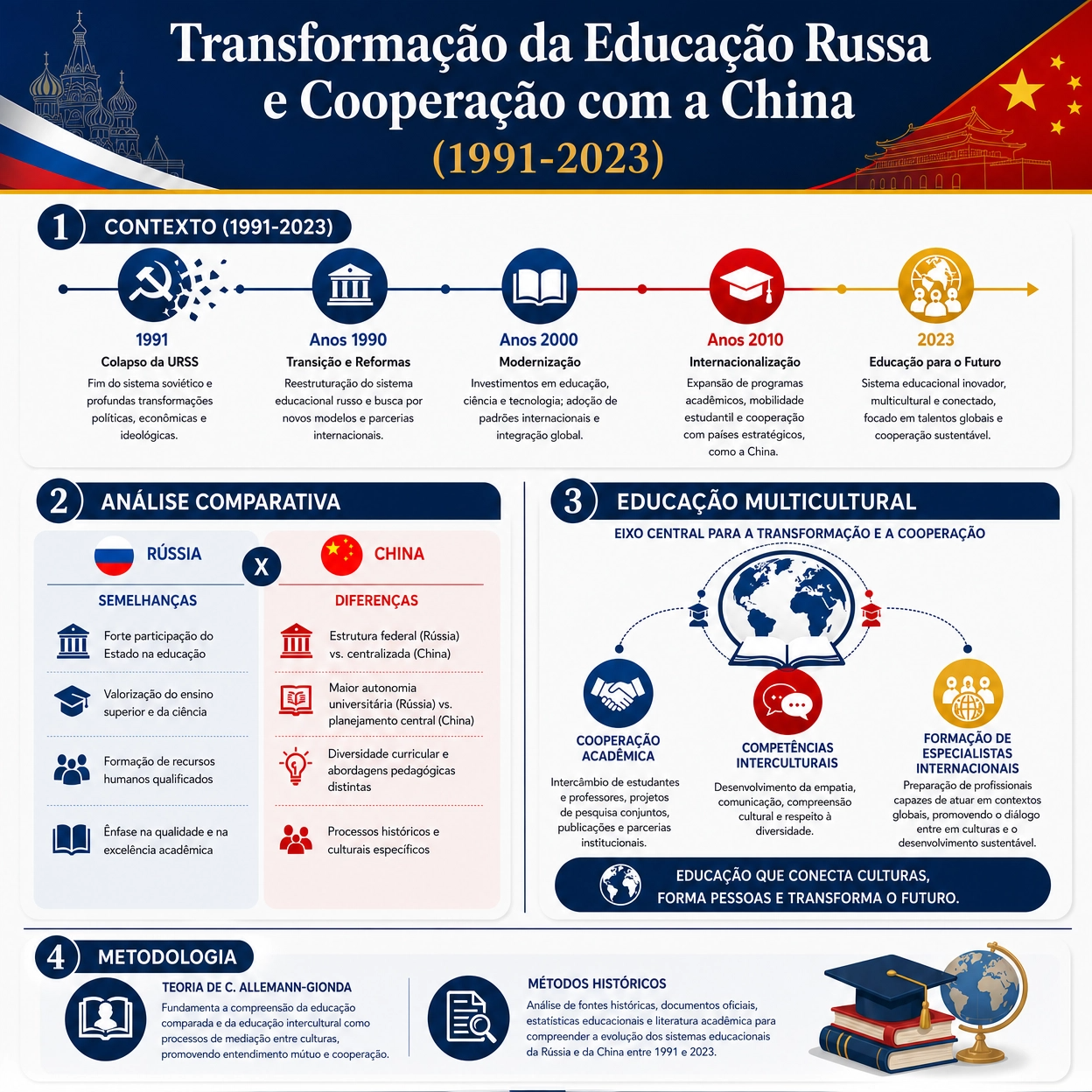
Este artigo analisa a transformação da educação russa após o colapso da União Soviética e examina como essas mudanças moldaram o desenvolvimento da interação educacional multicultural entre a Rússia e a China. O estudo abrange o período de 1991 a 2023 e utiliza a teoria das modalidades de C. Allemann-Ghionda, juntamente com os métodos comparativo-histórico e histórico-sistêmico. Identifica semelhanças e diferenças estruturais entre os dois sistemas educacionais, traça o papel histórico dos contatos educacionais russo-chineses e sistematiza as principais etapas da formação da educação multicultural em ambos os países. O artigo sustenta que a educação multicultural deve ser compreendida não apenas como um princípio geral de tolerância, mas também como um mecanismo prático de cooperação acadêmica, desenvolvimento de competências interculturais e formação de especialistas capazes de atuar em ambientes internacionais.
Downloads
Referências
Allemann-Ghionda, C. (2017). Teaching comparative education: Trends and issues informing practice. Zeitschrift für Pädagogik, 63(3), 387–389.
Antipovsky, A. A., Borevskaya, N. E., & Franchuk, N. V. (1980). Politika v oblasti nauki i obrazovaniya v KNR, 1949–1979 [Policy in the field of science and education in the PRC, 1949–1979]. Nauka.
Bessarabova, I. (2012). Polikul'turnoye obrazovaniye v Rossii: Sovremennoye sostoyaniye problemy [Multicultural education in Russia: Contemporary state of the issue]. Izvestiya VGPU, 69(5), 12–15.
Chankseliani, M. (2022). What happened to the Soviet university? Oxford University Press. https://doi.org/10.1093/oso/9780192849847.003.0002
Deng, X. (1987). Osnovnyye voprosy sovremennogo Kitaya [Main issues of modern China]. Politizdat.
Deng, X. (1994). Selected works (Vol. 2). Zhenmin chu-banshe.
Donetskaya, S. S., & Bin, W. (2022). Vyssheye obrazovaniye v Kitaye: Osobennosti sistemy upravleniya v vedushchikh vuzakh strany [Higher education in China: Features of management in leading universities]. RUDN Journal of Sociology, 22(1), 150–167. https://doi.org/10.22363/2313-2272-2022-22-1-150-167
Efremova, L. I. (2017). O rossiysko-kitayskom sotrudnichestve v oblasti obrazovaniya [Russian-Sino cooperation in education]. Vestnik RUDN. International Relations, 17(4), 857–865. https://doi.org/10.22363/2313-0660-2017-17-4-857-865
Erokhin, A. K., Vlasenko, A. A., & Tsareva, N. A. (2018). Organizational structure of the modern Russian system of higher education: Problems and development trends. Baltic Humanitarian Journal, 7(1[22]), 241–245.
Guruleva, T. L. (2017). Sistema obrazovaniya v Kitayskoy Narodnoy Respublike: Struktura i osnovnyye napravleniya razvitiya [Educational system in the People’s Republic of China: Structure and main directions of development]. Higher Education in Russia, (7), 152–164.
Gusevskaya, N. Y., & Mamkina, I. N. (2017). Rol' obrazovaniya v razvitii rossiysko-kitayskikh otnosheniy: Istoriya i sovremennost’ [The role of education in the development of Russian-Chinese relations: History and modernity]. Tomsk State University Journal, (423), 77–83.
Khukhlaeva, O. V., Hakimov, E. R., & Khukhlaev, O. E. (2023). Polikul'turnoye obrazovaniye [Multicultural education: A textbook for universities]. Yurait.
Logvinovich, G. V. (2018). Razvitiye i krizisnyye cherty v sisteme vysshego obrazovaniya SSSR v 1970–1980-kh godakh [Development and features of crisis in higher education of the USSR in the 1970s–1980s]. Tomsk State Pedagogical University Bulletin, 3(192), 186–193. https://doi.org/10.23951/1609-624X-2018-3-186-193
Nikiforova, E. P., Borisova, L. P., & Shadrina, S. N. (2016). Problemy prepodavaniya russkogo yazyka v polikul'turnoy srede [Problems of Russian language teaching in a multicultural environment]. Historical and Social Educational Idea, 8(4-1), 148–155.
Pepper, S. (1996). Radicalism and education reform in 20th-century China: The search for an ideal development model. Cambridge University Press.
Platonova, D. P. (2015). Gorizontal'naya i vertikal'naya differentsiatsiya sistemy vysshego obrazovaniya v Rossii [Horizontal and vertical diversity in Russian higher education]. University Management: Practice and Analysis, 4(98), 19–30.
President of the Russian Federation. (2023, May 12). Decree of the President of the Russian Federation of May 12, 2023, No. 343 “On some issues of improving the system of higher education”. http://www.kremlin.ru/acts/bank/49210
Simbirtseva, N., & Shulga, N. (2017). Polikul'turnoye obrazovaniye kak napravleniye deyatel'nosti otkrytogo universiteta [Multicultural education as a branch of open university activities]. Pedagogical Education in Russia, (8), 6–12. https://doi.org/10.26170/po17-08-01
State Duma of the Federal Assembly of the Russian Federation. (2012, December 31). Federal law of the Russian Federation of December 29, 2012 No. 273-FZ “On education in the Russian Federation” (latest edition). Rossiiskaia Gazeta, No. 303.
Wang, Y. (2018). Reformirovaniye sistemy vysshego obrazovaniya v Kitaye v XX – nachale XXI v. [The higher education system reforms in China in the 20th – early 21st centuries]. Obshchestvo: Sotsiologiya, Psikhologiya, Pedagogika, (3), 62–71. https://doi.org/10.24158/spp.2018.3.12
Xing, G. (2021). Faktor SSSR v stoletney istorii Kommunisticheskoy partii Kitaya v predstavleniyakh Mao Tszeduna i Den Syaopina [Mao Zedong and Deng Xiaoping about the Soviet factor in the one hundred years’ history of the Chinese Communist Party]. Russia and the Pacific, (2), 53–68. https://doi.org/10.24412/1026-8804-2021-2-53-68
Zajda, J. (2003). Educational reform and transformation in Russia: Why education reforms fail. European Education, 35(1), 58–88. https://doi.org/10.2753/EUE1056-4934350158
Publicado
Como Citar
Edição
Seção
Licença
Copyright (c) 2026 Revista on line de Política e Gestão Educacional

Este trabalho está licenciado sob uma licença Creative Commons Attribution-NonCommercial-ShareAlike 4.0 International License.
Manuscritos aceitos e publicados são de propriedade da Revista on line de Política e Gestão Educacional. É vedada a submissão integral ou parcial do manuscrito a qualquer outro periódico. A responsabilidade do conteúdo dos artigos é exclusiva dos autores. É vedada a tradução para outro idioma sem a autorização escrita do Editor ouvida a Comissão Editorial Científica.