Universities of the third age as a bridge between lifelong learning and social policy
insights from the Czech context
DOI:
https://doi.org/10.22633/rpge.v30i00.20817Keywords:
Lifelong learning, Active aging, University of the Third Age, Social policyAbstract
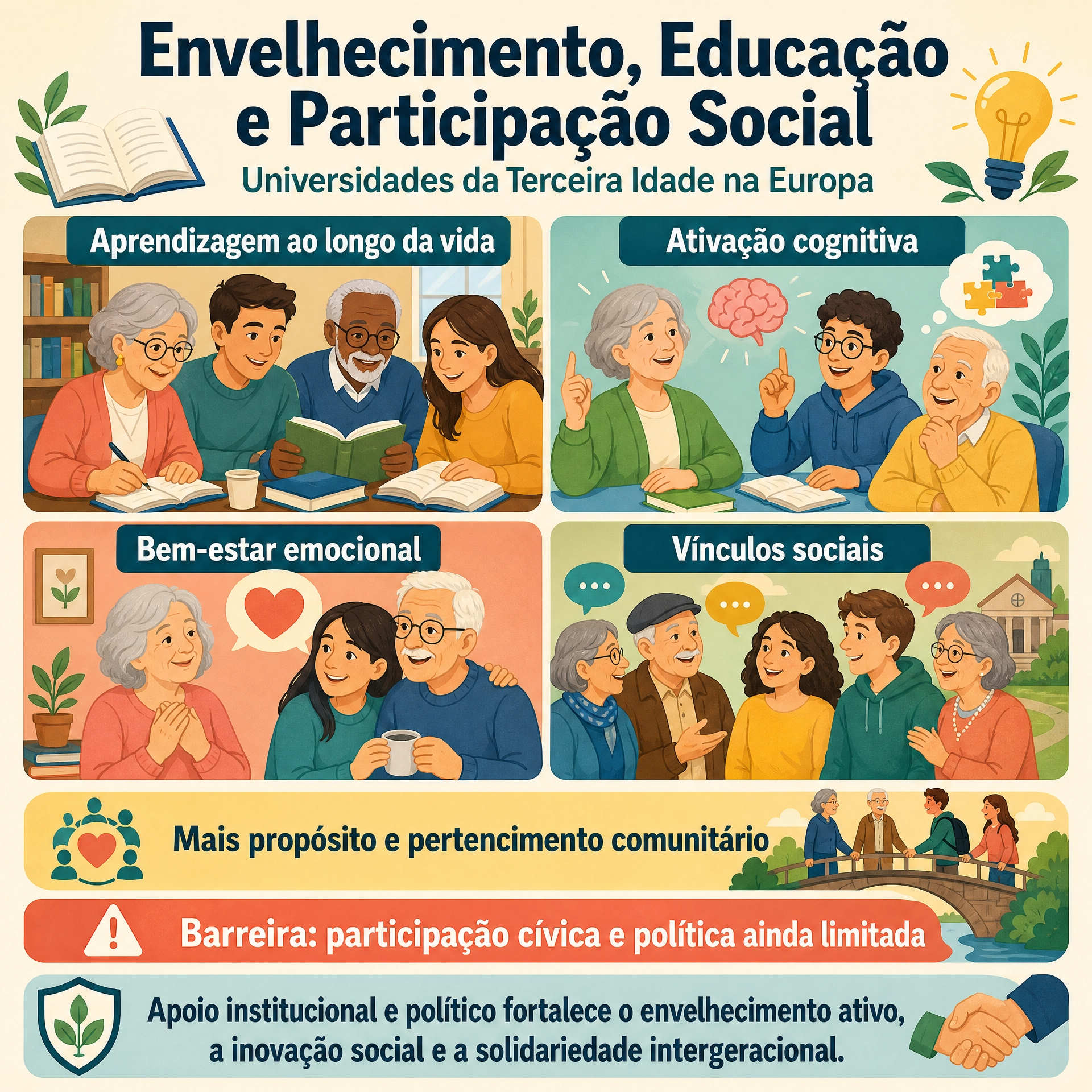
Population ageing is transforming education and social policy across Europe. This study examines the role of Universities of the Third Age as spaces that connect lifelong learning with social participation among older adults. Quantitative and qualitative data from 135 participants were analysed to explore motivation, perceived benefits, and barriers to participation. The results show that later-life education supports cognitive activation, emotional well-being, and social connectedness, while fostering a sense of purpose and community belonging. However, participation in civic or policy-related activities remains limited, indicating the need for stronger institutional and policy support. The discussion situates these findings within current European and Czech debates on active ageing and lifelong learning. The study suggests that education in later life can serve as a form of social innovation, contributing to inclusion, empowerment, and intergenerational solidarity in an ageing society.
Downloads
References
All European Academies. (2017). The European code of conduct for research integrity (Rev. ed.). https://allea.org/european-code-of-conduct-2017/
Anikeeva, O. A., Sizikova, V. V., Shimanovskaya, Y. V., Fomina, S. N., & Besschetnova, O. V. (2021). Formal and non-formal education in enhancing the well-being and security of older adults. Laplage em Revista, 7(Extra-E), 419–426. https://doi.org/10.24115/S2446-622020217Extra-E1214p.419-426
Barbaccia, V., Bravi, L., Murmura, F., Savelli, E., & Viganò, E. (2022). Mature and older adults’ perception of active ageing and the need for supporting services: Insights from a qualitative study. International Journal of Environmental Research and Public Health, 19(13), 7660. https://doi.org/10.3390/ijerph19137660
Braun, V., & Clarke, V. (2019). Reflecting on reflexive thematic analysis. Qualitative Research in Sport, Exercise and Health, 11(4), 589–597. https://doi.org/10.1080/2159676X.2019.1628806
Casanova, G., Weil, J., & Cerqueira, M. (2024). The evolution of universities of the third age around the world: A historical review. Gerontology & Geriatrics Education, 45(3), 483–498. https://doi.org/10.1080/02701960.2023.2231375
Chen, L.-K., & Wang, S. T. (2016). Seniors’ demographic correlates for motivations to enroll in degree-conferring programs in universities. Educational Gerontology, 42(6), 431–442. https://doi.org/10.1080/03601277.2016.1139968
Choi, I., & Cho, S. R. (2021). A case study of active aging through lifelong learning: Psychosocial interpretation of older adult participation in evening schools in Korea. International Journal of Environmental Research and Public Health, 18(17), 9232. https://doi.org/10.3390/ijerph18179232
Creswell, J. W., & Plano Clark, V. L. (2018). Designing and conducting mixed methods research (3rd ed.). Sage.
Cuyvers, G., Thomése, F., & van Tilburg, T. G. (2018). Participation narratives of third age adults: Their activities, motivations and expectations regarding civil society organisations. Journal of Aging Studies, 46, 10–16. https://doi.org/10.1016/j.jaging.2018.05.003
Daněk, A. (2022). Social integration of young adults leaving institutional care: Personal experiences. Ad Alta: Journal of Interdisciplinary Research, 12(2), 32–34. https://doi.org/10.33543/12023234
Daněk, A. (2024). The issue of extraordinary talent in the residential childcare institution: Giftedness or dual exceptionality? Pedagogika-Pedagogy, 96(9), 1297–1307. https://doi.org/10.53656/ped2024-9.09
Díaz-López, M. del P., Aguilar-Parra, J. M., López-Liria, R., Rocamora-Pérez, P., Vargas-Muñoz, M. E., & Padilla-Góngora, D. (2017). Skills for successful ageing in the elderly: Education, well-being and health. Procedia - Social and Behavioral Sciences, 237, 986–991. https://doi.org/10.1016/j.sbspro.2017.02.140
European Association for the Education of Adults. (2021). European agenda for adult learning (2021–2030). https://eaea.org/our-work/influencing-policy/monitoring-policies/european-agenda-for-adult-learning/
European Commission. (2024). Adult learning: About. European Education Area. https://education.ec.europa.eu/education-levels/adult-learning/about-adult-learning
Formosa, M. (Ed.). (2019). The university of the third age and active ageing: European and Asian-Pacific perspective. Springer. https://doi.org/10.1007/978-3-030-21515-6
Gierszewski, D., & Kluzowicz, J. (2021). The role of the University of the Third Age in meeting the needs of older adult learners in Poland. Gerontology & Geriatrics Education, 42(3), 437–451. https://doi.org/10.1080/02701960.2021.1871904
Halířová, J. (2018). Seniorské vzdělávání v českém kontextu: Reflexe a perspektivy. Andragogika, 8(2), 54–63.
Havlíková, J., & Sýkorová, D. (2019). Participace seniorů na utváření sociálních služeb. Sociální práce/Sociálna práca, 19(5), 30–44.
Huang, D., Feng, R., & Shi, M. (2024). Does the community service environment affect the willingness of older adults people to socialize for older adults care? Frontiers in Public Health, 12, 1370808. https://doi.org/10.3389/fpubh.2024.1370808
Kalenda, J., & Kočvarová, I. (2024). Enduring inequality: Long-term trends and factors in participation in adult education and learning among older adults. Gerontology & Geriatrics Education, 45(1), 125–140. https://doi.org/10.1080/02701960.2022.2156866
Lak, A., Rashidghalam, P., Amiri, S., Myint, P. K., & Baradaran, H. R. (2021). An ecological approach to the development of an active aging measurement in urban areas (AAMU). BMC Public Health, 21, 4. https://doi.org/10.1186/s12889-020-10036-5
Mühlpachr, P. (2014). Gerontopedagogika: Výchova a vzdělávání seniorů. Masarykova univerzita.
Narushima, M., Liu, J., & Diestelkamp, N. (2018). Lifelong learning in active ageing discourse: Its conserving effect on wellbeing, health and vulnerability. Ageing & Society, 38(4), 651–675. https://doi.org/10.1017/S0144686X16001136
Narushima, M., Liu, J., & Diestelkamp, N. (2018). I learn, therefore I am: A phenomenological analysis of meanings of lifelong learning for vulnerable older adults. The Gerontologist, 58(4), 696–705. https://doi.org/10.1093/geront/gnx044
Ordonez, T. N., Lima-Silva, T. B., & Cachioni, M. (2011). Subjective and psychological well-being of students of a University of the Third Age: Benefits of continuing education for psychological adjustment in the elderly. Dementia & Neuropsychologia, 5(3), 216–225. https://doi.org/10.1590/S1980-57642011DN05030010
Patterson, R., Moffatt, S., Smith, M., Scott, J., McLoughlin, C., Bell, J., & Bell, N. W. (2016). Exploring social inclusivity within the University of the Third Age (U3A): A model of collaborative research. Ageing & Society, 36(8), 1580–1603. https://doi.org/10.1017/S0144686X15000550
Rupavijetra, P., Nilsook, P., Manasatchakun, P., Chaiyarak, S., & Wannapaisan, C. (2022). Model of development of learning activities to promote mental health among the older adults at senior citizens school. Higher Education Studies, 12(3), 72–85. https://doi.org/10.5539/hes.v12n3p72
Ryan, R. M., & Deci, E. L. (2012). Self-determination theory: Basic psychological needs in motivation, development, and wellness. Guilford Press.
Sloane-Seale, A., & Kops, B. (2008). Older adults in lifelong learning: Participation and successful aging. Canadian Journal of University Continuing Education, 34(1), 37–62. https://doi.org/10.21225/d5pc7r
Stárek, L. (2025). Social work and its methods not only in the context of direct work with seniors living with dementia. European Journal of Social Work, 28(6), 1240–1251. https://doi.org/10.1080/13691457.2024.2426699
Šerák, M. (2009). Univerzity třetího věku: Vzdělávání a aktivní stárnutí. UK.
Špatenková, N. (2016). Mezigenerační dialog a vzdělávání seniorů. Pedagogická orientace, 26(3), 451–466.
Veteška, J. (2024). Gerontagogika: Psychologická, sociální a andragogická specifika edukace a aktivizace seniorů (3rd updated and expanded ed.). Česká andragogická společnost.
Vlach, F., & Stárek, L. (2025). Resocialization of convicts in the Czech Republic: The role of the prison system in promoting reintegration into society. Jurnal Cita Hukum, 13(1), 157–170.
World Health Organization. (2021). Decade of healthy ageing: Baseline report. https://www.who.int/publications/i/item/9789240017900
World Medical Association. (2013). World Medical Association Declaration of Helsinki: Ethical principles for medical research involving human subjects. JAMA, 310(20), 2191–2194. https://doi.org/10.1001/jama.2013.281053
Zeki Al Hazzouri, A., Elbejjani, M., Abi Chahine, M., Sadana, R., & Sibai, A. M. (2021). Late-life learning and health: Challenges, opportunities, and future directions. The Lancet Healthy Longevity, 2(10), e613–e614. https://doi.org/10.1016/S2666-7568(21)00207-5
Zhang, K., Kan, C., Luo, Y., Song, H., Tian, Z., Ding, W., Xu, L., Han, F., & Hou, N. (2022). The promotion of active aging through older adult education in the context of population aging. Frontiers in Public Health, 10, 998710. https://doi.org/10.3389/fpubh.2022.998710
Published
How to Cite
Issue
Section
License
Copyright (c) 2026 Revista on line de Política e Gestão Educacional

This work is licensed under a Creative Commons Attribution-NonCommercial-ShareAlike 4.0 International License.
Manuscritos aceitos e publicados são de propriedade da Revista on line de Política e Gestão Educacional. É vedada a submissão integral ou parcial do manuscrito a qualquer outro periódico. A responsabilidade do conteúdo dos artigos é exclusiva dos autores. É vedada a tradução para outro idioma sem a autorização escrita do Editor ouvida a Comissão Editorial Científica.