Universidades de la tercera edad como puente entre el aprendizaje a lo largo de la vida y la política social
perspectivas del contexto checo
DOI:
https://doi.org/10.22633/rpge.v30i00.20817Palabras clave:
Aprendizaje permanente, Envejecimiento activo, Universidad de la Tercera Edad, Política socialResumen
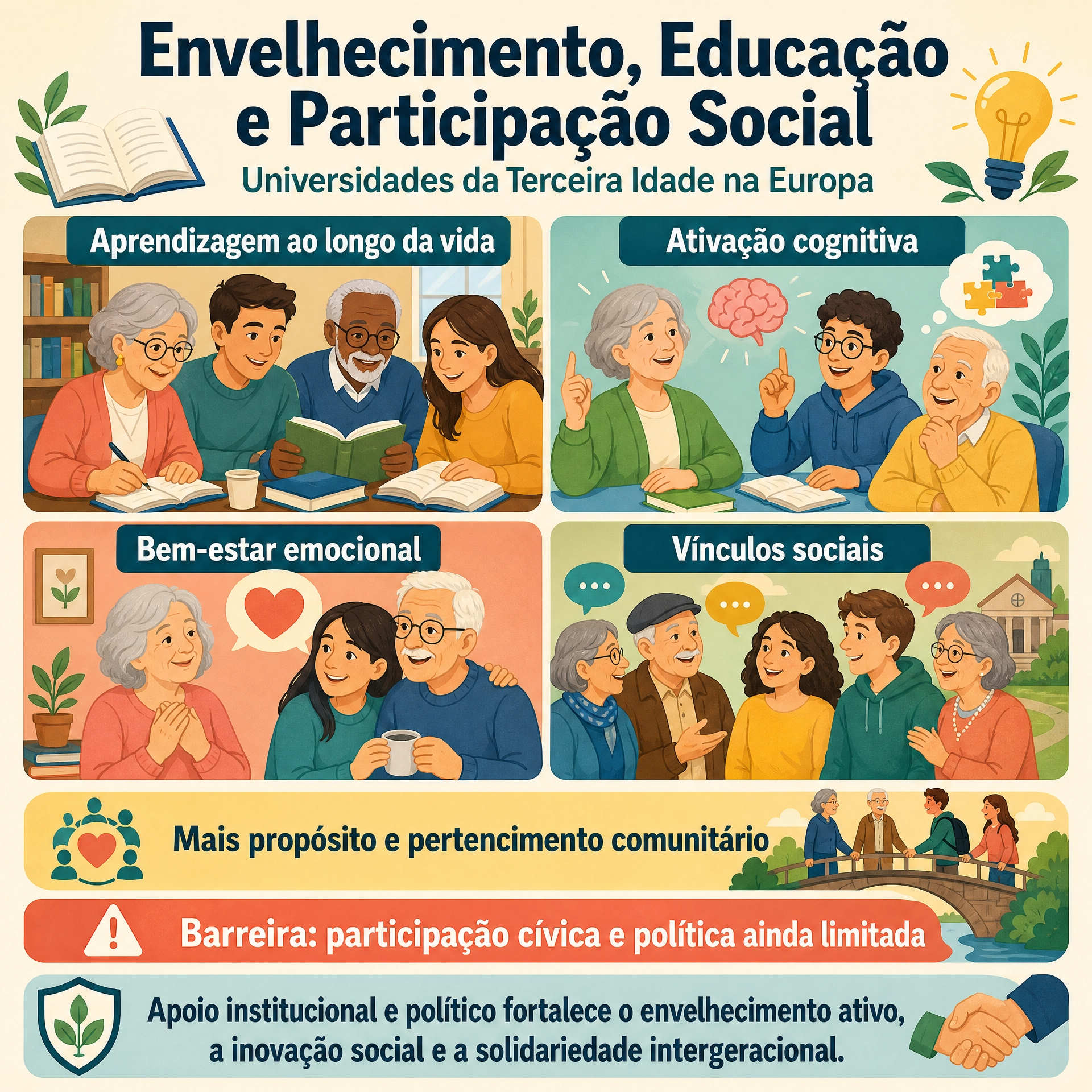
El envejecimiento poblacional está transformando la educación y las políticas sociales en toda Europa. Este estudio examina el papel de las Universidades de la Tercera Edad como espacios que vinculan el aprendizaje a lo largo de la vida con la participación social de las personas mayores. Se analizaron datos cuantitativos y cualitativos de 135 participantes para explorar motivaciones, beneficios percibidos y barreras a la participación. Los resultados muestran que la educación en la vejez favorece la activación cognitiva, el bienestar emocional y la conexión social, fortaleciendo al mismo tiempo el sentido de propósito y pertenencia comunitaria. Sin embargo, la participación en actividades cívicas o políticas sigue siendo limitada, lo que revela la necesidad de un mayor apoyo institucional y político. La discusión sitúa estos hallazgos en los debates europeos y checos actuales sobre el envejecimiento activo y el aprendizaje permanente, y sugiere que la educación en edades avanzadas puede funcionar como una forma de innovación social y de fortalecimiento de la solidaridad intergeneracional.
Descargas
Citas
All European Academies. (2017). The European code of conduct for research integrity (Rev. ed.). https://allea.org/european-code-of-conduct-2017/
Anikeeva, O. A., Sizikova, V. V., Shimanovskaya, Y. V., Fomina, S. N., & Besschetnova, O. V. (2021). Formal and non-formal education in enhancing the well-being and security of older adults. Laplage em Revista, 7(Extra-E), 419–426. https://doi.org/10.24115/S2446-622020217Extra-E1214p.419-426
Barbaccia, V., Bravi, L., Murmura, F., Savelli, E., & Viganò, E. (2022). Mature and older adults’ perception of active ageing and the need for supporting services: Insights from a qualitative study. International Journal of Environmental Research and Public Health, 19(13), 7660. https://doi.org/10.3390/ijerph19137660
Braun, V., & Clarke, V. (2019). Reflecting on reflexive thematic analysis. Qualitative Research in Sport, Exercise and Health, 11(4), 589–597. https://doi.org/10.1080/2159676X.2019.1628806
Casanova, G., Weil, J., & Cerqueira, M. (2024). The evolution of universities of the third age around the world: A historical review. Gerontology & Geriatrics Education, 45(3), 483–498. https://doi.org/10.1080/02701960.2023.2231375
Chen, L.-K., & Wang, S. T. (2016). Seniors’ demographic correlates for motivations to enroll in degree-conferring programs in universities. Educational Gerontology, 42(6), 431–442. https://doi.org/10.1080/03601277.2016.1139968
Choi, I., & Cho, S. R. (2021). A case study of active aging through lifelong learning: Psychosocial interpretation of older adult participation in evening schools in Korea. International Journal of Environmental Research and Public Health, 18(17), 9232. https://doi.org/10.3390/ijerph18179232
Creswell, J. W., & Plano Clark, V. L. (2018). Designing and conducting mixed methods research (3rd ed.). Sage.
Cuyvers, G., Thomése, F., & van Tilburg, T. G. (2018). Participation narratives of third age adults: Their activities, motivations and expectations regarding civil society organisations. Journal of Aging Studies, 46, 10–16. https://doi.org/10.1016/j.jaging.2018.05.003
Daněk, A. (2022). Social integration of young adults leaving institutional care: Personal experiences. Ad Alta: Journal of Interdisciplinary Research, 12(2), 32–34. https://doi.org/10.33543/12023234
Daněk, A. (2024). The issue of extraordinary talent in the residential childcare institution: Giftedness or dual exceptionality? Pedagogika-Pedagogy, 96(9), 1297–1307. https://doi.org/10.53656/ped2024-9.09
Díaz-López, M. del P., Aguilar-Parra, J. M., López-Liria, R., Rocamora-Pérez, P., Vargas-Muñoz, M. E., & Padilla-Góngora, D. (2017). Skills for successful ageing in the elderly: Education, well-being and health. Procedia - Social and Behavioral Sciences, 237, 986–991. https://doi.org/10.1016/j.sbspro.2017.02.140
European Association for the Education of Adults. (2021). European agenda for adult learning (2021–2030). https://eaea.org/our-work/influencing-policy/monitoring-policies/european-agenda-for-adult-learning/
European Commission. (2024). Adult learning: About. European Education Area. https://education.ec.europa.eu/education-levels/adult-learning/about-adult-learning
Formosa, M. (Ed.). (2019). The university of the third age and active ageing: European and Asian-Pacific perspective. Springer. https://doi.org/10.1007/978-3-030-21515-6
Gierszewski, D., & Kluzowicz, J. (2021). The role of the University of the Third Age in meeting the needs of older adult learners in Poland. Gerontology & Geriatrics Education, 42(3), 437–451. https://doi.org/10.1080/02701960.2021.1871904
Halířová, J. (2018). Seniorské vzdělávání v českém kontextu: Reflexe a perspektivy. Andragogika, 8(2), 54–63.
Havlíková, J., & Sýkorová, D. (2019). Participace seniorů na utváření sociálních služeb. Sociální práce/Sociálna práca, 19(5), 30–44.
Huang, D., Feng, R., & Shi, M. (2024). Does the community service environment affect the willingness of older adults people to socialize for older adults care? Frontiers in Public Health, 12, 1370808. https://doi.org/10.3389/fpubh.2024.1370808
Kalenda, J., & Kočvarová, I. (2024). Enduring inequality: Long-term trends and factors in participation in adult education and learning among older adults. Gerontology & Geriatrics Education, 45(1), 125–140. https://doi.org/10.1080/02701960.2022.2156866
Lak, A., Rashidghalam, P., Amiri, S., Myint, P. K., & Baradaran, H. R. (2021). An ecological approach to the development of an active aging measurement in urban areas (AAMU). BMC Public Health, 21, 4. https://doi.org/10.1186/s12889-020-10036-5
Mühlpachr, P. (2014). Gerontopedagogika: Výchova a vzdělávání seniorů. Masarykova univerzita.
Narushima, M., Liu, J., & Diestelkamp, N. (2018). Lifelong learning in active ageing discourse: Its conserving effect on wellbeing, health and vulnerability. Ageing & Society, 38(4), 651–675. https://doi.org/10.1017/S0144686X16001136
Narushima, M., Liu, J., & Diestelkamp, N. (2018). I learn, therefore I am: A phenomenological analysis of meanings of lifelong learning for vulnerable older adults. The Gerontologist, 58(4), 696–705. https://doi.org/10.1093/geront/gnx044
Ordonez, T. N., Lima-Silva, T. B., & Cachioni, M. (2011). Subjective and psychological well-being of students of a University of the Third Age: Benefits of continuing education for psychological adjustment in the elderly. Dementia & Neuropsychologia, 5(3), 216–225. https://doi.org/10.1590/S1980-57642011DN05030010
Patterson, R., Moffatt, S., Smith, M., Scott, J., McLoughlin, C., Bell, J., & Bell, N. W. (2016). Exploring social inclusivity within the University of the Third Age (U3A): A model of collaborative research. Ageing & Society, 36(8), 1580–1603. https://doi.org/10.1017/S0144686X15000550
Rupavijetra, P., Nilsook, P., Manasatchakun, P., Chaiyarak, S., & Wannapaisan, C. (2022). Model of development of learning activities to promote mental health among the older adults at senior citizens school. Higher Education Studies, 12(3), 72–85. https://doi.org/10.5539/hes.v12n3p72
Ryan, R. M., & Deci, E. L. (2012). Self-determination theory: Basic psychological needs in motivation, development, and wellness. Guilford Press.
Sloane-Seale, A., & Kops, B. (2008). Older adults in lifelong learning: Participation and successful aging. Canadian Journal of University Continuing Education, 34(1), 37–62. https://doi.org/10.21225/d5pc7r
Stárek, L. (2025). Social work and its methods not only in the context of direct work with seniors living with dementia. European Journal of Social Work, 28(6), 1240–1251. https://doi.org/10.1080/13691457.2024.2426699
Šerák, M. (2009). Univerzity třetího věku: Vzdělávání a aktivní stárnutí. UK.
Špatenková, N. (2016). Mezigenerační dialog a vzdělávání seniorů. Pedagogická orientace, 26(3), 451–466.
Veteška, J. (2024). Gerontagogika: Psychologická, sociální a andragogická specifika edukace a aktivizace seniorů (3rd updated and expanded ed.). Česká andragogická společnost.
Vlach, F., & Stárek, L. (2025). Resocialization of convicts in the Czech Republic: The role of the prison system in promoting reintegration into society. Jurnal Cita Hukum, 13(1), 157–170.
World Health Organization. (2021). Decade of healthy ageing: Baseline report. https://www.who.int/publications/i/item/9789240017900
World Medical Association. (2013). World Medical Association Declaration of Helsinki: Ethical principles for medical research involving human subjects. JAMA, 310(20), 2191–2194. https://doi.org/10.1001/jama.2013.281053
Zeki Al Hazzouri, A., Elbejjani, M., Abi Chahine, M., Sadana, R., & Sibai, A. M. (2021). Late-life learning and health: Challenges, opportunities, and future directions. The Lancet Healthy Longevity, 2(10), e613–e614. https://doi.org/10.1016/S2666-7568(21)00207-5
Zhang, K., Kan, C., Luo, Y., Song, H., Tian, Z., Ding, W., Xu, L., Han, F., & Hou, N. (2022). The promotion of active aging through older adult education in the context of population aging. Frontiers in Public Health, 10, 998710. https://doi.org/10.3389/fpubh.2022.998710
Publicado
Cómo citar
Número
Sección
Licencia
Derechos de autor 2026 Revista on line de Política e Gestão Educacional

Esta obra está bajo una licencia internacional Creative Commons Atribución-NoComercial-CompartirIgual 4.0.
Manuscritos aceitos e publicados são de propriedade da Revista on line de Política e Gestão Educacional. É vedada a submissão integral ou parcial do manuscrito a qualquer outro periódico. A responsabilidade do conteúdo dos artigos é exclusiva dos autores. É vedada a tradução para outro idioma sem a autorização escrita do Editor ouvida a Comissão Editorial Científica.