
From From formal recognition to semantic understanding
rethinking Falangcai porcelain pattern instruction in ceramic design education Jingdezhen, Jiangxi province in China
DOI:
https://doi.org/10.22633/rpge.v30iesp1.20933Keywords:
Falangcai porcelain patterns, Falangcai painted, icial intelligence-generated content (AIGC), KANO-AHP hybrid model, Low-rank adaptation (LoRA) technologyAbstract
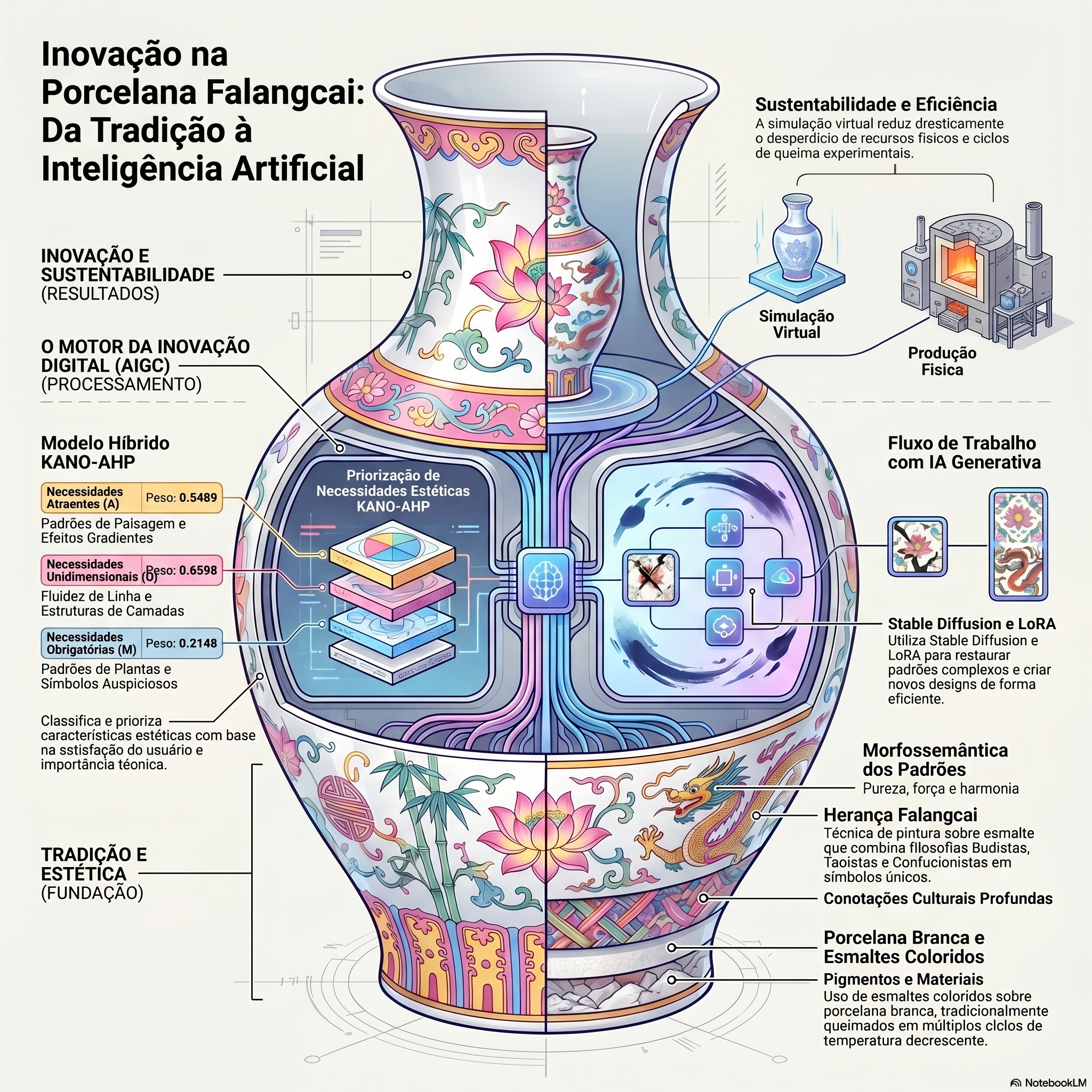
This study investigates the incorporation of traditional Chinese cultural elements into porcelain tea set design through the framework of morphosemantics, focusing on Falangcai porcelain as a case study. Utilizing archival records from the Imperial Workshop, researchers developed RGB and spectral databases (350–950 nm) specific to Jingdezhen Falangcai porcelain. Aesthetic features were systematically categorized using grounded theory in combination with the KANO-AHP hybrid model. To innovate and restore Falangcai patterns, a generative AI-assisted workflow was implemented, leveraging Stable Diffusion paired with Low-Rank Adaptation (LoRA). Findings reveal that AIGC serves as an effective bridge between traditional craftsmanship and contemporary design practices. Furthermore, the study highlights digital innovation strategies for Falangcai porcelain by incorporating sustainable design principles, providing actionable insights for modernizing this intangible cultural heritage.
Downloads
References
Aras, E., Ramachandran, G. S., Lawrence, P., & Hughes, D. (2017). Exploring the security vulnerabilities of LoRa. In Proceedings of the 2017 3rd IEEE International Conference on Cybernetics (CYBCONF) (pp. 1–6). IEEE.
Bao, Z., Yuan, H., Wen, R., & Chen, K. (2015). The fast and direct characterization of falangcai porcelain glaze from Jingdezhen by laser ablation–inductively coupled plasma mass spectrometry. Analytical Methods, 7, 5034–5040.
Bisalputra, P. (2017). Ceramic trade between early Qing China and late Ayutthaya, 1644–1767. The Journal of the Siam Society, 105, 1–42.
Cao, Y., Li, S., Liu, Y., Yan, Z., Dai, Y., Yu, P., & Sun, L. (2024). A survey of AI-generated content (AIGC). ACM Computing Surveys, 57, 1–38.
Colomban, P., Gironda, M., Simsek Franci, G., & d’Abrigeon, P. (2022). Distinguishing genuine imperial Qing dynasty porcelain from ancient replicas by on-site non-invasive XRF and Raman spectroscopy. Materials, 15(16), 5747.
Colomban, P., Ambrosi, F., Ngo, A.-T., Lu, T.-A., Feng, X.-L., Chen, S., & Choi, C.-L. (2017). Comparative analysis of wucai Chinese porcelains using mobile and fixed Raman microspectrometers. Ceramics International, 43, 14244–14256.
Colomban, P., Lu, T.-A., & Milande, V. (2018). Non-invasive on-site Raman study of blue-decorated early soft-paste porcelain: The use of arsenic-rich (European) cobalt ores—Comparison with huafalang Chinese porcelains. Ceramics International, 44, 9018–9026.
Du, H., Li, Z., Niyato, D., Kang, J., Xiong, Z., Huang, H., & Mao, S. (2024). Diffusion-based reinforcement learning for edge-enabled AI-generated content services. IEEE Transactions on Mobile Computing, 23, 8902–8918.
Edwards, H. G. M. (2021). Porcelain analysis and its role in the forensic attribution of ceramic specimens. Springer.
Fanni, F. A., Pellacini, F., Scateni, R., & Giachetti, A. (2022). PAVEL: Decorative patterns with packed volumetric elements. ACM Transactions on Graphics, 41(2), 1–15.
Fu, Y., Shi, K., & Xi, L. (2025). Artificial intelligence and machine learning in the preservation and innovation of intangible cultural heritage: Ethical considerations and design frameworks. Digital Scholarship in the Humanities, 40(2), 487–508.
Fu, X. (2020). Narrative and cultural analysis of porcelain. In Chinese narratologies (pp. 87–115). Springer.
Giannini, R., Freestone, I., & Shortland, A. (2017). European cobalt sources identified in the production of Chinese famille rose porcelain. Journal of Archaeological Science, 80, 27–36.
Goodfellow, I., Pouget-Abadie, J., Mirza, M., Xu, B., Warde-Farley, D., Ozair, S., Courville, A., & Bengio, Y. (2020). Generative adversarial networks. Communications of the ACM, 63, 139–144.
Hanzaei, S. H., Afshar, A., & Barazandeh, F. (2017). Automatic detection and classification of the ceramic tiles’ surface defects. Pattern Recognition, 66, 174–189.
Huang, E. (2008). China’s china: Jingdezhen porcelain and the production of art in the nineteenth century (Doctoral dissertation, University of California, San Diego).
Jiangsu Provincial Study Society for Ancient Ceramics. (2010). Flower and bird roll (Vol. 1). Southeast University Press.
Jing, J., & Ismail, R. (2023). Examining the continuation of tradition from the heritage construction of three ceramic education models in contemporary China.
Li, F., & Wang, Z. (2022). Research on the evolution of Chinese cultural symbol construction in falangcai porcelain. Ceramics and Ceramics Research, 37, 16–18.
Li, J., et al. (2024). Recognition of Yuan falangcai porcelain produced in Jingdezhen based on graph anomaly detection combining portable X-ray fluorescence spectrometry. Heritage Science, 12, 79.
Lin, H., Jiang, X., Deng, X., Bian, Z., Fang, C., & Zhu, Y. (2024). Comparing AIGC and traditional idea generation methods: Evaluating their impact on creativity in the product design ideation phase. Thinking Skills and Creativity, 54, 101649.
Liu, L. P., & Zhang, A. (2023). Exploring the innovative use of traditional Chinese cultural elements in tea set design. Industrial Design, (5), 130–133.
Liu, X., & Xu, Y. (2024). Exploring the application path of AIGC technology in the styling design of traditional artifacts: A case study of Song dynasty lacquerware. In Proceedings of the Third International Conference on Electronics Technology and Artificial Intelligence (ETAI 2024) (Vol. 13286, pp. 377–387). SPIE.
Ma, Z. (2022). Research on the application of auspicious patterns on falangcai porcelain in emotional product design (Doctoral dissertation, Jingdezhen Ceramic University).
Montanari, R., Alberghina, M. F., Casanova Municchia, A., Massa, E., Pelagotti, A., Pelosi, C., Schiavone, S., & Sodo, A. (2018). A polychrome mukozuke (1624–1644) porcelain offers a new hypothesis on the introduction of European enameling technology in Japan. Journal of Cultural Heritage, 32, 232–237.
Montanari, R., Murakami, N., Alberghina, M. F., Pelosi, C., & Schiavone, S. (2019). The origin of overglaze-blue enameling in Japan: New discoveries and a reassessment. Journal of Cultural Heritage, 37, 94–102.
Pan, Y., Luo, Q., & Xu, Z. (2024). The diversified influence of Ming and Qing porcelain symbols on modern clothing patterns and cultural and artistic connotations from the perspective of intangible cultural heritage. Mediterranean Archaeology and Archaeometry, 24, 148–162.
Shih, C. F. (2005). A record of the establishment of a new art form: The unique collection of painted enamels at the Qing court. Collections and Concepts, 7.
Shih, C. F. (2007). Evidence of East–West exchange in the eighteenth century: The establishment of painted enamel art at the Qing court in the reign of Emperor Kangxi. National Palace Museum Research Quarterly, 24, 45–94.
Shih, C. F. (2012). Radiant luminance: The painted enamelware of the Qing imperial court. National Palace Museum.
Shih, C. F. (2021). Hua falang: The Chinese concept of painted enamels. In The RA collection of Chinese ceramics: A collector’s vision (pp. 28–59). Jorge Welsh Research & Publishing.
Shin, J. (2022). Ming and Qing dynasty “hundred antiques (bógǔ)” export ceramics for the European market in the seventeenth and eighteenth centuries. Korean Journal of Art History, 313, 121–154.
Tang, H. (2017). The colours of each piece: Production and consumption of Chinese enamelled porcelain, c. 1728–c. 1780 (Doctoral dissertation, University of Warwick).
Verganti, R., Vendraminelli, L., & Iansiti, M. (2020). Innovation and design in the age of artificial intelligence. Journal of Product Innovation Management, 37, 212–227.
Wang, A., & Luo, S. (2021). Chinese Islamic style: A study on the decorative patterns of falangcai porcelain in the Zhengde official kiln of the Ming dynasty. Chinese Ceramics, 57, 98–105.
Wang, X., He, Z., & Peng, X. (2024). Artificial intelligence-generated content with diffusion models: A literature review. Mathematics, 12, 977.
Wu, Y., & Kim, K. (2024). Automatic generation of traditional patterns and aesthetic quality evaluation technology. Information Technology & Management, 25(2), 125–143.
Wu, B., Hu, B., Yang, Z., Xu, H., Chen, M., Huang, Y., Liang, K., Huang, H., & Xiong, H. (2024). Formula process and coloring mechanism of bluish-white porcelains from the Lanxi kiln in Fujian, China. Archaeometry, 67, 313–327.
Xu, X. D. (2015). Europe–China–Europe: The transmission of the craft of painted enamel in the seventeenth and eighteenth centuries. In M. Berg (Ed.), Goods from the East, 1600–1800: Trading Eurasia (pp. 92–106). Palgrave Macmillan.
Yan, C. (2024a). Exceptional gorgeousness of porcelain from the Qianlong reign. In A brief history of Chinese imperial porcelain: From Song dynasty to Qing dynasty (pp. 317–338). Springer Nature.
Yan, C. (2024b). Magnificence of porcelain from the Kangxi reign. In A brief history of Chinese imperial porcelain: From Song dynasty to Qing dynasty (pp. 253–290). Springer Nature.
Yin, H., Zhang, Z., & Liu, Y. (2023). The exploration of integrating the Midjourney artificial intelligence generated content tool into design systems to direct designers towards future-oriented innovation. Systems, 11, 566.
Zhang, Y., & Pollard, A. M. (2022). The archaeological and scientific analysis of blue-decorated ceramics in the Tang and Song dynasties. Archaeometry, 64, 1394–1410.
Zhou, S. Z. (2008). Research on painted enamels porcelain ware from the Qing court. Wenwu Chubanshe.
Downloads
Published
How to Cite
Issue
Section
License
Copyright (c) 2026 Revista on line de Política e Gestão Educacional

This work is licensed under a Creative Commons Attribution-NonCommercial-ShareAlike 4.0 International License.
Manuscritos aceitos e publicados são de propriedade da Revista on line de Política e Gestão Educacional. É vedada a submissão integral ou parcial do manuscrito a qualquer outro periódico. A responsabilidade do conteúdo dos artigos é exclusiva dos autores. É vedada a tradução para outro idioma sem a autorização escrita do Editor ouvida a Comissão Editorial Científica.