
Interpersonal judgment in digital media
lexico-grammatical patterns and applications in public perception monitoring
DOI:
https://doi.org/10.22633/rpge.v30i00.21192Keywords:
Appraisal, Interpersonal judgment, Digital media, Mixed methods, Public policyAbstract
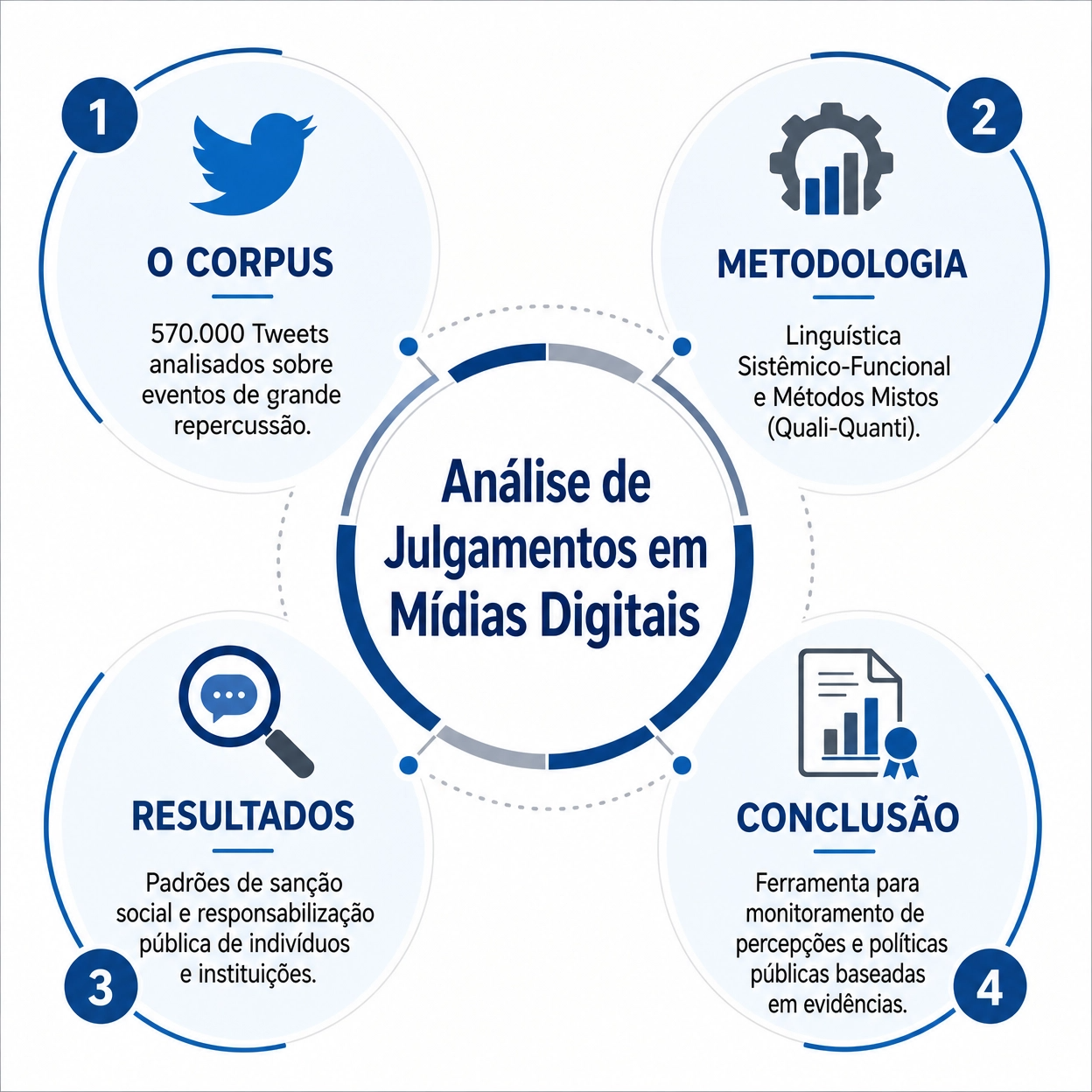
Violent events generate wide repercussion in digital environments, mobilize intense public reactions, and produce large volumes of evaluative texts. In this context, this article aims to analyze lexico-grammatical patterns associated with interpersonal judgment in digital media. The study is grounded in Systemic Functional Linguistics and adopts a Mixed Methods Research approach, integrating qualitative and quantitative procedures. The corpus consists of approximately 570,000 tweets collected after a high-profile event that occurred in 2020. The results highlight linguistic strategies in the construction of social sanctions directed at individuals and institutions, as well as the recurrence of discursive patterns associated with public accountability. It is concluded that the proposed model shows potential for monitoring public perceptions and for the use of large-scale digital data, contributing to analyses aimed at the formulation and evaluation of evidence-based public policies.
Downloads
References
Boyd, D., & Crawford, K. (2012). Critical questions for big data: Provocations for a cultural, technological, and scholarly phenomenon. Information, Communication & Society, 15(5), 662–679. https://doi.org/10.1080/1369118X.2012.678878
Bruns, A. (2021). Social media: A critical introduction (2nd ed.). Polity Press.
Corsi, G. (2024). Evaluating Twitter’s algorithmic amplification of low-credibility content: An observational study. EPJ Data Science, 13, Article 18. https://doi.org/10.1140/epjds/s13688-024-00456-3
Creswell, J. W., & Plano Clark, V. L. (2011). Designing and conducting mixed methods research (2nd ed.). Sage.
Creswell, J. W., & Plano Clark, V. L. (2013). Mixed methods research. Sage.
Jenkins, H., Ford, S., & Green, J. (2013). Spreadable media: Creating value and meaning in a networked culture. New York University Press.
Lima-Lopes, R. E., & Vian Jr., O. (2005). The language of evaluation: Appraisal in English. DELTA: Documentação de Estudos em Linguística Teórica e Aplicada, 23(2), 371–381.
Martin, J. R., & White, P. R. R. (2005). The language of evaluation: Appraisal in English. Palgrave Macmillan.
Milli, S., Carroll, M., Wang, Y., Panday, S., Zhao, S., & Dragan, A. D. (2023). Engagement, user satisfaction, and the amplification of divisive content on social media (arXiv Preprint No. 2305.16941). arXiv. https://doi.org/10.48550/arXiv.2305.16941
Perrin, D. (2018). The linguistics of newswriting. John Benjamins.
Reback, J., McKinney, W., Jones, T., Maschler, J., VanderPlas, J., Garcia, J., et al. (2024). pandas-dev/pandas: Pandas (Version 2.2.2) [Computer software]. Zenodo. https://doi.org/10.5281/zenodo.10957263
Sampson, T. D. (2012). Virality: Contagion theory in the age of networks. University of Minnesota Press.
Tashakkori, A., Johnson, R. B., & Teddlie, C. (2020). Foundations of mixed methods research: Integrating quantitative and qualitative approaches in the social and behavioral sciences (2nd ed.). Sage.
Downloads
Published
How to Cite
Issue
Section
License
Copyright (c) 2026 Revista on line de Política e Gestão Educacional

This work is licensed under a Creative Commons Attribution-NonCommercial-ShareAlike 4.0 International License.
Manuscritos aceitos e publicados são de propriedade da Revista on line de Política e Gestão Educacional. É vedada a submissão integral ou parcial do manuscrito a qualquer outro periódico. A responsabilidade do conteúdo dos artigos é exclusiva dos autores. É vedada a tradução para outro idioma sem a autorização escrita do Editor ouvida a Comissão Editorial Científica.