
Educational implications for penitentiary pedagogy, rehabilitation and resocialisation
DOI:
https://doi.org/10.22633/rpge.v30iesp2.21377Keywords:
Correctional education, Penitentiary pedagogy, Resocialisation, Educational policyAbstract
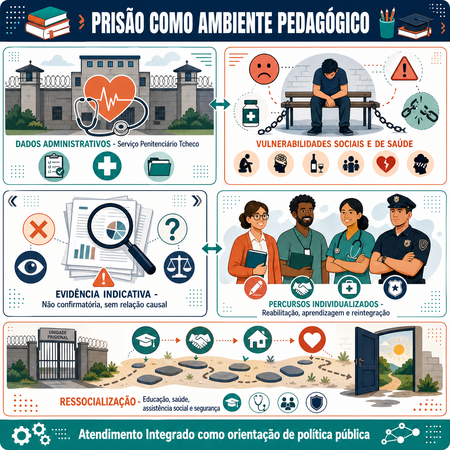
The study analyzes aggregate administrative data from the Czech Prison Service, including health status, medical interventions, and crisis behavior indicators. Using a descriptive and exploratory approach, it assesses what conclusions can legitimately be drawn from such data. The findings indicate a high accumulation and interconnection of health and social vulnerabilities among prisoners. However, the data do not establish causal relationships between service fragmentation and specific outcomes, nor confirm the effectiveness of integrated care models. The article argues that aggregate data should be interpreted as indicative rather than confirmatory evidence. It contributes to the debate by clarifying the analytical limits of commonly used data sources and framing integrated care as a policy orientation requiring further empirical validation. To strengthen its educational relevance, the analysis also frames prison as a pedagogical and resocialization environment involving educators, social workers, health professionals, and security staff in individualized rehabilitation, learning, and reintegration pathways.
Downloads
References
Act No. 38/2025 Coll. (2025). Act amending Act No. 108/2006 Coll., on social services, as amended, and other related acts. Collection of Laws of the Czech Republic. https://www.zakonyprolidi.cz/cs/2025-38
Act No. 48/1997 Coll. (1997). Act on public health insurance and on amendments and supplements to certain related acts. Collection of Laws of the Czech Republic.
Act No. 108/2006 Coll. (2006). Act on social services. Collection of Laws of the Czech Republic. https://www.zakonyprolidi.cz/cs/2006-108
Bačová, V. (2025). Implementation of the RRRR methodology in education: Impacts on students’ socio-emotional skills and teachers’ well-being. Journal of School Health, 95(11), 978–987. https://doi.org/10.1111/josh.70066
Bartůněk, P., & Ptáček, R. (Eds.). (2023). Soucit v medicíně. Grada.
Ben-Moshe, L. (2017). Why prisons are not “the new asylums.” Punishment & Society, 19(3), 272–289. https://doi.org/10.1177/1462474517704852
Citoreš, F. K. (2024). Řešení pro sociálně-zdravotní pomezí. Možná už od roku 2025. Medical Tribune. https://www.tribune.cz/nase-tituly/medical-tribune
Council of Europe. (2013). Prison health care and medical ethics. Council of Europe.
Council of Europe. (2020). European prison rules: Recommendation Rec(2006)2-rev. Council of Europe.
Czech Statistical Office. (2025). Kriminalita 2024. Czech Statistical Office.
Daněk, A., & Klugerová, J. (2023). Inclusive education as an instrument for preventing social exclusion. Ad Alta, 13(2), 142–144. https://doi.org/10.33543/1302
Eichelberger, M., Wertli, M. M., & Tran, N. T. (2023). Equivalence of care, confidentiality, and professional independence must underpin the hospital care of individuals experiencing incarceration. BMC Medical Ethics, 24, Article 13. https://doi.org/10.1186/s12910-023-00891-3
Gormley, C. (2022). The hidden harms of prison life for people with learning disabilities. The British Journal of Criminology, 62(2), 261–278. https://doi.org/10.1093/bjc/azab061
Holmerová, I. (2015). Dlouhodobá péče: Geriatrické aspekty a kvalita. Grada. https://www.bookport.cz/kniha/dlouhodoba-pece-2460/
Jůzl, M. (2010). Základy pedagogiky. IMS.
Jůzl, M. (2017). Penitenciaristika jako věda žalářní. UJAK.
Kučerová, J. (2013). Historický vývoj zdravotnické služby ve vězeňství se zřetelem na činnost pankrácké nemocnice v letech 1918–1998 (Bachelor’s thesis). Vysoká škola zdravotníctva a sociálnej práce sv. Alžbety.
Larsen, B. K., Dale, K. Y., & Odegard, A. (2022). Interprofessional collaboration in reintegration after prison for prisoners with substance abuse issues: A scoping review. International Journal for Crime, Justice and Social Democracy, 11(2), 174–190.
Miller, K. E. M., Shen, K., Yang, Y., Williams, B., & Wolff, J. L. (2024). Prevalence of disability among older adults in prison. JAMA Network Open, 7(12), e2452334. https://doi.org/10.1001/jamanetworkopen.2024.52334
Ministry of Labour and Social Affairs of the Czech Republic. (2024a). MPSV a MZ představila změnový zákon o sociálně-zdravotním pomezí. https://www.mpsv.cz/mpsv-a-mzd-predstavila-zmenovy-zakon-o-socialne-zdravotnim-pomezi-navrhuji-efektivnejsi-zpusob-poskytovani-sluzeb-v-teto-oblasti-a-aktualizaci-systemu
Ministry of Health of the Czech Republic. (2024b). Vláda schválila změnový zákon o sociálně-zdravotním pomezí. https://mzd.gov.cz/tiskove-centrum-mz/vlada-dnes-schvalila-zmenovy-zakon-o-socialne-zdravotnim-pomezi/
Ondrašek, S., Kozlová, L., Hricová, A., & Urban, D. (2024). Sociální politika. Grada.
Průša, L. (2021). Dlouhodobá péče nejen v České republice. Asociace poskytovatelů sociálních služeb ČR.
Řezáč, F. J. (1995). Vězenství v posavádních spůsobech svých s návrhem o zdárnější trestání a polepšování zločinců. České vězeňství, (4–5).
Spreat, S. (2020). Persons with intellectual disability in prison. Journal of Intellectual Disabilities and Offending Behaviour, 11(4), 233–237. https://doi.org/10.1108/JIDOB-03-2020-0006
Stárek, L., Klugerová, J., Chrzová, D., & Roubalová, A. (2025). Perspectivas educacionais e éticas sobre a eugenia: Impacto em indivíduos com deficiência do século XIX a meados do século XX. Revista on line de Política e Gestão Educacional, 29(spe. 1), e025041. https://doi.org/10.22633/rpge.v29iesp1.20476
Prison Service of the Czech Republic. (2016–2024). Statistická ročenka Vězeňské služby České republiky. https://www.vs.gov.cz/sekce/statisticke-rocenky-vezenske-sluzby
Tomeš, I., & Šámalová, K. (Eds.). (2017). Sociální souvislosti aktivního stáří. Karolinum.
United Nations Office on Drugs and Crime. (2015). United Nations Standard Minimum Rules for the Treatment of Prisoners (the Nelson Mandela Rules).
Válková, M. (2015). Dlouhodobá péče v ošetřovatelství. Institut postgraduálního vzdělávání ve zdravotnictví.
Vlach, F., Klugerová, J., & Daněk, A. (2025). Behind bars and beyond limits: Psychological strain on professional prison staff in the Czech Republic. Interacción y Perspectiva, 16(1), 294–316. https://doi.org/10.5281/zenodo.17643075
World Health Organization Regional Office for Europe. (2014). Prisons and health. WHO Regional Office for Europe.
World Health Organization Regional Office for Europe. (2021). The WHO prison health framework: A framework for assessment of prison health system performance. WHO Regional Office for Europe.
Downloads
Published
How to Cite
Issue
Section
License
Copyright (c) 2026 Revista on line de Política e Gestão Educacional

This work is licensed under a Creative Commons Attribution-NonCommercial-ShareAlike 4.0 International License.
Manuscritos aceitos e publicados são de propriedade da Revista on line de Política e Gestão Educacional. É vedada a submissão integral ou parcial do manuscrito a qualquer outro periódico. A responsabilidade do conteúdo dos artigos é exclusiva dos autores. É vedada a tradução para outro idioma sem a autorização escrita do Editor ouvida a Comissão Editorial Científica.