Análisis bibliométrico de tesis relacionadas con el fútbol publicadas en el Turkish National Thesis Center
implicaciones para la educación física, la pedagogía del deporte y la formación de posgrado
DOI:
https://doi.org/10.22633/rpge.v30iesp2.21400Palabras clave:
Fútbol, Análisis bibliométrico, National Thesis Center, Educación Física, Pedagogía del deporteResumen
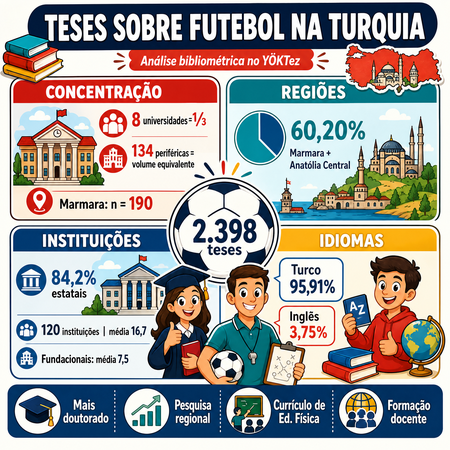
Se realizó un análisis bibliométrico de 2.398 tesis sobre fútbol registradas en el Turkish National Thesis Center (YÖKTez), con énfasis en sus implicaciones educativas para la Educación Física, la pedagogía del deporte y la formación profesional universitaria. El análisis de las zonas de Bradford reveló que 8 universidades produjeron un tercio de las tesis, mientras que fueron necesarias 134 instituciones periféricas para alcanzar un volumen equivalente. La Universidad de Marmara lideró la producción (n = 190), mientras que las regiones de Marmara y Anatolia Central concentraron el 60,20 % de la producción nacional. Las universidades estatales fueron responsables del 84,2 % de las tesis, distribuidas en 120 instituciones, con un promedio de 16,7 tesis por institución, frente a 7,5 en las universidades fundacionales. El turco fue el idioma predominante (95,91 %), seguido del inglés (3,75 %). Los resultados evidencian un crecimiento continuo de la investigación sobre fútbol, pero también revelan concentración institucional, disparidades regionales, baja producción doctoral y limitada visibilidad internacional, lo que pone de manifiesto la necesidad de fortalecer la formación doctoral, ampliar la investigación en regiones subrepresentadas e integrar más estrechamente los estudios relacionados con el fútbol en los planes de estudio y la formación docente.
Descargas
Citas
Al, U., & Coştur, R. (2007). Türk Psikoloji Dergisi'nin bibliyometrik profili [Bibliometric profile of the Turkish Journal of Psychology]. Türk Kütüphaneciliği, 21(2), 142–163.
Algin, A. (2024). Bibliometric analysis of research on “gamification in nursing” via visual mapping technique. Cadernos de Educação, Tecnologia e Sociedade, 17(se5), 219–229. https://doi.org/10.14571/brajets.v17.nse5.219-229
Alkan, İ., Algin, A., Toros, T., & Serin, E. (2025). Social inclusion and sports: Strategies to promote participation of people with disabilities (last 10 years). Cuestiones de Fisioterapia, 54(3), 4849–4858. https://doi.org/10.48047/jbfsy872
Aşçı, A. (2009). Futbolcularda kuvvet performansının değerlendirilmesi [Evaluation of strength performance in football players]. In 3. Ulusal Futbol Bilim Kongresi Bildiri Kitabı (p. 27).
Babacan, D. (1993). Futbol ve hakem [Football and the referee]. TFF Eğitim Yayınları.
Bailey, R. (2006). Physical education and sport in schools: A review of benefits and outcomes. Journal of School Health, 76(8), 397–401. https://doi.org/10.1111/j.1746-1561.2006.00132.x
Bozdemir, M. (1998). Futbol fanatizminin sosyolojik açıdan tahlili [A sociological analysis of football fanaticism] [Unpublished master’s thesis, Marmara Üniversitesi].
Göksel, A. G., Pala, A., & Caz, Ç. (2016). Futbol hakemlerinin boş zamanlarını değerlendirme tercihleri ile iletişim becerileri arasındaki ilişkinin incelenmesi [Examining the relationship between football referees' leisure preferences and communication skills]. Uluslararası Hakemli İletişim ve Edebiyat Araştırmaları Dergisi, 11, 15–28.
Hastie, P. A., Martínez de Ojeda, D., & Calderón Luquin, A. (2011). A review of research on sport education: 2004 to the present. Physical Education and Sport Pedagogy, 16(2), 103–132. https://doi.org/10.1080/17408989.2010.535202
Jacobs, D. (2001). A bibliometric study of the publication patterns of scientists in South Africa 1992–96, with particular reference to status and funding. Information Research, 6(3).
Kaya, N., & Algın, A. (2022). Kamu hastanelerinde teknik etkinlik: Bir meta-regresyon analizi. Eskişehir Osmangazi Üniversitesi İktisadi ve İdari Bilimler Dergisi, 17(3), 810–821. https://doi.org/10.17153/oguiibf.1094736
Kirk, D. (2010). Physical education futures. Routledge.
Koçer, M. (2012). Futbol derneklerine üye olan taraftarların şiddet ve holiganizm eğilimlerinin belirlenmesi: Kayseri örneği [Determining violence and hooliganism tendencies of fans affiliated with football associations: The case of Kayseri]. Erciyes Üniversitesi Sosyal Bilimler Enstitüsü Dergisi, 1(32), 111–135.
Köseoğlu, M. A., Rahimi, R., Okumuş, F., & Liu, J. (2016). Bibliometric studies in tourism. Annals of Tourism Research, 61, 180–198. https://doi.org/10.1016/j.annals.2016.10.006
Kuyucu, M. (2014). Futbol endüstrisinde sosyal medya pazarlama uygulamaları [Social media marketing practices in the football industry]. Akademik Sosyal Araştırmalar Dergisi, 2(7), 161–175.
Okubo, Y. (1997). Bibliometric indicators and analysis of research systems: Methods and examples. OECD. https://doi.org/10.1787/208277770603
Özüak, A., & Çağlayan, A. (2019). Differential learning as an important factor in training of football technical skills. Journal of Education and Training Studies, 7(6), 68–76. https://doi.org/10.11114/jets.v7i6.4135
Polat, H. (2003). Türk futbolunda 50 yıl [50 years of Turkish football]. Afşaroğlu Matbaası.
Polat, S., & Bingöl, H. (2022). Bir meslek olarak spor yöneticiliği ve etik değerleri [Sport management as a profession and its ethical values]. In S. Dal & S. Biçer Baikoğlu (Eds.), Spor bilimlerinde akademik çalışmalar 20 (p. 22). Duvar Yayınları.
Pritchard, A. (1969). Statistical bibliography or bibliometrics? Journal of Documentation, 25, 348–349.
Raisig, L. M. (1962). Statistical bibliography in the health sciences. Bulletin of the Medical Library Association, 50(3), 450–461.
Roy, B. S., & Basak, M. (2013). Journal of Documentation: A bibliometric study. Library Philosophy and Practice, 1–10.
Sanchez, A. D., Del Rio, M. D. L. C., & Garcia, J. A. (2017). Bibliometric analysis of publications on wine tourism in the databases Scopus and WoS. European Research on Management and Business Economics, 23(1), 8–15.
Schrader, A. M. (1981). Teaching bibliometrics. Library Trends, 30(6), 151–172.
Sengupta, I. N. (1992). Bibliometrics, informetrics, scientometrics and librametrics: An overview. Libri, 42(2), 75–98. https://doi.org/10.1515/libr.1992.42.2.75
Serin, E., Algin, A., & Toros, T. (2025). The relationship between exercise and sport and epigenetics. Cuestiones de Fisioterapia, 54(3), 4859–4871. https://doi.org/10.48047/5eznhz12
Singh, P., & Lamba, P. S. (2019). Influence of crowdsourcing, popularity and previous year statistics in market value estimation of football players. Journal of Discrete Mathematical Sciences and Cryptography, 22(2), 113–126. https://doi.org/10.1080/09720529.2019.1576333
Solmaz, B., & Baritci, F. (2019). Mohamed Salah üzerinden popüler kültür ve futbol ilişkisini yeniden düşünmek [Rethinking the relationship between popular culture and football through Mohamed Salah]. Selçuk Üniversitesi Sosyal Bilimler Enstitüsü Dergisi, 41, 127–138.
Stemmler, T. (2000). Futbolun kısa tarihi [A short history of football] (N. Aça, Trans.). Dost Kitabevi.
Talimciler, A. (2006). Türkiye'de futbol ve ideoloji ilişkisi: Medya'daki futbol söylemi üzerine bir inceleme [The relationship between football and ideology in Turkey: An examination of football discourse in the media]. Sosyoloji Dergisi, (15).
Talimciler, A. (2008). Futbol değil iş: Endüstriyel futbol [Not football but business: Industrial football]. İletişim Kuram ve Araştırma Dergisi, 26, 89–114.
Tazegül, Ü. (2014). Sporun kişilik üzerindeki etkisinin araştırılması [Investigating the effect of sport on personality]. Journal of Academic Social Science Studies, (25), 537–544. https://doi.org/10.9761/JASSS2352
Tokgöz, M. (2014). Üniversite erkek futbol takımı oyuncularında bazı motorik ve koordinatif özelliklerin futbol teknik becerisi üzerine etkilerinin incelenmesi [Examining the effects of selected motoric and coordinative characteristics on football technical skills in university men's football team players] [Unpublished master's thesis, Mehmet Akif Ersoy University].
Toros, A. A., & Şekeroğlu, M. Ö. (2026). Teknolojinin ve küreselleşmenin kesişiminde klinik otorite ve bakım paradigması: Hemşirelik ve sağlık tarihine sistemik bir bakış. Journal of History School, 19(80), 186–197. https://doi.org/10.29228/joh.88740
UNESCO. (2015). Quality physical education (QPE): Guidelines for policy-makers. UNESCO Publishing.
Descargas
Publicado
Cómo citar
Número
Sección
Licencia
Derechos de autor 2026 Revista on line de Política e Gestão Educacional

Esta obra está bajo una licencia internacional Creative Commons Atribución-NoComercial-CompartirIgual 4.0.
Manuscritos aceitos e publicados são de propriedade da Revista on line de Política e Gestão Educacional. É vedada a submissão integral ou parcial do manuscrito a qualquer outro periódico. A responsabilidade do conteúdo dos artigos é exclusiva dos autores. É vedada a tradução para outro idioma sem a autorização escrita do Editor ouvida a Comissão Editorial Científica.