Estratégias pedagógicas para mitigar déficits académicos em contextos educativos contemporâneos
DOI:
https://doi.org/10.22633/rpge.v30iesp1.20895Palavras-chave:
Estratégias pedagógicas, Formação de professores, Instituições de ensino superior, Perdas de aprendizagem, Mitigação das perdas de aprendizagemResumo
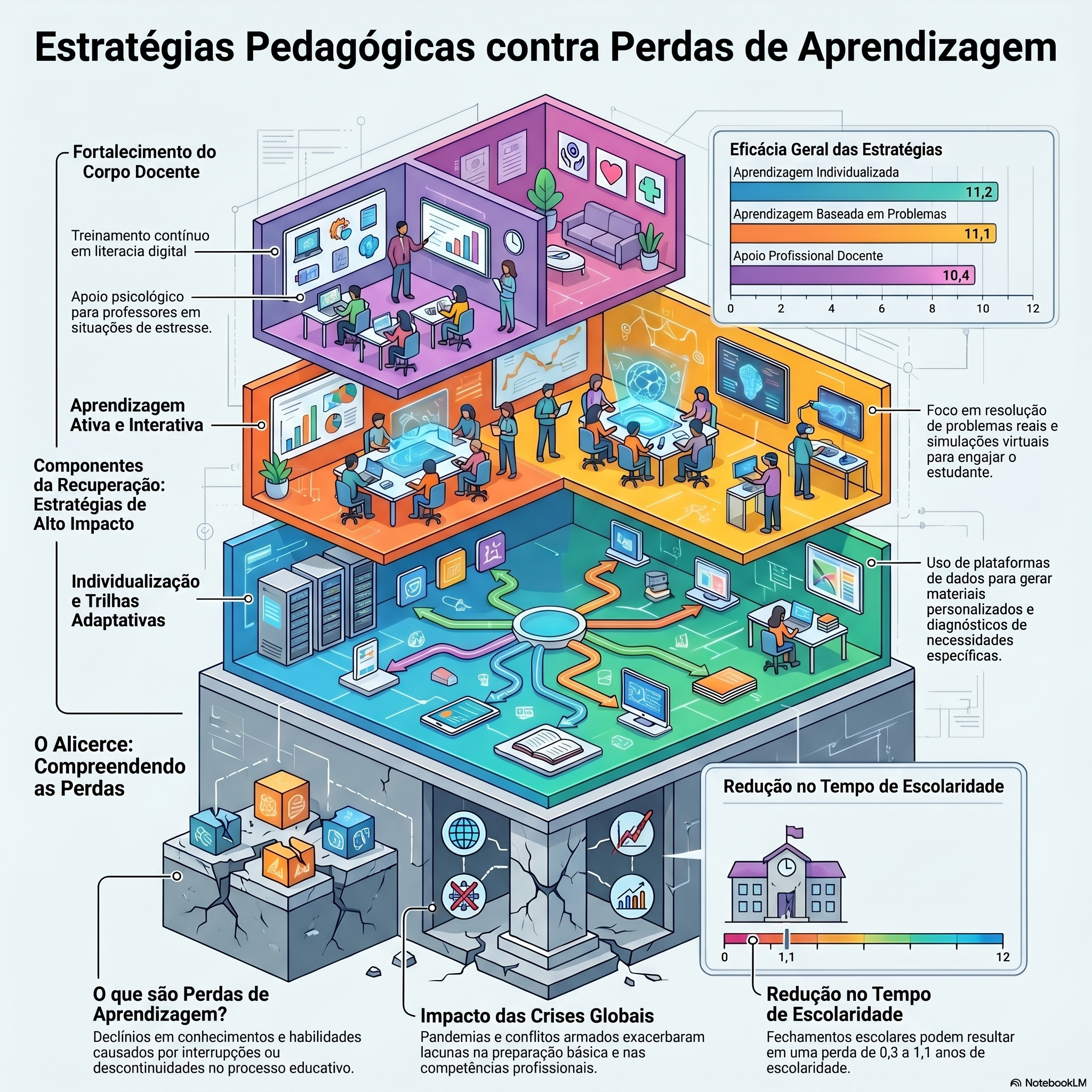
O contexto educacional atual é moldado pela necessidade de enfrentar as perdas de aprendizagem causadas por crises globais, como pandemias, guerras e instabilidade econômica. Este estudo tem como objetivo desenvolver e avaliar a eficácia de estratégias pedagógicas para superar as perdas de aprendizagem diante dos desafios contemporâneos. As estratégias analisadas incluem o uso de tecnologias da informação e da comunicação, o desenvolvimento da resiliência, a aprendizagem baseada em problemas e interativa, a intensificação do processo educativo, trajetórias de aprendizagem individualizadas, apoio psicológico, pedagógico e social, bem como programas de desenvolvimento profissional para professores. O estudo utilizou questionários, métodos experimentais e análise comparativa dos resultados ao longo das etapas do experimento, iniciado em 2024, com medições de controle realizadas em junho e dezembro de 2024. Os critérios de avaliação definidos foram desempenho acadêmico, engajamento dos estudantes, bem-estar psicológico e sustentabilidade do processo educacional, com indicadores correspondentes. Questionários para estudantes e professores foram elaborados de acordo com esses critérios. As estratégias mais eficazes foram identificadas, e seu impacto sustentado na equidade educacional e na eficiência da aprendizagem foi confirmado.
Downloads
Referências
Alam, A. (2023). Improving learning outcomes through predictive analytics: Enhancing teaching and learning with educational data mining. In 2023 7th International Conference on Intelligent Computing and Control Systems (ICICCS) (pp. 249–257). https://doi.org/10.1109/ICICCS56967.2023.10142392
Altes, T., Willemse, T., Goei, S. L., & Ehren, M. (2024). Higher education teachers’ understandings of and challenges for inclusion and inclusive learning environments: A systematic literature review. Educational Research Review, 43, 100605. https://doi.org/10.1016/j.edurev.2024.100605
Amine, T. M., Amal, R., & Abdelalime, S. (2020). Storage management of educational scenarios modelled with the recursive entity modelling method. In 2020 Fourth International Conference on Intelligent Computing in Data Sciences (ICDS) (pp. 1–5). https://doi.org/10.1109/ICDS50568.2020.9268773
Azevedo, J. P., Hasan, A., Goldemberg, D., Geven, K., & Iqbal, S. A. (2021). Simulating the potential impacts of COVID-19 school closures on schooling and learning outcomes: A set of global estimates. The World Bank Research Observer, 36(1), 1–40.
Beck, D., Morgado, L., & O’Shea, P. (2024). Educational practices and strategies with immersive learning environments: Mapping of reviews for using the metaverse. IEEE Transactions on Learning Technologies, 17, 319–341. https://doi.org/10.1109/TLT.2023.3243946
Blaskó, Z., Costa, P. da, & Schnepf, S. V. (2022). Learning losses and educational inequalities in Europe: Mapping the potential consequences of the COVID-19 crisis. Journal of European Social Policy, 32(4), 361–375. https://doi.org/10.1177/09589287221091687
Chen, S. (2020). Analysis of mindfulness and flow. In 2020 International Conference on Public Health and Data Science (ICPHDS) (pp. 13–18). https://doi.org/10.1109/ICPHDS51617.2020.00009
Chuang, T.-Y., Lu, Y.-H., Tsai, S.-K., & Chen, W.-F. (2024). Examining critical thinking skills in game-based learning: A behavioural analysis approach. In 2024 16th IIAI International Congress on Advanced Applied Informatics (IIAI-AAI) (pp. 148–151). https://doi.org/10.1109/IIAI-AAI63651.2024.00037
Collins Dictionary. (2023). Strategy. https://www.collinsdictionary.com/dictionary/english/strategy
Great Schools Partnership. (n.d.). Learning loss. The Glossary of Education Reform. https://www.edglossary.org/learning-loss/
Guo, X., He, X., Pei, Z., & Han, Y. (2024). Application research and hotspot analysis of learning analysis technology in education based on CiteSpace. In 2024 International Symposium on Educational Technology (ISET) (pp. 148–152). https://doi.org/10.1109/ISET61814.2024.00037
Kang, J., & Yang, W. (2023). Research on teaching strategies to promote classroom interaction in smart classroom environment. In 2023 International Symposium on Educational Technology (ISET) (pp. 121–123). https://doi.org/10.1109/ISET58841.2023.00032
Karhiy, M., Sagar, M., Antoni, M., Loveys, K., & Broadbent, E. (2023). Mindfulness-based stress reduction: A randomised trial of a virtual human, teletherapy, and a chatbot. In 2023 11th International Conference on Affective Computing and Intelligent Interaction Workshops and Demos (ACIIW) (pp. 1–7). https://doi.org/10.1109/ACIIW59127.2023.10388195
Komar, O., Dzhurylo, A., & Honcharuk, N. (2024). The peculiarities of increasing students’ motivation for learning English by means of information and communication technologies. Pedagogy and Education Management Review, 1(15), 68–76. https://doi.org/10.36690/2733-2039-2024-1-68
Kosharna, N., & Petryk, L. (2022). Hyflex organization of foreign language teaching: Specialties 013 primary education and 012 preschool education. Continuing Professional Education: Theory and Practice (Series: Pedagogical Sciences), (3), 24–32.
Kosharna, N., Petryk, L., & Rudnik, Y. (2023). The use of Hyflex technology in teaching foreign languages to students of pedagogical specialties under modern challenges. Open Educational E-Environment of Modern University, 15, 62–72. https://doi.org/10.28925/2414-0325.2023.155
Kosharna, N., Petryk, L., Sytnyk, O., Rudnik, Y., & Hapon, L. (2023). An adaptive system of teaching a foreign language to students of pedagogical specialties: European experience. Multidisciplinary Science Journal, 5. https://doi.org/10.31893/multiscience.2023ss0512
Kotenko, O., & Rudnik, Y. (2024). Dialogues on teaching and learning in multicultural and multilingual environments. Nova Science Publishers. https://doi.org/10.52305/RIIP7832
Lokshyna, O., Dzhurylo, A., Maksymenko, O., & Shparyk, O. (2023). On the question of educational losses: A terminological concept in modern scientific and pedagogical discourse. Ukrainian Pedagogical Journal, 2, 6–18. https://doi.org/10.32405/2411-1317-2023-2-6-18
Nik Rashidi, N. A., et al. (2023). A study of mindfulness effectiveness among neurotic students based on EEG. In 2023 IEEE International Conference on Sensors and Nanotechnology (SENNANO) (pp. 69–72). https://doi.org/10.1109/SENNANO57767.2023.10352575
Palamarchuk, Y., Zamkova, N., Novytsky, R., & Kovalenko, O. (2022). IT strategies for the development of higher educational institutions. In 2022 IEEE 17th International Conference on Computer Sciences and Information Technologies (CSIT) (pp. 270–273). https://doi.org/10.1109/CSIT56902.2022.10000458
Patrinos, H. A., Jakubowski, M., & Gajderowicz, T. (2023). Evaluation of educational loss in Europe and Central Asia (Policy Research Working Paper No. 10542). World Bank. https://documents1.worldbank.org/curated/en/099532508082317537/pdf/IDU0dd8d4c3d07d0c0477a0993e0aabe17fd627e.pdf
Pier, L., Hough, H. J., Christian, M., Bookman, N., Wilkenfeld, B., & Miller, R. (2021). COVID-19 and the educational equity crisis: Evidence on learning loss from the CORE data collaborative. Policy Analysis for California Education. https://edpolicyinca.org/newsroom/covid-19-and-educational-equity-crisis
Udovychenko, L., Kuzminets, N., Stadnik, O., Kosharna, N., & Petryk, L. (2021). The use of blended learning technology in training for students of pedagogical specialties. Revista on Line de Política e Gestão Educacional, 25, 2258–2271.
UNICEF. (2023, December). Education survey reveals impact of war on Ukraine’s students. https://www.unicef.org/ukraine/en/press-releases/international-education-quality-research
Vasheka, T. V., Lych, O. M., Palamar, B. I., Palamar, S. P., Zhelanova, V. V., Safir, T. Y., & Kurdil, N. V. (2023). Psychological factors of students’ vitality during the war in Ukraine. Wiadomosci Lekarskie, 76(5, Pt 2), 1279–1284. https://doi.org/10.36740/WLek202305222
Xie, Y., Luo, W., Ouyang, Z., & Xia, W. (2023). A study of effective strategies to improve classroom-based blended learning experience of university students. In 2023 International Symposium on Educational Technology (ISET) (pp. 54–58). https://doi.org/10.1109/ISET58841.2023.00019
Yazici, M., & Uzuner, F. (2024). School-based inclusive mentoring within the scope of an experiential learning model (IEM) for teacher education. Teaching and Teacher Education. Advance online publication. https://doi.org/10.1016/j.tate.2024.104799
Yuzkiv, H., Ivanenko, I., Marchenko, N., Kosharna, N., & Medvid, N. (2020). Innovative methods in language disciplines during profile training implementation. International Journal of Higher Education, 9(7), 230–242. https://doi.org/10.5430/ijhe.v9n7
Zhou, J. (2024). Research on higher education evaluation system based on war strategy optimisation algorithms. In 2024 7th International Conference on Artificial Intelligence and Big Data (ICAIBD) (pp. 603–609). https://doi.org/10.1109/ICAIBD62003.2024.10604515
Zhou, Y., & Zhang, Y. (2023). Analysis of vocabulary learning strategies in vocabulary learning software from the perspective of psycholinguistics. In 2023 3rd International Conference on Educational Technology (ICET) (pp. 238–243). https://doi.org/10.1109/ICET59358.2023.10424136
Publicado
Como Citar
Edição
Seção
Licença
Copyright (c) 2026 Revista on line de Política e Gestão Educacional

Este trabalho está licenciado sob uma licença Creative Commons Attribution-NonCommercial-ShareAlike 4.0 International License.
Manuscritos aceitos e publicados são de propriedade da Revista on line de Política e Gestão Educacional. É vedada a submissão integral ou parcial do manuscrito a qualquer outro periódico. A responsabilidade do conteúdo dos artigos é exclusiva dos autores. É vedada a tradução para outro idioma sem a autorização escrita do Editor ouvida a Comissão Editorial Científica.