Aprendizagem de línguas on-line no ensino superior ganense durante a covid-19 na perspectiva dos estudantes
DOI:
https://doi.org/10.22633/rpge.v30iesp1.20896Palavras-chave:
Aprendizagem de línguas, Educação on-line, Ensino superior, Percepções dos estudantesResumo
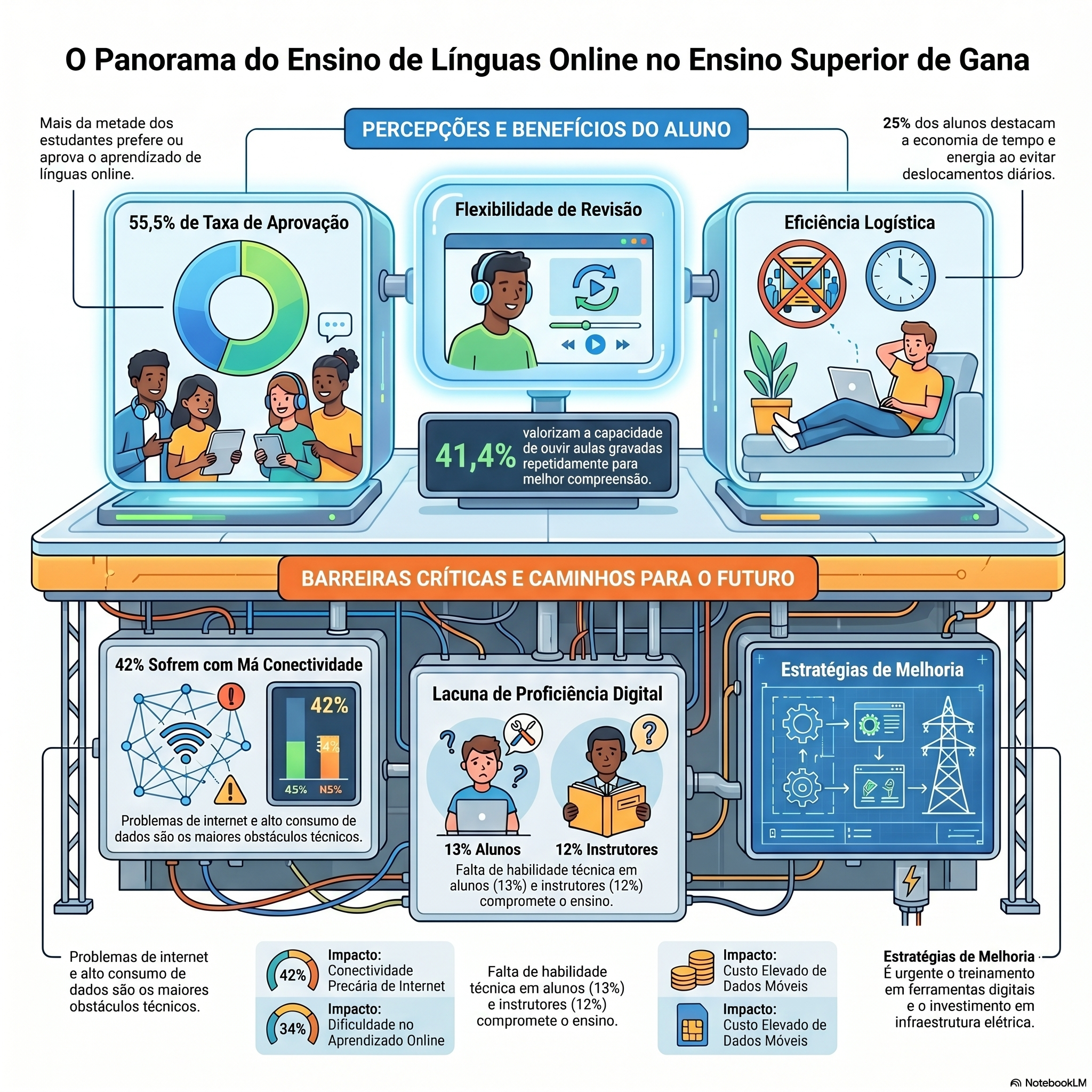
O estudo tem como objetivo examinar as percepções dos estudantes acerca da aprendizagem de línguas online, incluindo inglês, francês, espanhol, chinês e línguas ganenses, no ensino superior em Gana durante a pandemia de covid-19. No estudo, adotou-se uma abordagem de levantamento quantitativo. Os dados foram coletados de 138 estudantes de graduação selecionados intencionalmente, por meio de um questionário online e de um formulário de observação desenvolvido pelos pesquisadores. Os dados obtidos foram analisados utilizando estatística descritiva e inferencial. Os resultados revelaram que mais da metade dos estudantes participantes preferiu aprender línguas on-line. Os desafios enfrentados incluíram problemas de conectividade à internet, falta de acesso à internet, limitada proficiência tecnológica entre os estudantes, conhecimento limitado dos docentes sobre plataformas on-line, frequentes quedas de energia e ausência de eletricidade em algumas comunidades.
Downloads
Referências
Alscher, D. (2024, May 14). What is a webinar? How to engage and educate your audience. https://learn.g2.com/what-is-a-webinar
Al-Zboon, K. O. M. (2020). The effectiveness of distance learning compared to direct education in the achievement of first-grade students in the Arabic language subject in Jordan. Arab Journal of Specific Education, 4(14), 201–220.
Basilaia, G., & Kvavadze, D. (2020). Transition to online education in schools during a SARS-CoV-2 coronavirus (COVID-19) pandemic in Georgia. Pedagogical Research, 5(4), 1–9.
Brown, J. C., & Park, H. (2015). Comparing student research competencies in online and traditional face-to-face learning environments. TOJDEL: The Online Journal of Distance Education and e-Learning, 3(1), 1–7.
Candelaria, P. C. (2023). Online distance learning in the development of macro skills communication of selected private school in the district of Victoria, Laguna, Philippines. International Journal of Education, Technology and Science, 3(1), 1–15.
Çalık, E. Ö., & Altay, I. F. (2021). Analysis of English lesson broadcasts during emergency remote teaching from pedagogical, instructional and technical aspects. International Journal of Education, Technology and Science, 1(2), 71–87.
Davis, F. D. (1989). Perceived usefulness, perceived ease of use, and user acceptance of information technology. MIS Quarterly, 13(3), 319–339. https://doi.org/10.2307/249008
Dutot, V. (2014). Adoption of social media using technology acceptance model: The generational effect. International Journal of Technology and Human Interaction, 10(4), 18–35. https://doi.org/10.4018/ijthi.2014100102
Garrison, D. R., Anderson, T., & Archer, W. (1999). Critical inquiry in a text-based environment: Computer conferencing in higher education. The Internet and Higher Education, 2(2–3), 87–105.
Huba, M. E., & Freed, J. E. (2000). Learner-centered assessment on college campuses: Shifting the focus from teaching to learning. Community College Journal of Research and Practice, 24(9), 759–766.
Karsenti, T., Parent, S., & Cuerrier, M. (2020). L’école à la maison: La pandémie a-t-elle réellement exacerbé les iniquités sociales? Éducation Canada, 60(4), 4–9.
Kokroko, E., & Addei, C. (2020). Teaching and learning French language in Ghana through digital resources: Prospects and challenges. American Journal of Online and Distance Learning, 2(2), 22–30.
Madhavi, I. (2010). Use of language laboratory in English language learning and teaching. Institute of Management, GITAM University.
Mahat, H., Norkhaidi, S. B., Hashim, M., Saleh, N., Nayan, N., Abdullah, N. H. L., Baharudin, N. H., & Jamhari, N. (2021). Determining the effectiveness of pre-university students’ online learning in geography subject using relative importance index. Pegem Journal of Education and Instruction, 11(4), 160–168.
Ozfidan, B., & Marks, J. M. (2025). Perceptions of Saudi undergraduate students’ experiences toward online and traditional learning: Mixed method study. International Journal of Education, Technology and Science, 5(1), 47–61. https://doi.org/10.5281/zenodo.14904948
Paul, J., & Jefferson, F. (2019). A comparative analysis of student performance in an online vs face-to-face environmental science course from 2009 to 2016. Frontiers in Computer Science, 1, Article 7. https://doi.org/10.3389/fcomp.2019.00007
Parahoo, K. (1997). Nursing research: Principles, process, and issues. Palgrave Macmillan.
Ritonga, M. (2020). Learning from home (LFH) dan kerinduan yang mendalam. In Inovasi pembelajaran era Covid-19: Pengalaman & pengamatan selama pandemi Covid-19 (pp. 80–83). CV Markumi.
Savvidou, C., & Katarzyna, A. (2022). “It has potential but…”: Exploring university students’ experiences and perceptions of breakout rooms during the COVID-19 pandemic. Teaching English with Technology, 22(2), 3–26. http://www.tewtjournal.org
Shaughnessy, J. J., Zechmeister, E. B., & Zechmeister, J. S. (2012). Research methods in psychology (9th ed.). McGraw-Hill.
Tabiri, M. O., Jones-Mensah, I., Fenyi, D. A., & Asunka, S. (2022). Challenges of online learning of English/French language in higher education in Ghana. Journal of Language and Linguistic Studies, 18(1), 207–222. https://doi.org/10.52462/jlls.176
Tabiri, M. O. (2021). L’enseignement/apprentissage en ligne du français langue étrangère au Ghana: Quels avantages d’un recours au numérique? Akofena, 4(3), 195–200.
University World News. (2021). Ghana, Senegal closes all universities. https://www.universityworldnews.com/post.php?story=20200315115142951
Vygotsky, L. S. (1978). Mind in society: The development of higher psychological processes. Harvard University Press.
Publicado
Como Citar
Edição
Seção
Licença
Copyright (c) 2026 Revista on line de Política e Gestão Educacional

Este trabalho está licenciado sob uma licença Creative Commons Attribution-NonCommercial-ShareAlike 4.0 International License.
Manuscritos aceitos e publicados são de propriedade da Revista on line de Política e Gestão Educacional. É vedada a submissão integral ou parcial do manuscrito a qualquer outro periódico. A responsabilidade do conteúdo dos artigos é exclusiva dos autores. É vedada a tradução para outro idioma sem a autorização escrita do Editor ouvida a Comissão Editorial Científica.