
From students to future teachers
early teacher identity development in an EFL teacher education program
DOI:
https://doi.org/10.22633/rpge.v30iesp2.21398Keywords:
Early teacher identity, Student teacher identity, EFL student teachers, Teacher educationAbstract
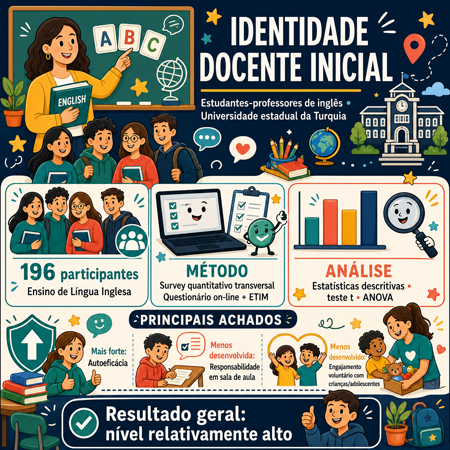
This study aims to examine the early teacher identity of EFL student teachers at a Turkish state university. The research was designed as a quantitative cross-sectional survey to measure the level of early teacher identity and its sub-dimensions. The study also explored whether early teacher identity varied according to the demographic characteristics of the participants. The cohort consisted of 196 EFL student teachers enrolled in the English Language Teaching Department at a state university in Turkey. The data were collected through an online questionnaire consisting of a demographic information form and the Early Teacher Identity Measure (ETIM). Descriptive statistics, independent-samples t tests, and one-way ANOVA tests were used to analyze the data. The results indicated that the participants had a relatively high level of early teacher identity. Self-efficacy was found to be the strongest sub-dimension, while classroom responsibility and voluntary engagement with children or adolescents were less developed.
Downloads
References
Arpacı, D., & Bardakçı, M. (2015). Adaptation of early teacher identity measure into Turkish. Gaziantep University Journal of Social Sciences, 14(3), 687–719. https://doi.org/10.21547/jss.256762
Babanoğlu, M. P., & Ağçam, R. (2019). Turkish EFL teacher candidates’ early teacher identity. Asian Journal of Education and Training, 5(2), 386–391. https://doi.org/10.20448/journal.522.2019.52.386.391
Bandura, A. (1986). Social foundations of thought and action: A social cognitive theory. Prentice-Hall.
Barahona, M., & Toledo-Sandoval, F. (2025). Exploring Chilean EFL student teachers’ development of teacher identity through perezhivanie. Journal of Language, Identity & Education, 24(1), 57–72. https://doi.org/10.1080/15348458.2022.2075875
Beauchamp, C., & Thomas, L. (2009). Understanding teacher identity: An overview of issues in the literature and implications for teacher education. Cambridge Journal of Education, 39(2), 175–189. https://doi.org/10.1080/03057640902902252
Can, T., & Karacan, C. G. (2021). Exploring pre-service English teachers’ early teacher identity in relation to emerging ICT technologies training. Novitas-Royal: Research on Youth and Language, 15(1), 57–75.
Chang, Y. J. (2018). Certified but not qualified? EFL pre-service teachers in liminality. Journal of Language, Identity & Education, 17(1), 48–62. https://doi.org/10.1080/15348458.2017.1401929
Çelik, H. R., & Kalkan, Ö. K. (2019). Öğretmen adaylarının meslek öncesi öğretmen kimliği algıları: Pamukkale Üniversitesi örneği. Ege Eğitim Dergisi, 20(2), 351–365. https://doi.org/10.12984/egeefd.628810
Çelik, Ö., Yorulmaz, A., & Çokçalışkan, H. (2021). Pre-service primary school teachers’ beliefs about the consistency of the teacher training program on the formation of their teacher identity. International Online Journal of Education and Teaching, 8(2), 1279–1290.
Friesen, M. D., & Besley, S. C. (2013). Teacher identity development in the first year of teacher education: A developmental and social psychological perspective. Teaching and Teacher Education, 36, 23–32. https://doi.org/10.1016/j.tate.2013.06.005
Groenewald, E., & Arnold, L. (2025). Teacher professional identity: Agentic actions of a novice teacher in a challenging school context. Teachers and Teaching, 31(3), 453–470. https://doi.org/10.1080/13540602.2024.2308890
Hanna, F., Oostdam, R., Severiens, S. E., & Zijlstra, B. J. H. (2019). Domains of teacher identity: A review of quantitative measurement instruments. Educational Research Review, 27, 15–27. https://doi.org/10.1016/j.edurev.2019.01.003
Hanna, F., Oostdam, R., Severiens, S. E., & Zijlstra, B. J. H. (2020). Assessing the professional identity of primary student teachers: Design and validation of the Teacher Identity Measurement Scale. Studies in Educational Evaluation, 64, 100822. https://doi.org/10.1016/j.stueduc.2019.100822
Huang, X., & Wang, C. (2024). Pre-service teachers’ professional identity transformation: A positioning theory perspective. Professional Development in Education, 50(1), 174–191. https://doi.org/10.1080/19415257.2021.1942143
Iwai, Y. (2025). Seeing themselves as teachers: Preservice teachers’ development of teacher identity and self-efficacy with the early field experience. International Online Journal of Education and Teaching, 12(2), 98–112.
Nguyen, H. T. M., & Loughland, T. (2018). Pre-service teachers’ construction of professional identity through peer collaboration during professional experience: A case study in Australia. Teaching Education, 29(1), 81–97. https://doi.org/10.1080/10476210.2017.1353965
Nguyen, H. T. M., & Yang, H. (2018). Learning to become a teacher in Australia: A study of pre-service teachers’ identity development. The Australian Educational Researcher, 45, 625–645. https://doi.org/10.1007/s13384-018-0276-9
Pallant, J. (2020). SPSS survival manual: A step by step guide to data analysis using IBM SPSS (7th ed.). Routledge.
Peker, H., Torlak, M., Toprak-Çelen, E., Eren, G., & Günsan, M. (2020). Language teacher identity construction of foreign language teaching assistants. International Online Journal of Education and Teaching, 7(1), 229–246.
Pillen, M. T., Den Brok, P. J., & Beijaard, D. (2013). Profiles and change in beginning teachers’ professional identity tensions. Teaching and Teacher Education, 34, 86–97. https://doi.org/10.1016/j.tate.2013.04.003
Prabjandee, D. (2019). Becoming English teachers in Thailand: Student teacher identity development during teaching practicum. Issues in Educational Research, 29(4), 1277–1294.
Sang, Y. (2025). Seeing teacher identity through teachers’ beliefs: Narratives of pre-service EFL teachers in China. Language Teaching Research, 30(4), 1914–1937. https://doi.org/10.1177/13621688231165349
Stenberg, K., Karlsson, L., Pitkaniemi, H., & Maaranen, K. (2014). Beginning student teachers’ teacher identities based on their practical theories. European Journal of Teacher Education, 37(2), 204–219. https://doi.org/10.1080/02619768.2014.882309
Tabachnick, B. G., & Fidell, L. S. (2019). Using multivariate statistics (7th ed.). Pearson.
Taşdemir, H., & Seferoğlu, G. (2022). Understanding teacher professional identity: Voices from pre-service English language teachers. Bartın University Journal of Faculty of Education, 11(3), 702–717. https://doi.org/10.14686/buefad.1112591
Torres-Cepeda, N. M., & Ramos-Holguín, B. (2019). Becoming language teachers: Exploring student-teachers’ identities construction through narratives. GIST Education and Learning Research Journal, (18), 6–27. https://doi.org/10.26817/16925777.441
Uştuk, Ö., Yazan, B., Uzum, B., Akayoğlu, S., & Keleş, U. (2025). The nexus of identity, emotions, and agency in virtual exchanges between pre-service teachers from Türkiye and the United States. International Journal of Applied Linguistics, 35, 1625–1638. https://doi.org/10.1111/ijal.12707
Villegas, D. F. M., Varona, W. H., & Sánchez, A. G. (2020). Student teachers’ identity construction: A socially-constructed narrative in a second language teacher education program. Teaching and Teacher Education, 91, 103055. https://doi.org/10.1016/j.tate.2020.103055
Wang, C., & Yazan, B. (2024). Negotiating identity tensions: Challenges of an online volunteer English language teacher in rural China. RELC Journal, 56(3), 590–604. https://doi.org/10.1177/00336882241275163
Yuan, R., & Lee, I. (2015). The cognitive, social and emotional processes of teacher identity construction in a pre-service teacher education programme. Research Papers in Education, 30(4), 469–491. https://doi.org/10.1080/02671522.2014.932830
Zeng, J., & Liu, W. (2024). The development and validation of the teacher professional identity scale in a Chinese university context. PLOS ONE, 19(3), e0293156. https://doi.org/10.1371/journal.pone.0293156
Zhang, Q., Clarke, A., & Lee, J. C. K. (2018). Pre-service teachers’ professional identity development within the context of school-based learning to teach: An exploratory study in China. The Asia-Pacific Education Researcher, 27(6), 477–486. https://doi.org/10.1007/s40299-018-0408-z
Zhao, H., & Zhang, X. (2017). The influence of field teaching practice on pre-service teachers’ professional identity: A mixed methods study. Frontiers in Psychology, 8, 1264. https://doi.org/10.3389/fpsyg.2017.01264
Downloads
Published
How to Cite
Issue
Section
License
Copyright (c) 2026 Revista on line de Política e Gestão Educacional

This work is licensed under a Creative Commons Attribution-NonCommercial-ShareAlike 4.0 International License.
Manuscritos aceitos e publicados são de propriedade da Revista on line de Política e Gestão Educacional. É vedada a submissão integral ou parcial do manuscrito a qualquer outro periódico. A responsabilidade do conteúdo dos artigos é exclusiva dos autores. É vedada a tradução para outro idioma sem a autorização escrita do Editor ouvida a Comissão Editorial Científica.