Implicações educacionais, sociais e psicológicas da exclusão das aulas de Educação Física em escolas de ciências do 12º ano
uma análise baseada nas opiniões dos professores de educação física
DOI:
https://doi.org/10.22633/rpge.v30iesp2.21368Palavras-chave:
Educacional, Social, Psicológico, Aulas de Educação Física, ProfessorResumo
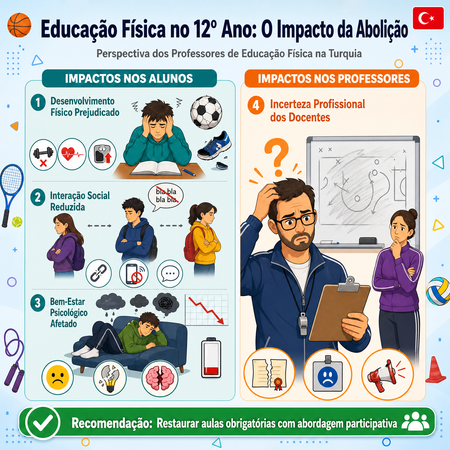
O objetivo deste estudo é examinar as opiniões dos professores de educação física sobre a abolição das aulas de educação física no 12º ano das escolas de ensino médio de perfil científico, sob as perspectivas educacional, social e psicológica. Foi adotada uma abordagem qualitativa, utilizando-se um desenho de estudo de caso. O grupo de estudo foi composto por 20 professores de educação física selecionados por meio de amostragem intencional e atuantes em seis províncias da Turquia (Karabük, Osmaniye, Çankırı, Antalya, Ordu e Sinop). Os resultados revelam que a abolição das aulas de educação física impacta negativamente o desenvolvimento físico, a interação social e o bem-estar psicológico dos alunos. As habilidades de gestão do estresse dos estudantes enfraquecem, seus níveis de motivação diminuem e as oportunidades de interação social se reduzem. Além disso, observa-se que os professores vivenciam incertezas em seus papéis profissionais, menor satisfação no trabalho e enfraquecimento dos processos de comunicação intraescolar. Assim, recomenda-se que as aulas de educação física sejam restabelecidas como obrigatórias e que as políticas educacionais sejam estruturadas com uma abordagem participativa.
Downloads
Referências
Cheon, S. H., Reeve, J., Lee, Y., & Lee, J. W. (2018). Why autonomy-supportive interventions work: Explaining the professional development of teachers’ motivating style. Teaching and Teacher Education, 69, 43–51. https://doi.org/10.1016/j.tate.2017.09.022
Côté, J., & Fraser-Thomas, J. (2007). Youth involvement in sport. In P. R. E. Crocker (Ed.), Introduction to sport psychology: A Canadian perspective (pp. 270–298). Pearson.
Dato, B. (2025). Teacher’s practices, students’ motivation and performance in physical education among senior high school students in the Division of Northern Samar. Journal of Interdisciplinary Perspectives, 3(8), 212–221. https://doi.org/10.69569/jip.2025.381
Fernandez-Rio, J., García, S., & Ferriz-Valero, A. (2023). Selecting (or not) physical education as an elective subject: Spanish high school students’ views. Physical Education and Sport Pedagogy, 30(5), 563–575. https://doi.org/10.1080/17408989.2023.2256762
Franco, E., González-Peño, A., & Coterón, J. (2023). Understanding physical education teachers’ motivational outcomes and feasibility beliefs to implement motivational strategies: The role of perceived pressures from a variable- and person-centered approach. Psychology of Sport and Exercise, 64, Article 102337. https://doi.org/10.1016/j.psychsport.2022.102337
Gelius, P., Messing, S., Goodwin, L., Schow, D., & Abu-Omar, K. (2020). What are effective policies for promoting physical activity? A systematic review of reviews. Preventive Medicine Reports, 18, Article 101095. https://doi.org/10.1016/j.pmedr.2020.101095
Lubans, D., Richards, J., Hillman, C., Faulkner, G., Beauchamp, M., Nilsson, M., Kelly, P., Smith, J., Raine, L., & Biddle, S. (2016). Physical activity for cognitive and mental health in youth: A systematic review of mechanisms. Pediatrics, 138(3), e20161642. https://doi.org/10.1542/peds.2016-1642
Matson, M. (2019). Removal of students from physical education for response to intervention on students development of personal and social responsibility (Master’s thesis, Illinois State University). Milner Library. https://doi.org/10.30707/etd2019.matson(neeleffel).m
Murfay, K., Beighle, A., Erwin, H., & Aiello, E. (2022). Examining high school student perceptions of physical education. European Physical Education Review, 28(3), 704–719. https://doi.org/10.1177/1356336X211072860
Portillo-Torres, M., Hernández-Quesada, Ó., & Quirós-Quirós, H. (2016). Opinión de docentes y estudiantes sobre las clases de educación física en secundaria. Revista Electrónica Educare, 20(2), 1–23. https://doi.org/10.15359/ree.20-2.5
Prior, L., & Curtner-Smith, M. (2020). Effects of occupational socialization on United States secondary physical education teachers’ beliefs regarding curriculum design. European Physical Education Review, 26(1), 179–197. https://doi.org/10.1177/1356336X19840062
Trigueros, R., Aguilar-Parra, J., Cangas, A., López-Liria, R., & Álvarez, J. (2019). Influence of physical education teachers on motivation, embarrassment and the intention of being physically active during adolescence. International Journal of Environmental Research and Public Health, 16(13), Article 2295. https://doi.org/10.3390/ijerph16132295
Woods, C. B., Volf, K., Kelly, L., Casey, B., Gelius, P., Messing, S., Forberger, S., Lakerveld, J., Zukowska, J., & Bengoechea, E. G. (2021). The evidence for the impact of policy on physical activity outcomes within the school setting: A systematic review. Journal of Sport and Health Science, 10(3), 263–276. https://doi.org/10.1016/j.jshs.2021.01.006
Zengin, O., Demir, H., Alıncak, F., & Abakay, U. (2016). The evaluation of high school 12th grade students’ opinions about the effectiveness of physical education classes. European Journal of Physical Education and Sport Science, 2(4), 1–16. https://doi.org/10.5281/zenodo.162244
Zhang, T. (2021). Physical education teacher motivation: A conceptual review and reconceptualisation. Review of Education, 9(3), e3301. https://doi.org/10.1002/rev3.3301
Downloads
Publicado
Como Citar
Edição
Seção
Licença
Copyright (c) 2026 Revista on line de Política e Gestão Educacional

Este trabalho está licenciado sob uma licença Creative Commons Attribution-NonCommercial-ShareAlike 4.0 International License.
Manuscritos aceitos e publicados são de propriedade da Revista on line de Política e Gestão Educacional. É vedada a submissão integral ou parcial do manuscrito a qualquer outro periódico. A responsabilidade do conteúdo dos artigos é exclusiva dos autores. É vedada a tradução para outro idioma sem a autorização escrita do Editor ouvida a Comissão Editorial Científica.